
THE DALLES — In January, an annual review focused on the work of county watershed councils was presented to the Wasco County Board of Commissioners.
The review highlighted the following:
Small Grant Program
The Oregon Watershed Enhancement Board funded $66,667 in small project grants in Wasco County in the 2020-21 fiscal year.
Two of those projects were identified as “medium priority” watershed concerns: Krein Solar Development Livestock Water and the Trail Creek Upland Livestock Management. Both were undertaken to further better livestock distribution and management in the county.
The solar development project distributed water to numerous areas throughout the landowners property to provide livestock water in areas that were otherwise ungrazed, as well as provide water to wildlife. The Trail Creek Cross fencing project achieved multiple goals for grazing land, including improved water quality and increased wildlife habitat, by promoting forage utilization. The projects will reduce water runoff and compaction from heavy use areas and promote vigorous new growth for the growing season.
An additional three projects addressed “high priority” watershed concerns. The Duling Juniper Flat Pivot and Ingles Place Fifteenmile Creek Pivot replaced older irrigation systems with modern systems that have a 97% efficiency rate for water application. The Ayres Road Irrigation Pipeline project replaced an above ground water mainline with an underground one, which will be as much as 85% more efficient. According to the annual report, “Water is our most valuable resource and by converting these systems to the highest efficiency rate possible, more water is being left instream for fish and wildlife, and less is being lost to excessive over watering and leaky systems.”
Pesticide Stewardship Partnership
The Wasco County Pesticide Stewardship Partnership (PSP) entered into its 10th consecutive year of monitoring in 2020. The program monitors the presence of current use pesticides and their breakdown products in surface waters as a result of pesticide drift and runoff.
The 2020 PSP season found the lowest number of unique chemicals (and their breakdown products) detected in the program’s history.
The number of total pesticide detections was up from last year, but is still quite a bit lower than it was when the program started in Wasco County. Yearly detections show a general decline in pesticide presence, but a slight increase in 2020 over results in 2018 and 2019. Ken Bailey, a member of The Dalles Watershed Council, told the Wasco County Board of Commissioners in December the increase was likely because surface water levels in 2020 were below normal because of drought conditions in the county, and measures to reduce over spray and drift were continuing to have a positive impact on watershed health.
•••
The annual report also covered projects and activities undertaken each watershed council.
Bakeoven/Buck Hollow Watershed Council
The Bakeoven/Buck Hollow council finished an inventory of rangeland on nine different ranches in the watershed. Inventories were collected in strategic locations that included vegetation sampling, rangeland condition analysis, forage production analysis, ecological status, and identification of weeds and other invasive species in order to identify resource concerns with participating landowners. The grant inventoried 31 locations on seven landowner’s ranches. There were 16 practices that are planned to address the concerns identified at each site, along with invasive weed control and prescribed grazing that will be based on each landowners specific operation.
The projects identified were “upland” areas rather than creek or riparian areas. “It’s a top down approach,” Drake Gilbert , watershed council coordinator for Wasco County, explained. “It’s not in-stream work, but it will benefit the in-stream environment.”
White River Watershed Council
After five years of work, a culvert on Threemile creek was replaced, opening 3 1/2 miles of the upper creek to the endangered red band trout. The project was on USFS property and therefore took much longer than similar projects under different ownership, said Pat Davis of the White River Watershed council. The results, Davis noted, were immediate. “As they pulled the old pipe out and were getting ready to put the new pipe in, they counted five fish swimming up the creek where the new pipe was going to go,” Davis told the commissioners. “So even before the new culvert was installed, we had reconnected those fish to the upstream portion of Threemile.”
Additional watershed work was also undertaken on an irrigation project in Tygh Valley. Also within the watershed, the Oregon Watershed Enhancement Board funded a wildfire impact response grant in the fall of 2020 to facilitate aerial spaying and seeding of areas burned in the summer of 2020, and the removal of invasive juniper trees.

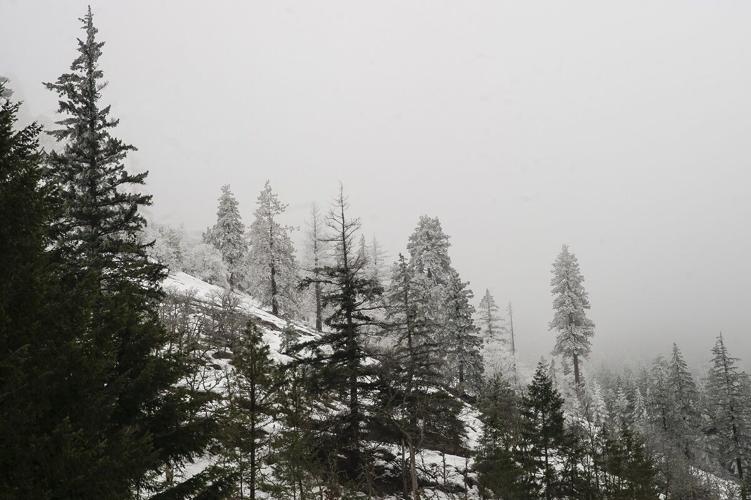
The frost line is clearly seen above the North Fork of Mill Creek.
Mark B. Gibson photoThe Dalles Watershed Council
The Dalles Watershed Council maintained a heavy involvement in water quality monitoring within The Dalles watershed, E. coli monitoring project wrapping up its ninth consecutive year in 2020. The watershed was also central to a pesticide monitoring program in the county (see discussion above).
In addition to water quality monitoring, The Dalles Watershed Council helped secure funding to continue fish monitoring in Mill Creek, and expanded the project to nearby Chenoweth and Threemile creeks. All three creeks are considered to be critical habitat for the Endangered Species Act (ESA) listed Mid-Columbia Steelhead distinct population segment (DPS), making the monitoring of fish runs within these streams vital in understanding steelhead returns in the area.
The final year of fish tagging in Mill Creek wrapped up in June 2021, with the most steelhead being tagged in Mill Creek fish monitoring history. In addition to tagging on Mill Creek, The Dalles fish monitoring project also expanded into Chenoweth and Threemile Creeks for the first time. Tagging in these smaller creeks will continue for the next three years, and the PIT tag array on Mill Creek will continue to operate.
The 2020 Mill Creek E. coli season showed an increase in average E. coli concentrations throughout the watershed, which prompted the council to take action by becoming involved in a process with DEQ that aims to analyze water quality data in hopes of identifying the source of E. coli in Mill Creek. Sampling is set to continue through the next year.
Fifteenmile Watershed Council
The Fifteenmile Watershed Council continued work on a managed underground storage project, which secured a $300,000 state grant for a pilot project.
The FAST program also continued in the watershed, with 16 landowners enrolled accounting for 770 acres. The program participants have a guaranteed agreement to curtail water usage during periods critical to salmonid survival. In 2021, the FAST season issued nine days of alerts in June, the result of record-breaking heat waves throughout the state. As a result of the unprecedented heatwave triggering such an unusual alert, an emergency Fifteenmile Watershed Council meeting was held to discuss any amendments that should be made to the FAST plan as a result of these unforeseen circumstances. It was ultimately decided to amend the FAST work plan so that an alert may only be triggered if critical temperatures are expected within three days of the current date at two or more sites within the watershed for two or more days, rather than within the entirety of the forecast period like it previously had been.
Mosier Watershed Council
The Mosier Watershed Council continued to work on improving the condition of the aquifers within the Mosier area over the last year, but also began working on addressing surface water issues by restarting the monitoring of E. coli within Mosier Creek to determine if an E. coli contamination problem existed within the creek. Sampling will be conducted at three sites within the creek, with two sites on the mainstem and one on the west fork of the creek.
The council also successfully lobbied congress to secure $900,000 in funding to continue repairing commingling wells within the Mosier Watershed. The commingling of wells has exacerbated groundwater drawdown throughout the watershed.
The watershed council coordinator for Wasco County is Drake Gilbert, who started at the district in June 2020.
Abbie Forrest works for the Wasco County Soil and Water Conservation District, where she serves as grants and program manager/watershed council liaison.


Commented