Dr. Damon L. Swift, American Heart Association volunteer and chair of the writing group for the scientific statement and an associate professor of kinesiology at the University of Virginia in Charlottesville. (American Heart Association via SWNS)
Physical activity — whether it be jogging, swimming, walking or cycling — improves blood pressure, insulin sensitivity, cholesterol levels and general fitness in adults who are overweight or have obesity, say scientists.
Physical activity is an essential part of effective obesity treatment — adding health benefits even with weight-loss medications or surgery — according to a new scientific statement from the American Heart Association (AHA).
It states the long-term success of any weight loss program also depends on team-based support, with doctors and other health professionals helping people build and maintain realistic health habits.
Obesity now affects more than 40% of American adults, and is fueling rising rates of heart disease.
Walking with a dog is one way to stay active. (American Heart Association via SWNS)
By Talker
The new AHA statement, published in the journal Circulation, calls for a comprehensive treatment approach that puts physical activity front and center.
The statement underscores that regular physical activity improves several health measures in overweight people, independent of weight loss.
Damon Swift, chair of the AHA writing group for the statement, said: "Doctors and health professionals often focus on weight loss to help people lower their risk of heart disease.
"There are certainly health benefits from weight loss, especially when it's sustained long-term.
"However, encouraging physical activity should always be an important part of that care plan, as it can support both weight loss and long-term maintenance.
A woman stretches before starting tennis match. (American Heart Association via SWNS)
By Talker
"Physical activity delivers powerful heart and metabolic health gains even when the scale doesn't move.
"These benefits are especially important because many people with overweight or obesity already have cardiovascular risk factors.
"For most people, cardio exercise without changing your diet is unlikely to result in a large amount of weight loss.
Dr. Damon L. Swift, American Heart Association volunteer and chair of the writing group for the scientific statement and an associate professor of kinesiology at the University of Virginia in Charlottesville. (American Heart Association via SWNS)
By Talker
"Dietary changes remain the primary driver of weight loss.
"However, physical activity plays a powerful supporting role when combined with other treatments, including healthy eating, weight loss medications or surgery.
"Exercise can help people lose a little more weight, preserve important lean mass — especially with resistance exercise — and improve overall health."
Swift, from the University of Virginia, says when people lose weight by cutting calories, they often lose muscle, too.
Studies show that adding exercise to dietary weight loss helps people preserve more muscle compared with dieting alone.
Strength or resistance training appears especially effective, particularly for middle-aged and older adults.
Swift says eating at least the recommended daily amount of protein also helps the body maintain muscle while losing fat.
He said: "Keeping muscle isn't just about strength, it helps with mobility, metabolism, and blood sugar control.
"On its own, exercise usually does not lead to clinically meaningful weight loss unless people are able to be active for very long periods each week."
The scientific statement highlights that exercise by itself rarely leads to any more than a 5% or more loss in body weight unless aerobic activity levels are quite high, at least 225 to 420 minutes per week.
Fewer than 15% of people reach a "clinically significant" amount of weight loss through exercise alone.
Modest weight loss of around 3% — and less than 5% — of body weight is more achievable and does support some health benefits.
Most Americans are not getting an adequate amount of physical activity for any health benefits, much less weight loss, according to the AHA's latest heart disease and stroke statistics.
Only one in four adults and one in five youngsters, aged six to 17, meet national recommendations for being physically active.
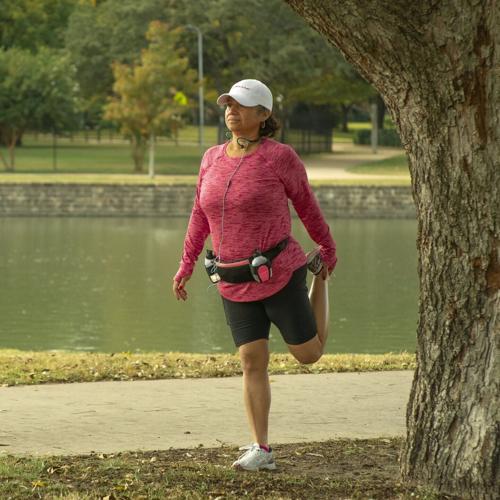
Woman stretching at a park. (American Heart Association via SWNS)
By Talker
The AHA recommends that adults achieve a minimum of 150 minutes per week of moderate-intensity aerobic activity or 75 minutes per week of vigorous aerobic activity.
Swift said maintaining weight loss is often more difficult than achieving it.
The statement highlights strong evidence that high levels of consistent physical activity — often 200 to 300 minutes per week of moderate-intensity physical activity — are associated with long-term weight-loss maintenance.
However, even if people can't reach those levels, it is still beneficial to maintain a regular schedule with some exercise and stay as active as possible.
Swift says doing any physical activity is much better than doing nothing.
He said: "Many of the health benefits achieved from weight loss may be reversed if the weight is gained back.
"Physical activity can not only help maintain weight loss, it also may protect cardiovascular health even if some weight regain occurs, helping preserve earlier improvements in blood pressure and insulin sensitivity.
"As with any major medical issue, treatment of obesity should be individually tailored to a person's specific needs and usually requires a comprehensive, multipronged approach that's best achieved with guidance from a health professional.
Female swimmer in a lap pool. (American Heart Association via SWNS)
By Talker
"Not only does this support individual accountability, but just as you wouldn't likely treat high blood pressure or diabetes on your own, optimal results in treating obesity will come from a collaboration with your clinician and health care team."
The statement also emphasizes the role of doctors and healthcare professionals to help people address obesity by setting realistic goals, staying motivated and using evidence-based approaches including medications or surgery, counseling and digital tools.
Dr. Stacey Rosen, volunteer president of the AHA, said: "Despite the known benefits of physical activity, many people face challenges being active, including time constraints and limited access to safe or convenient ways to move during daily routines.
"Addressing these barriers can help support healthier habits over time."
Swift added: "For many people, lasting weight loss can feel out of reach.
"When movement is added as part of obesity care, it not only supports weight loss goals, but improves key health risk factors.
"Physical activity should be prescribed and prioritized for its cardiovascular and metabolic benefits in obesity treatment.
"Exercise can help you be healthier even if you don't lose weight."











Commented