
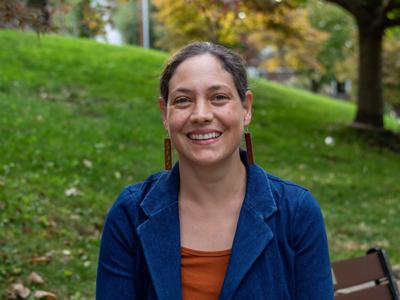
HOOD RIVER — This summer, former State Representative for House District 52 (HD 52) Anna Williams made the tough decision not to return to the Oregon State legislature. Mostly working from home as the new executive director for the Oregon System of Care Advisory Council, Williams can finally exhale, free from the unpredictability of the state legislature.
“I am glad to be moving into this executive director role where I have one job. That’s a lot easier, mentally,” said Williams.
Helping the state, help children
The System of Care (SOC) Advisory Council was created in 2019 thanks to Senate Bill 1 and revised two years later by Senate Bill 4. The 25-person council is focused on improving the usefulness of state agencies that assist children and their families experiencing serious mental and emotional health problems.
“The governor-appointed advisory board is supposed to advise agencies and the legislature on how to coordinate and collaborate our various systems so that when a youth or child needs some kind of service, they can get it,” Williams said.
She added that time and time again children are overlooked by agencies that believe the youth is not their responsibility because of a specific diagnosis.
“It’s our job to facilitate a shared vocabulary to make sure that everybody feels a shared responsibility for every child in our state,” Williams said.
The SOC is a national model, and many other states are working to help coordinate with agencies that serve children with disabilities.
On the ground and in the communities is the practice level workshop team that analyzes barriers to access submitted from professionals and consumers. The next step up is the advisory, or steering committee — that guides policy development — deals with finances and addresses system barriers given to them by the practice level workshop team. The executive council is the board that develops and approves policies while identifying unmet needs in communities.
“If they feel like there’s a kid who has a disability and needs mental health care and is struggling in school, they would go to their local SOC council and provider council. If those local councils can’t resolve it through case consultation, they would send it out to the regional SOC executive council. And if the SOC council can’t resolve it, they send it up to my department and the System Of Care Advisory Council,” explained Williams.
Leaving legislature behind
Elected in 2018, Williams served as a representative for HD 52 which stretches east from Troutdale to The Dalles and south from Hood River to Government Camp.
She focused much of her time and energy in the capital advocating for domestic abuse survivors and bringing attention to houselessness around the state. Williams said what drove her to run for office was the discrepancies in policies for urban and rural communities.
“It’s part of the cultural relevancy. In a state like Oregon, being conscious of the differences of how people live across our state and making sure that we have services in Spanish and services that work for the ways that Native American youth think about their challenges and the solutions that would work for them,” said Williams.
As a representative for her district, she was responsible for distributing $30 million in state and federal funding to address those issues.
Williams was just one of two democratic representatives that lives east of the Cascade Mountain Range, which proved to be a scheduling and travel nightmare. She would often receive less than two hours warning before a vote was scheduled to be held.
“It’s a different experience than folks who don’t live that far away from Salem,” Williams said. “I think my experience was sort of uniquely unpredictable. If you’re going to pick four years to serve in the legislature, I picked the most chaotic (four years).”
Her experience was unpredictable not only due to short notices, but she came into office when nationwide walkouts protesting gun violence occured, special sessions in legislature were being held, and then COVID-19 struck, which surrounded the world with uncertainty. Williams also attributes low wages as a factor in opting to leave. Oregon legislators are paid a base salary of $33,000 a year, which is low compared to California and Washington — who bring in almost $120,000 and $58,000 a year, respectively.
“[My family] needed more stability in our lives than I could provide as a legislator,” said Williams. “I was working part time jobs to pay the rest of the bills.”
As Williams makes her own transition, so is the rest of her family. She and her husband, who is a math teacher at Hood River Valley High School, Jacob Kellert, are busy with their two sons Eli, age 14, and Noah, age 11. Fortunately, they have family in town that help whenever needed.
“We always have backup if we just needed an extra set of hands. And I think that’s been really, really helpful over the past four years, but also in this new transition,” Williams said.


Commented
Sorry, there are no recent results for popular commented articles.