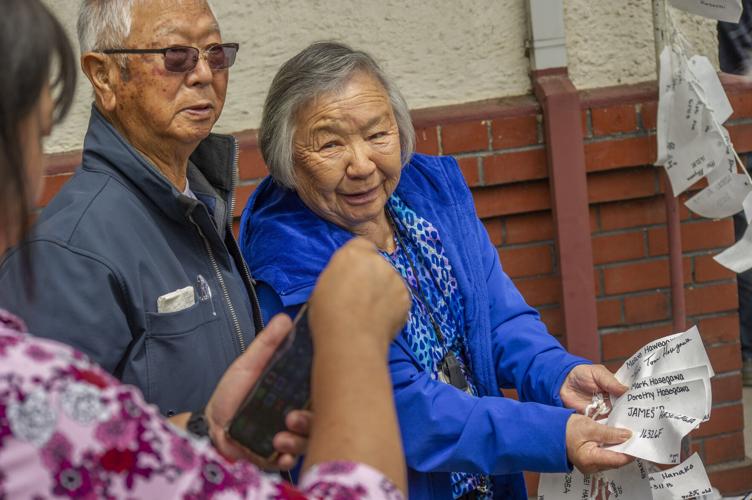
Jim and Ella Hasegawa find the names of family members among memorial luggage tags following a ceremony at the Hood River train depot May 13. Ella is holding Jim’s tag and those of his three siblings, Dorothy, Mark and Toru. Each tag displayed the name, age and government assigned identification number of the 431 Japanese Americans who were forced into train cars in Hood River on May 13, 1942, for removal to detention camps in California.
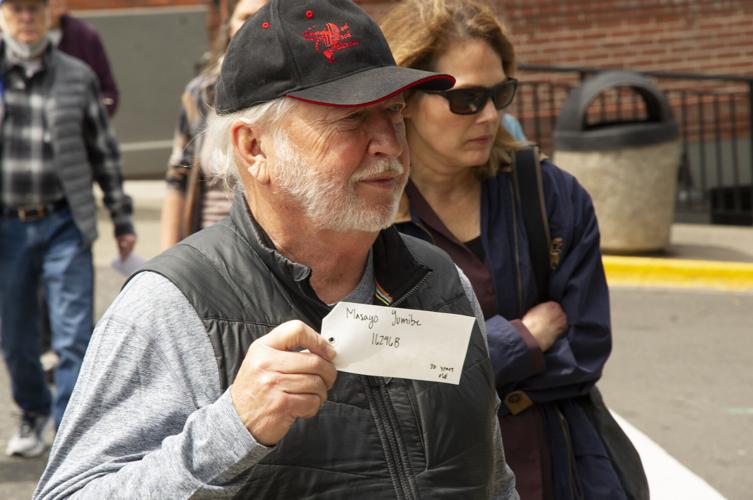
Hjalmer Lofstrom, a Hood River resident from 1974 to 1986, walks in procession through downtown holding a tag commemorating one of those transported from Hood River to a detention center in California in 1942. The tag reads, “Masayo Ymibe, 16296B, 35 years old.”
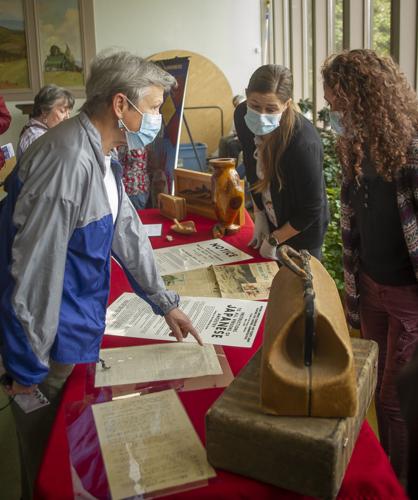
Betsy Brown of Hood River, at left, asks a question about memorabilia from 1942 removal Japanese Americans in Hood River on display during an even May 13 at Riverside Community Church. At right is Katherine France, an AmeriCorps outreach coordinator for the Hood River History Museum. In the background is Anna Goodwin, executive director of the museum.
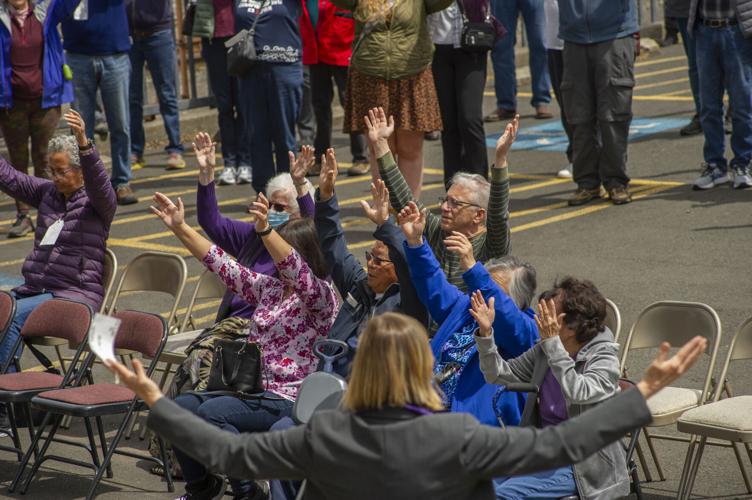
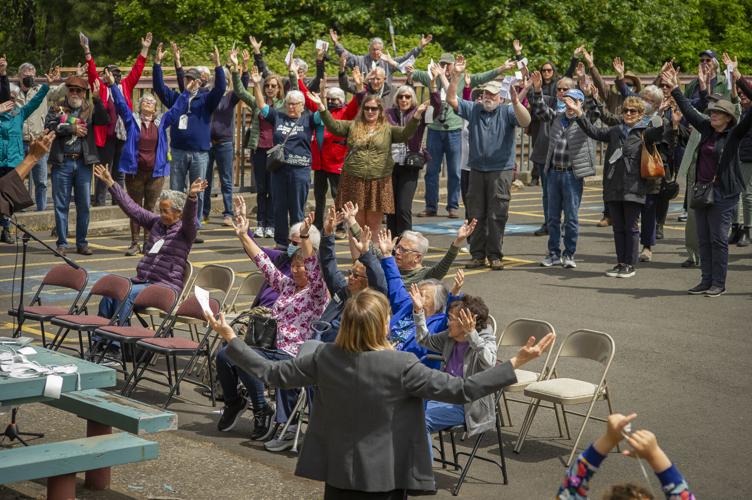
Participants in a “Train of Tears” commemoration, above, raise their hands as Thay Kozen of the Trout Lake Buddhist Abbey leads a Metta Prayer at the Hood River train station where on May 13, 1942, 431 people of Japanese ancestry living in the region were forced onto trains and transported to detention camps in California.
Participants in a “Train of Tears” commemoration, above, raise their hands as Thay Kozen of the Trout Lake Buddhist Abbey leads a Metta Prayer at the Hood River train station where on May 13, 1942, 431 people of Japanese ancestry living in the region were forced onto trains and transported to detention camps in California.
Jim and Ella Hasegawa find the names of family members among memorial luggage tags following a ceremony at the Hood River train depot May 13. Ella is holding Jim’s tag and those of his three siblings, Dorothy, Mark and Toru. Each tag displayed the name, age and government assigned identification number of the 431 Japanese Americans who were forced into train cars in Hood River on May 13, 1942, for removal to detention camps in California.
Mark B. Gibson photo
Hjalmer Lofstrom, a Hood River resident from 1974 to 1986, walks in procession through downtown holding a tag commemorating one of those transported from Hood River to a detention center in California in 1942. The tag reads, “Masayo Ymibe, 16296B, 35 years old.”
Mark B. Gibson photo
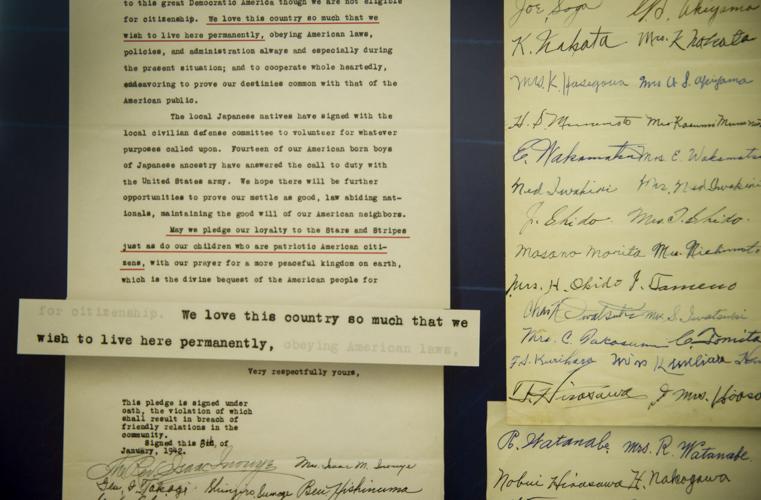
A quote is highlighted as part of a Hood River Museum display on the "Train of Tears."
Betsy Brown of Hood River, at left, asks a question about memorabilia from 1942 removal Japanese Americans in Hood River on display during an even May 13 at Riverside Community Church. At right is Katherine France, an AmeriCorps outreach coordinator for the Hood River History Museum. In the background is Anna Goodwin, executive director of the museum.
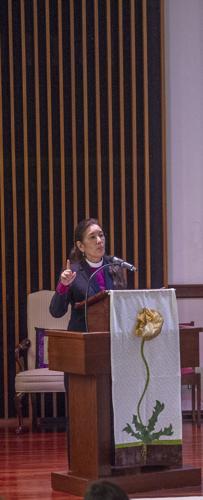
Reverend Vicky Stifter welcomes participants to the "Train of Tears" event at Riverside Community Church in Hood River.
Mark B. Gibson photo
Reverend Vicky Stifter welcomes participants to the "Train of Tears" event at Riverside Community Church in Hood River.
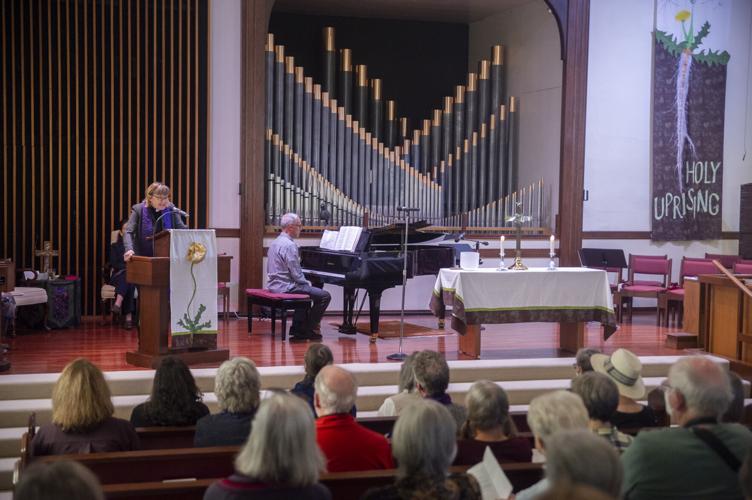
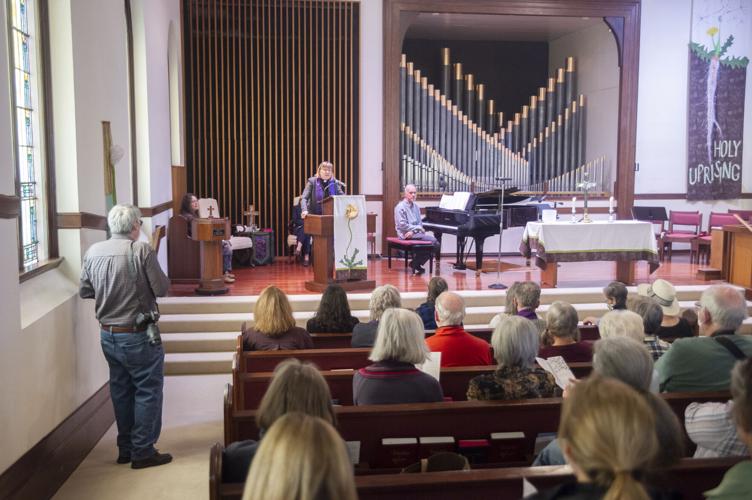
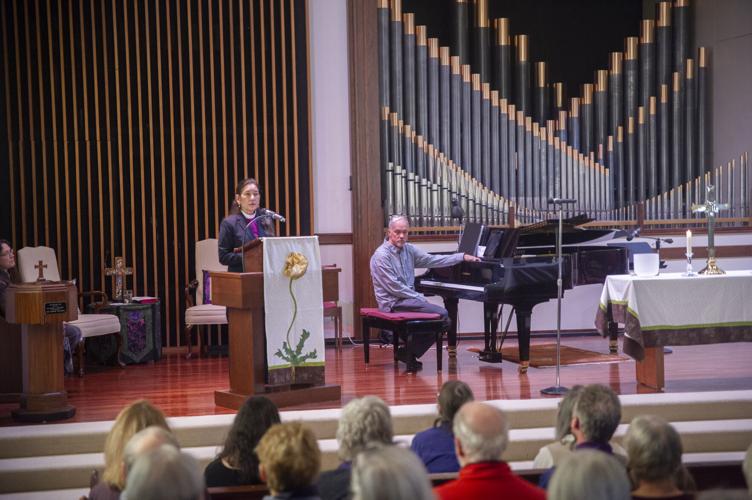
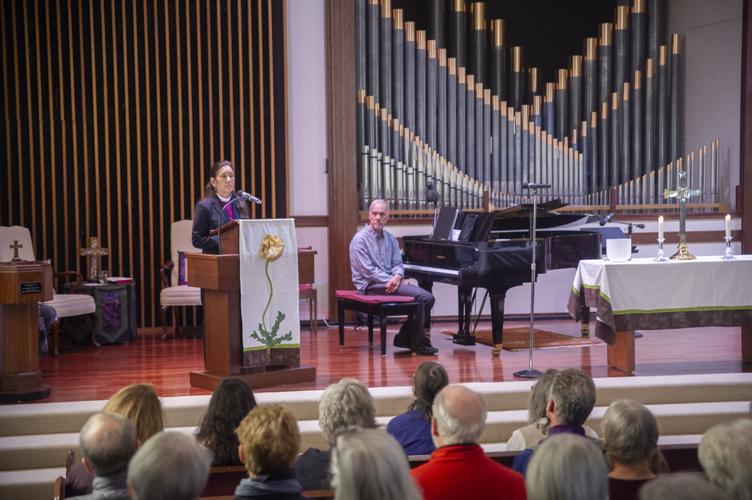
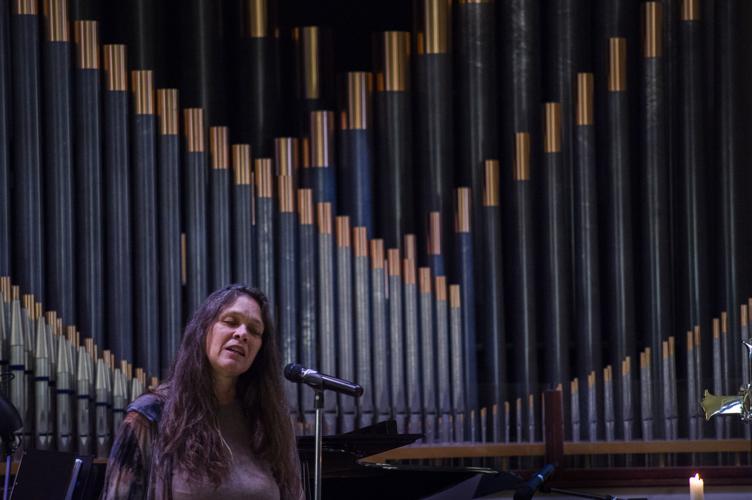
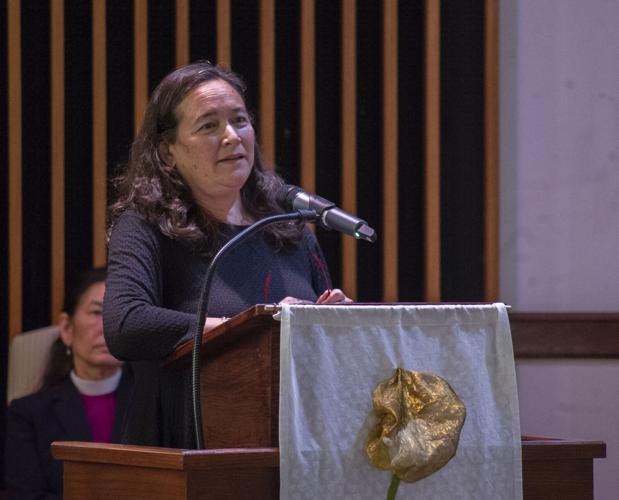
Bishop Diana Akiyama speaks at Riverside Community Church during a Train of Tears event in Hood River.
Mark B. Gibson photo
Bishop Diana Akiyama speaks at Riverside Community Church during a Train of Tears event in Hood River.
Bishop Diana Akiyama speaks at Riverside Community Church during a Train of Tears event in Hood River.
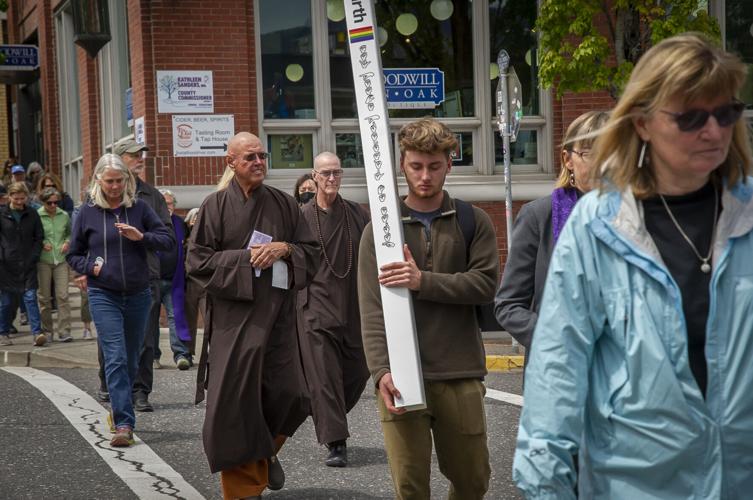
A peace pole is carried in the procession to the train station, where it was dedicated in a related ceremony.
Participants in a “Train of Tears” commemoration, above, raise their hands as Thay Kozen of the Trout Lake Buddhist Abbey leads a Metta Prayer at the Hood River train station where on May 13, 1942, 431 people of Japanese ancestry living in the region were forced onto trains and transported to detention camps in California.
Participants in a “Train of Tears” commemoration, above, raise their hands as Thay Kozen of the Trout Lake Buddhist Abbey leads a Metta Prayer at the Hood River train station where on May 13, 1942, 431 people of Japanese ancestry living in the region were forced onto trains and transported to detention camps in California.
Members of Riverside Community Church United Church of Christ publicly apologized on May 13, 2022, for their silence as a church on May 13, 1942, the day 431 people of Japanese ancestry were forced onto train cars in Hood River to be transported to detention centers in California by order of the U.S. military.
“On May 13, 1942, 431 people of Japanese ancestry were forced onto trains less than 600 steps from the sanctuary where we now gather,” said Reverend Vicky Stitfer. “Few of us were here then, but it has impacted us all whether we are aware of it or not. This history lives on in the land and in our bodies, in our relationships and in this community. And without an honest reckoning, we cannot live into the just and flourishing future that we desire for ourselves and our children and our grandchildren,” she explained. “And so we gather on this day to remember, to reflect and declare, ‘never again.’”
Bishop Diana Akiyama, who grew up in a Japanese-American community in Hood River, expressed gratitude for the acknowledgment. Akiyama was the first Japanese American woman ordained into the priesthood of the Episcopal Church in 1989, and was consecrated as the 11th Bishop of the Diocese of Oregon at Trinity Cathedral in Portland in 2021.
Speaking before a crowd that filled the small church to capacity, Akiyama said her own story was shaped by the internment of Japanese-Americans in 1942, even through she was not alive at that time. “My story is a continuation of the trauma that my family — my father and his family and the entire community — suffered when they were taken,” she explained.
Akiyama explained that most of the Nisei (Japanese-Americans) in his generation did not talk about the internment experience, but while in college, she pressed for answers. “I challenged him for his silence, asked why he didn’t share more about the experience. I felt that it was important for us to know the story, for him to tell us. And in the midst of my pummeling him with questions and challenging him, he paused and said, ‘I think it’s a little bit like those rape victims that you work with.’
She was at the time working on a rape crisis line, she explained. “That was really when I really began to understand how trauma works,” and how trauma can impact generations. “We now know that trauma is actually a physical phenomenon. It actually becomes part of the body and it can be passed on as if part of one’s DNA to generation after generation after generation.”
“Trauma changes not just the lives of those who experience it,” she explained. “It changes generation after generation after generation.”
But so does healing, she added. “What the congregation of Riverside Church has done is a courageous and radical act of healing. It’s so perfect and fitting that a church who should understand reconciliation and forgiveness, that a church should call itself together and begin to examine what it would mean to participate in the act of reconciliation.”
The apology, and the acceptance of that apology in gratitude, were the beginning, Akiyama said. “You have begun the process of healing, which is a return to the fullness of what has been fractured.”
The declaration, read by Yvonee Arbogast, read in part, “We now declare as a congregation that our silence 80 years ago was wrong, and that by remaining silent, we too caused harm. We are sorry for our silence when voices mattered most. We therefore are signing on to this declaration as a form of public apology for that silence and a vow to never again stay silent in the face of oppression.”
•••
Following the reading of the declaration, those gathered formed a silent procession through downtown Hood River to the nearby train station. Faith leaders, church members and Japanese Americans detained in 1942 were represented, as well as their families.
Large luggage tags resembling those used to identify those slated for removal were carried by many in their memory. The tags included the name and age of the person removed, and a number assigned them for the duration of their internment by the United States government.
At the train station, Thay Kozen of Trout Lake Buddhist Abbey led those assembled in a Metta Prayer, and a Peace Pole was placed at a corner of the train depot and blessed by Rev. Tyler Connoley, the conference minister of Central Pacific Conference of the United Church of Christ.



Commented
Sorry, there are no recent results for popular commented articles.