
Part 1 of 2
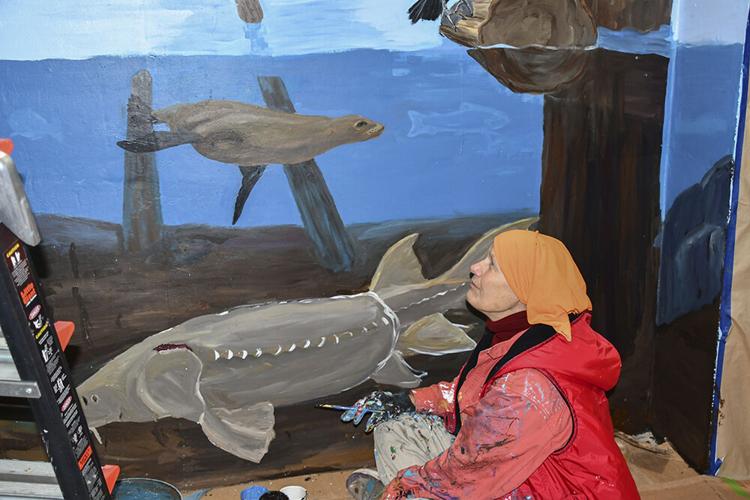
The National Fish Hatchery has a newly completed mural at the Cook, Wash., Little White Fish Hatchery visitor center, 56961 State Road 14, thanks to local artist Janet Essley.
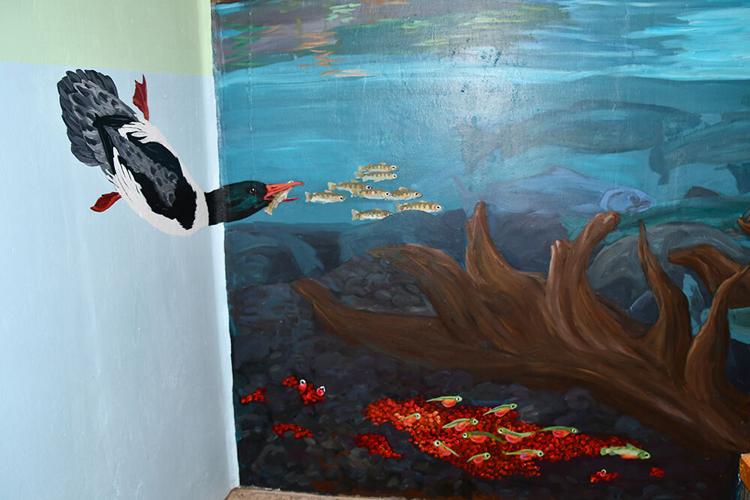
The mural displays all predators to the salmon lifecycle along two walls and down the stairs leading visitors to the salmon viewing window, where the big fish swim by.
Essley, who lives in White Salmon, said it was important to her that the mural be realistic, with all elements as proportioned as possible in the available space. She used a grid, both on a small canvas and the walls, to be sure all details were correct.
“The site was definitely a challenge — to physically reach all the corners, both top and bottom, and because the changing perspective of a viewer moving down or up the stairwell created such interesting design options,” she said. “Fishery employees were very helpful in answering questions about the fish that affected color and position in the mural. What was most fun was taking breaks and going outside to warm up and to look at the beautiful surroundings, and inside watching the salmon swim past the window was fascinating.”
She spent 120 hours creating models for each mural, measuring approximately 11 feet, 8 inches by 15 feet, 8 inches — a project she worked on last winter. She began with a list of basic items to include, provided by Cheri Anderson, information and education specialist for the Columbia River Gorge National Fish Hatchery complex.
Essley is also the artist behind the Spring Creek mural, another hatchery in the Columbia Gorge complex.
Anderson said when the idea for a second mural came up, it took months to decide how to get it done. Classrooms where one idea, but COVID caused disruptions. She remembers thinking, “If only I could get a hold of Janet Essley.”
And then one day, many years after their first introduction, Essley was visiting her mural work at Spring Creek with some friends when the two were reunited.
“Creating public murals has always been interesting for me because the topics are so varied — researching the information necessary to know for different murals has been lifelong learning in many subjects,” Essley said. “Even though I had learned much about the salmon life cycle and the history of hatcheries along the Columbia while doing the Spring Creek mural in 2001, I needed to know more about salmon, sturgeon, lampreys, and aquatic invertebrates for this one.”
Anderson's wish list “presented fascinating artistic challenges,” she said: “How to present tiny, barely visible salmon eggs and invertebrate larvae underwater along with huge above-water structures such as barges, hydroelectric dams, and Mount Adams in the same, apparently rational space, and how to fit animals of diverse sizes within a limited space when in nature, they would be much more widely dispersed.
“Traditional means of showing space on a two-dimensional surface were complicated because many viewers would not have a good understanding of the relative sizes of the birds and animals shown,” Essley continued. “Most important in the design was that the optimal viewing space of the painting would be constantly changing as one walked up and down the stairwell, and different for adults and children.”
Anderson, who has 24 years’ experience and works out of the Spring Creek hatchery location, said she expects the new mural at Little White Fish Hatchery to be a talking piece for visitors, much like Essley’s Spring Creek mural.
“(Essley’s) got the lifecycle in there,” said Anderson. “She’s got salmon predators — everything that’s in both of those murals is completely accurate. Like there’s not a bird in there that does not have some interaction with salmon, whether it’s eating them or not, so I just think it’s going be an opportunity to talk about the bigger picture, the bigger story.”
She added, “This will be helpful for tours as well, giving a visual aid. And visitors are always commenting on the mural at Spring Creek hatchery on the history of Salmon fishing and asking who the artist is. This new mural should be very popular as well.
“(Essley’s) got a great use of color,” Anderson said. “Both of our murals are realistic, you know, so I feel like she captures that integrity.”
•••
Coming up in the Aug. 10 issue of Columbia Gorge News: The long history of fish hatcheries in the Columbia River Gorge, the educational opportunities they provide, and their collaboration with Native peoples.


Commented
Sorry, there are no recent results for popular commented articles.