Don Budd, Michael Houser and Terray Harmon contributed to this report.
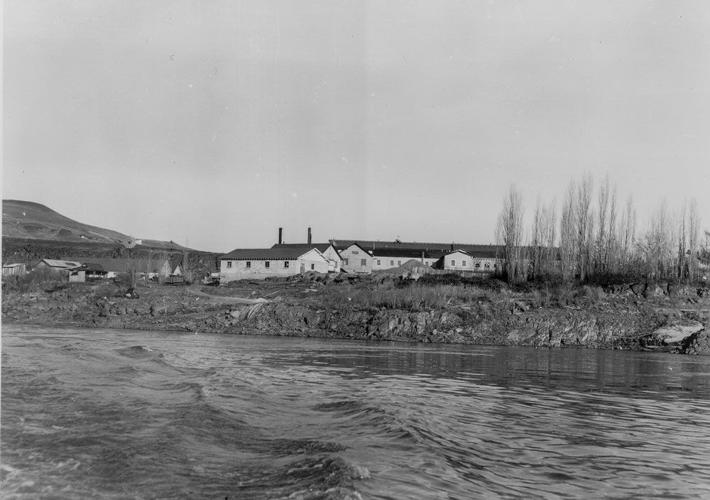
Last week’s History Mystery, above, is a view the Seufert Borthers Cannery, photographed from a boat on the Columbia River in 1947.
According to The Oregon Encyclopedia, a project of the Oregon Historical Society, “In 1884, Francis A. and Theodore J. Seufert built their first wheel on land they had purchased three miles east of The Dalles. They initially leased part of the property to another partnership, Everding and Farrell, which built a salmon cannery there in 1886. Ten years later, Seufert Brothers bought the facility for $2,500, beginning a process of expansion that would culminate in the ownership of four canneries, more than a dozen fish wheels, and much of the riparian property between The Dalles and Celilo Falls, about fifteen miles upriver. The company’s prodigious output helped make canned salmon Oregon’s second largest export in the early twentieth century, but it also contributed to the precipitous decline of fish runs during the same period.”
Terray Harmon said the cannery, located near where The Dalles Dam Visitor Center is today, was torn down in the late 1970s. Many of the buildings were vacant at the time, but one of the buildings housed the Winquat Museum in the late ‘60s and ‘70s, which his mother curated for years. The dugout canoe now on display at the Columbia Gorge Discovery Center was at the museum for many years, Harmon said, “but no one really knows were those artifacts all went” after the museum shut down. A home fair was also held at the property, with booths and displays from different businesses.
The museum appeared to take its name from a Wasco fishing village described by Pat Courtney Gold, a native American fiber artist and weaver online at www.patcourtneygold.com/wasco_history. In describing the “long narrows” immediately east of The Dalles, Gold writes, “There were two major trade Markets in this area: Nixluidix, a Wishram town located on the north side of Wauna, near what is now Horse Thief Park. The southern Market on the south of Wauna (the Columbia River) was Winquat, a Wasco town. The Wasco fishing village, Wac’uqs, is nearby, and continues to be used as a fishing sight.”
Regarding the previous History Mystery of the wreck of the steam-powered sternwheeler Georgie Burton, Don Budd noted the vessel was planned as a maritime museum, rather than a general or historical museum.
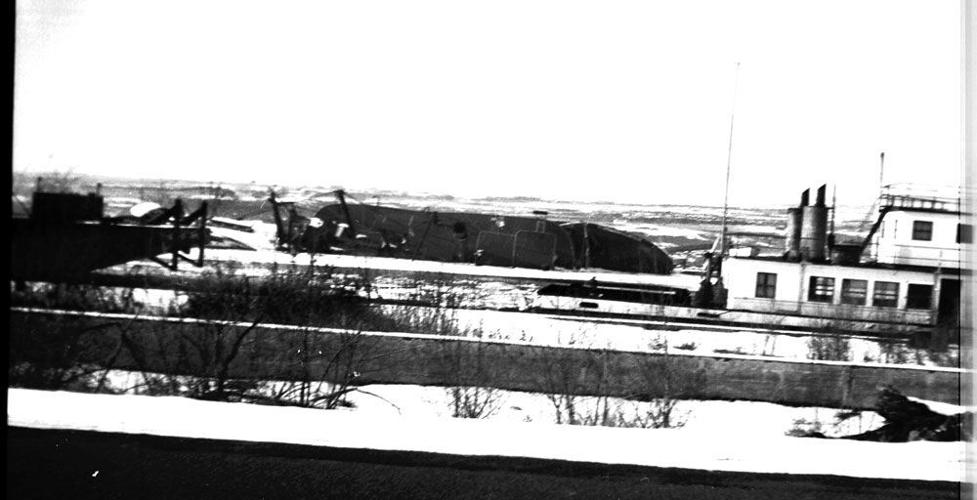
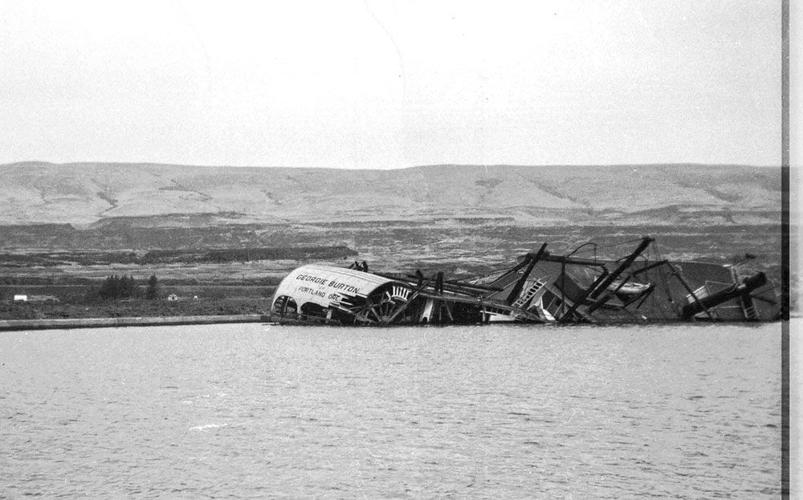
Last week’s History Mystery photo, at top, shows the steam-powered sternwheeler Georgie Burton. Above is a second view of the wreck. Both were scanned from black-and-white negatives sent to the Chronicle by a member of the Cushing family.
The photograph shows the aftermath of the Columbia River flood waters receding in June of 1948.
Gary Elkinton wrote that “with much fanfare, the sternwheeler Georgie Burton had left Portland and traveled upriver to The Dalles in 1947. It was planned to become a maritime museum. When the Columbia River flooded in 1948, the sternwheeler was moored in the Celilo Canal just east of The Dalles. The steamer broke it’s mooring during the flood. As the flood waters receded, the Goergie Burton broke its keel after settling on top of the canal’s wall. The Georgie Burton was launched on the date of the Great San Francisco earthquake in 1906.
Myron Egbert said The Dalles Yacht Club and the City of The Dalles had planned the transfer of the stearnwheeler to serve as a museum. The Portland Yacht Club was also involved. He said the steering wheel had been restored and was now on display at the yacht club, as was the ship’s flag and a few other items rescued from the flood waters.
Terray Harmon noted that the boiler was believed to remain in deep water offshore from the Port of The Dalles.
Don Budd, Michael Houser and Terray Harmon contributed to this report.
Last week’s History Mystery, above, is a view the Seufert Borthers Cannery, photographed from a boat on the Columbia River in 1947.
According to The Oregon Encyclopedia, a project of the Oregon Historical Society, “In 1884, Francis A. and Theodore J. Seufert built their first wheel on land they had purchased three miles east of The Dalles. They initially leased part of the property to another partnership, Everding and Farrell, which built a salmon cannery there in 1886. Ten years later, Seufert Brothers bought the facility for $2,500, beginning a process of expansion that would culminate in the ownership of four canneries, more than a dozen fish wheels, and much of the riparian property between The Dalles and Celilo Falls, about fifteen miles upriver. The company’s prodigious output helped make canned salmon Oregon’s second largest export in the early twentieth century, but it also contributed to the precipitous decline of fish runs during the same period.”
Terray Harmon said the cannery, located near where The Dalles Dam Visitor Center is today, was torn down in the late 1970s. Many of the buildings were vacant at the time, but one of the buildings housed the Winquat Museum in the late ‘60s and ‘70s, which his mother curated for years. The dugout canoe now on display at the Columbia Gorge Discovery Center was at the museum for many years, Harmon said, “but no one really knows were those artifacts all went” after the museum shut down. A home fair was also held at the property, with booths and displays from different businesses.
The museum appeared to take its name from a Wasco fishing village described by Pat Courtney Gold, a native American fiber artist and weaver online at www.patcourtneygold.com/wasco_history. In describing the “long narrows” immediately east of The Dalles, Gold writes, “There were two major trade Markets in this area: Nixluidix, a Wishram town located on the north side of Wauna, near what is now Horse Thief Park. The southern Market on the south of Wauna (the Columbia River) was Winquat, a Wasco town. The Wasco fishing village, Wac’uqs, is nearby, and continues to be used as a fishing sight.”
Regarding the previous History Mystery of the wreck of the steam-powered sternwheeler Georgie Burton, Don Budd noted the vessel was planned as a maritime museum, rather than a general or historical museum.
Last week’s History Mystery photo, at top, shows the steam-powered sternwheeler Georgie Burton. Above is a second view of the wreck. Both were scanned from black-and-white negatives sent to the Chronicle by a member of the Cushing family.
The photograph shows the aftermath of the Columbia River flood waters receding in June of 1948.
Gary Elkinton wrote that “with much fanfare, the sternwheeler Georgie Burton had left Portland and traveled upriver to The Dalles in 1947. It was planned to become a maritime museum. When the Columbia River flooded in 1948, the sternwheeler was moored in the Celilo Canal just east of The Dalles. The steamer broke it’s mooring during the flood. As the flood waters receded, the Goergie Burton broke its keel after settling on top of the canal’s wall. The Georgie Burton was launched on the date of the Great San Francisco earthquake in 1906.
Myron Egbert said The Dalles Yacht Club and the City of The Dalles had planned the transfer of the stearnwheeler to serve as a museum. The Portland Yacht Club was also involved. He said the steering wheel had been restored and was now on display at the yacht club, as was the ship’s flag and a few other items rescued from the flood waters.
Terray Harmon noted that the boiler was believed to remain in deep water offshore from the Port of The Dalles.
Wreck of the steam-powered sternwheeler Georgie Burton



Commented