
Welcome to our shortest month of the year — this year one day longer (Leap Year).
Most of you know that Feb. 2 is “Groundhog Day.” That comes roughly from an old Celtic calendar, as one of four “Cross Quarter” days, the others being May Day, Lammas Day (Aug. 1) and Halloween. Those days fall roughly at the mid-point of our seasons. Groundhog Day is about halfway between the start of winter and the start of spring. We are (usually) past the worst of winter and looking forward to spring.
Jupiter reigns as the only prominent planet in our February evening sky, riding high in the southwest. If skies are clear on Valentine’s Day, you’ll be treated to the crescent Moon just to the right of Jupiter, for a very nice sight.
Saturn will be visible very low in the west, early in February. Later in the month it will be lost in the glare of the Sun.
Mars and Venus are both visible, low in the southeast, at dawn. On Feb. 21-22, the two planets will be very close to each other. Brilliant Venus will be easy to spot, with Mars just below. On Feb. 20-21, Mars will be just to the lower left of Venus. On Feb. 22-23, you will see Mars now to the right of Venus, as Mars moves in its orbit. Both planets are on the “back” side of their orbits, both farther from us than the Sun. Venus will be about 137 million miles from us, Mars about 208 million miles. The solar system is huge!
Earth’s Moon will be new early in the month, on Feb. 9, with full Moon following on Feb. 24 (known as the “Snow Moon”). In addition to being close to Jupiter on Valentine’s Day, look for the first-quarter Moon near the star cluster Pleiades Feb. 16.
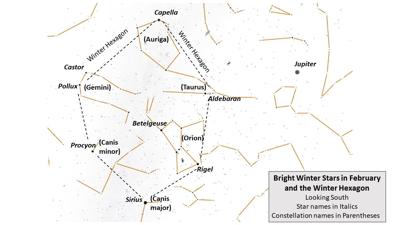
February remains a good month to view the bright winter constellations, when skies clear in the evening. Bright Orion is located in the southern sky, with Taurus and Gemini above and Canis major below. Sirius, the brightest star in our sky, lies below Orion.
Other bright stars include Betelgeuse, in the right (as we look at it) shoulder of Orion; Rigel, one of Orion’s feet; Aldebaran, the reddish “eye” of Taurus the bull, above Orion; the twins Castor and Pollux in Gemini, to the left of Orion; Procyon, the bright star in Canis minor, also to the left of Orion; and Capella, in the constellation Auriga, high overhead, above Orion.
In addition to Sirius, our brightest star, the group includes the sixth brightest star, Capella; the seventh, Rigel; the eighth, Procyon; the tenth, Betelgeuse; the 14th, Aldebaran; the 17th, Pollux; and the 24th, Castor. The outer stars in this group make up what is called the “Winter Hexagon.”
Check out the drawing with this column for star and constellation names, and the Hexagon outline.
If you get a chance, brave the cold to see the brilliance of the February evening sky!


Commented