October, our first full month of fall, brings colorful leaves, a nip of frost in the air, and very dark skies when the weather is clear.
The bright planets Saturn and Mars are visible, but fainter, and Jupiter is sinking toward the sunset this month. However, the bright winter constellations are appearing on the eastern horizon, and the Milky Way is still stunning on dark nights. Put on a coat and take a look!
Jupiter will still be visible low in the southwest after sunset in early October. Look for it on the 11th, right below the thin crescent Moon. By the end of the month, it will be just to the right of Mercury and only barely above the horizon at sunset. You’ll need a good view of the western horizon to see them both.
Saturn is in the south and southwest after sunset. It is a bit smaller than it appeared in August, but not by much. With a sufficiently powerful telescope you can still see its rings.
Mars was brilliant red in late July and early August, but it has grown much fainter. The red planet will be about 56 million miles from us on Oct. 1, and over 730 million miles away by the 31st. At its closest this year, in late July, it was only about 35 million miles from us. Mars will make its next close approach in a couple of years, October 2020 to be precise.
Last month I mentioned that Neptune, our outermost planet (with apologies to fans of Pluto), made its closest approach in September. October is Uranus’ turn. Uranus makes its closest approach Oct. 23, although “close” is still about 1.75 billion miles distant — about 18 times as far as we are from the Sun. Uranus is visible to the naked eye and will look much like a dim star. The trick is knowing which faint “star” is the planet.
Our Moon will be full on Oct. 24, and we’ll have a new Moon on Oct. 8.
Astronomers have recently confirmed that there is water on our Moon!
It has been suspected for some time that permanently shadowed craters near the Moon’s poles could harbor stable deposits of ice thanks to their inaccessibility by solar radiation. The theory was confirmed recently by specific observations of near-infrared parts of the light spectrum.
Temperatures in those dark craters are very cold by the standards of life on Earth, approaching -390 degrees Fahrenheit.
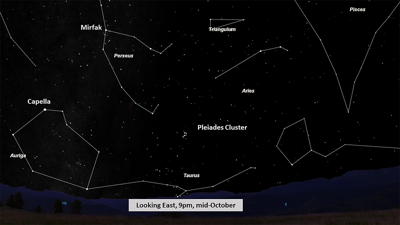
I think of October as the month that brings the Pleiades into the evening sky. Look for the bright star cluster early in the month, low in the east-northeast after 9 p.m. As I have mentioned before in this column, the Pleiades are called “Subaru” in Japan, and, yes, the car is named after the cluster. Point a pair of binoculars toward the Pleiades and you’ll get an amazing view.
This star cluster also makes a good guide to a couple of bright constellations nearby.
A bright star, Capella, will be to the Pleiades’ left in the northeast. It is the brightest star in the constellation Auriga, the charioteer. Look for Auriga as a semi-circle of moderately bright stars, low in the northeast.
One Native American legend has Auriga as a circle of natives protecting their cache of camas from marauding skunks. Somehow, I like that interpretation better than a chariot.
Above the Pleiades are three constellations that may be hard to pick out.
Aries the ram sits directly above the Pleiades. Above the Ram, a more recognizable form is Triangulum, which does in fact look like a triangle. To the left of Triangulum is Perseus, which sports the moderately bright star Mirfak. Perseus is intersecting with the Milky Way, just below “W” shaped Cassiopeia.



Commented