
Guess how fast a sparrow can fly?
Interestingly, I once tentatively clocked one sparrow at more than 25 miles per hour. Driving a country road lined with a bare icy hedgerow of common snowberry and red osier dogwood, I noted a tiny, sleek shape flying alongside. Long tail streaming, wings steadily blurring, body just a speeding line of motion, the sparrow was peeling along in the same direction as me, and at about the same speed. That little speck was going like the wind.
I don’t know which species it was, but I recognized the sparrow-like flight.
Each bird’s aerial habits, airfoil, and flight patterns are a bit different. Some species’ behaviors are so distinctive, they’re good field marks.
An obvious example: Downy Woodpecker and Hairy Woodpecker, both locally common, fly in scallops. A few frantic wingbeats angle them up; then, wings clapped to their sides, they arrow down. A split second later, those wings snap open, and they level out again. Nothing else flies quite like our small woodpeckers.
Or take some Rock Pigeons in a hurry, with their straight, arrowing flight paths; tails shut, wings half open, smoothly curved and pointed like a falcon’s, snapping off an occasional wingbeat to help them on their way.
Or consider a Wild Turkey. On the ground, a turkey is a gawky thing. In the air, coasting downhill like a fighter jet, it’s strange and terrifying, with a long dinosaurian neck, crooked wings, and huge, striped, fanning tail. Every Douglas Ground Squirrel on the hill starts screaming high-pitched one syllable “hawk alarms.” Predator in the air! Squeak! Squeak!
Each different flight style reflects a different avian life history. Take swifts, those tiny, sickle wingspans that never touch the ground. Perfectly adept, they spend almost their entire lives in flight, tracing out the flight paths of doomed insects and scooping them up.
Unlike swallows, you won’t see them land on telephone wires. Or twigs. Or, in fact, anywhere.
The Common Swift of Europe may fly for its entire life after the moment of fledging. It eats, mates, and sleeps on the wing. Unihemispheric slow-wave sleep, an ability the Common Swift shares with dolphins and other marine mammals, allows one hemisphere of the brain to rest while the other remains wakeful, guiding the swifts’ flights through the upper air.
Our spring-and-summer local, the Vaux’s Swift, descends at night, roosting in woodpecker holes, together for warmth, like bees. But it’s still airbound. The Vaux’s feet are tiny, short, and useful only for clinging to a vertical surface. They can’t very well walk, hop, or crawl. Just touch down and lift off, like house flies.
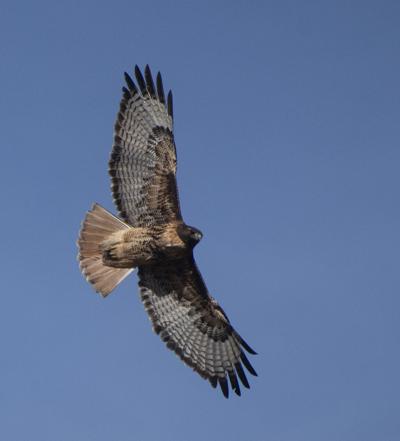
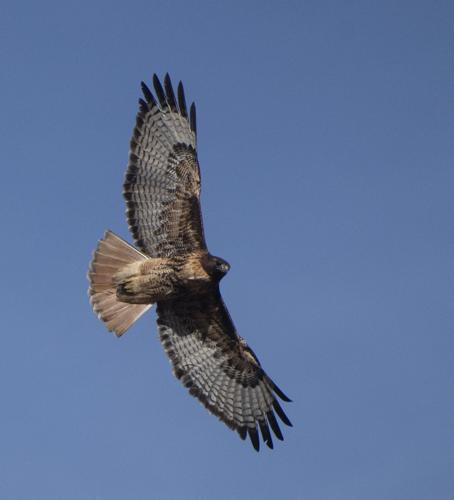
The swifts are migrated now and winter raptors ride the wind. The Red-tailed Hawk, Bald Eagle and Common Raven are local common “soaring birds,” a good place to start if you’re interested.
Soaring on a thermal, or perched solidly on a sturdy telephone pole or tree trunk, the Red-tail hunts mainly rodents (like those ubiquitous, delicious Douglas Ground Squirrels, so terrified of strange flying objects). In the air, Red-tails have an elegant shape, with curved wings, a dark belly-stripe, a large dark head. Sometimes, depending on age, morph, and subspecies, it even has a reddish tail.
And so species’ airfoil is unique to its needs, from the long, slender high-aspect-ratio gliding wings of seabirds like albatross (who may stay in the air for days and circumnavigate the globe many times in one life), to the pointy boomerang wings of fast falcons, to the rounded, maneuverable, curved wings of quail.
Soaring raptors have slotted, “fingery” wing silhouettes. If you find one of the long, strong primary feathers from the end of an eagle’s wing, you’ll notice long “notches” cut from both vanes. These create narrow channels through which air flows faster, increasing lift and aiding the bird’s soar. (But know that possessing feathers is illegal under the Migratory Bird Treaty Act of 1918. Take a photo, take notes, measure the feather, and leave the feather where you found it.)
With the forest bare, distant flights are more visible in winter. Eagles and gulls soar and coast on the Columbia. In the open country, hawks and warblers and sparrows winter over, each with its own habitat, its own flight habits, its own complicated, mysterious wings.
For readers interested in the complexities of bird flight and feather ID, “Bird Feathers” by S. David Scott and Casey McFarland is a good resource.


Commented