In 2020, I watched swallows curling in low flight, as they do before a rainstorm. The air was stagnant, dry, smoke-brown; the sun a pale yellow disk. Wildfires were burning almost 21,000 acres in the United States, mostly in Oregon, Washington and California.
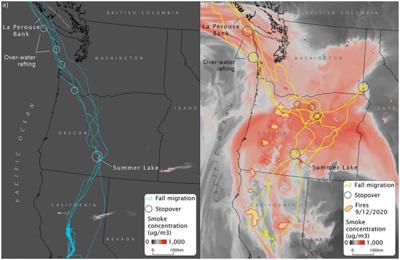
A peer-reviewed study in Ecology, by Cory T. Overton and 15 other scientists, cited data showing wildfire smoke and particulate pollution (a fancy word for icky smoky bits) have increased in the last few decades, impacting birds. They put trackers on White-Fronted geese and reviewed data for Canada geese, and found a substantial energetic cost, with Canadas feeding five times more frantically and still needing extra days to recover from trips through smoke-smothered flyways.
Now, more and more wildfires light up during fall migration, when millions of birds are winging their way south from every corner of North America, funneling toward their winter landings in Mexico or South America.
Climate change has lengthened the wildfire season. Fuel accumulation due to fire suppression, and invasive plants, feed the wildfires. The Gorge lies under the Pacific Flyway, a great concentration of fall migrants. Sandpipers and shorebirds, among others, zoom south above us, starting in September. Here one of the world’s smallest shorebirds, the Least Sandpiper, zips between Alaska and South America, carried over the Gorge by a ten-inch wingspan and a few grams of fat.
Observers during the 2020 fires saw birds dead and dying in the Pacific and Central flyways, grain-eating bird and insect-eating birds alike starving to death and dropping from the atmosphere like biblical frogs.
While the cause remains unclear, one study presented evidence that disruption by the massive wildfires played a role.
Another group of researchers, summarizing studies published since 1950, found air pollution like smoke caused “respiratory distress and illness, increased detoxification effort, elevated stress levels, immunosuppression, behavioral changes, and impaired reproductive success” in birds.
Apparently, those swallows were suffering from the same smoke that forced us to cough and mask up and stay inside.
The same efforts could help birds and people survive accelerating wildfire seasons: Advocate for wildfire management that focuses on preparedness and local knowledge of the local ecology; conduct prescribed burns, which have proven to drastically reduce the severity of wildfires, protecting the soil and trees; and advocate for much stronger climate legislation.
So, what can we do right now? Let’s see; President Donald Trump is seeking to consolidate all firefighters into a single federal agency (mid-fire season!), stripping USFS of nearly all its workers and funding while separating fire suppression from local ecological knowledge. This could be disastrous for firefighters, and all who depend on their efforts — human, and bird, and tree, and river, and all.
Oh, and: the budget bill currently moving through the U.S. Senate requires the sale of at least 2 million acres of publicly-owned land, including Bureau of Land Management and National Forest Service land, possibly including land right here on Mt. Hood. Yes, you read that correctly.
Calling our legislators and objecting — monotonously, like a Common Poorwill — sounds like an excellent start.
Separating social justice, politics, and birding is impossible when the same ills threaten us all.



Commented