
Wildwood Academy’s lawsuit against Mt. Hood Railroad for violating an easement is in process but on pause, said Wildwood Academy co-founder Carrington Barrs, as Wildwood tries to pick up negotiations with the railroad for a parking deal.
While Mt. Hood Railroad and Wildwood have been attempting to negotiate a parking deal for a little over a year, negotiations were closed on July 9, when Iowa Pacific Holdings, the company that owns Mt. Hood Railroads, terminated the easement agreement between the two businesses.
“It was not what I wanted to do,” said Ed Ellis, the president of Iowa Pacific Holdings.
“They (Wildwood) are a startup. They’re trying to do something good,” he said. “What they were doing though was making my small business untenable in a lot of ways … I couldn’t stand still for that.”
Ellis said that, while he has been aware of the dispute since Mt. Hood Railroad General Manager Ron Kaufmann and Barrs, began negotiations for a parking deal began a little over a year ago, he first became directly involved about a month and a half ago, when he received an email from an Wildwood employee about the severity of the dispute.
Ellis then went down to the property himself and “spent some time trying to understand their (Wildwood’s) business),” he said.
“The more I looked at the situation … I came to the conclusion that if I was going to be mad at Ron (Kaufmann) about anything, it was waiting this long to stop it, because it’s madness,” he said.
The easement, originally between Mt. Hood Railroad and Phil Jensen of Luhr Jensen Co., was signed in 1998 and set up to be transferred along with the property. It allows employees and visitors of the Wildwood property — which currently houses three tenants: Wildwood Academy, Wildwood Events, and Story Gorge — to cross railroad property in order to access Wildwood’s property and six allotted parking spaces.
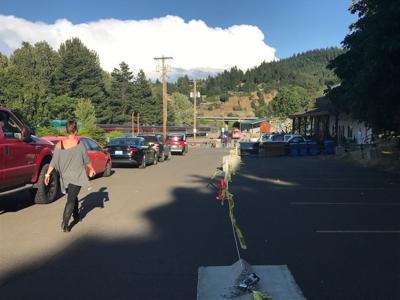
However, there has been a consistent problem with Wildwood patrons using railroad parking spaces, despite Wildwood putting up signs and telling customers not to park there.
The easement requires the owner of the Wildwood building to provide “custodial monitoring” of the parking, but that term is not defined in the easement, and Barrs said that he doesn’t feel it’s Wildwood’s responsibility to enforce the parking lot.
“We feel like we did our best,” said Barrs. “I’m not sure what else to do.”
On Tuesday, July 9, Ellis met with Wildwood representatives in Portland and informed them that he was terminating the easement agreement, effective immediately — on the grounds that Wildwood breached the easement by failing to provide “custodial monitoring,” and violated a section of the easement that requires them to “cure the breach” in agreement within 30 days.
By the morning of July 10, Mt. Hood Railroad had blockaded the parking lot with a parked van and a backhoe.
“The reason we locked them out was really for safety,” Ellis said, citing instances where Wildwood has tried to move the railroad’s barriers, which are made primarily of cable wires, cinder blocks and railroad ties. “For us, safety is the most important factor.”
The backhoe and van were removed on a court order after Wildwood successfully filed for a temporary restraining order (TRO) against the railroad on July 10. The TRO effectively keeps the easement in effect until the legal case is settled; but the railroad’s existing barriers, first set up approximately six months ago, will remain in place.
Despite Wildwood’s current lawsuit suing the railroad for breach of easement, Ellis said that he stands by Mt. Hood Railroad’s termination of the easement, and believes that position is defensible in court.
“It (the easement) is not what should have been done in the first place,” Ellis said, adding that it effectively put Wildwood tenants in a position where it’s “impossible for them to do business in a successful way.”
Wildwood has begun the process of suing Mt. Hood Railroad, Barrs said, but the lawsuit is currently “on pause” because Wildwood wants to resume negotiations with the railroad for a parking deal.
Since March 2018, the two parties have been trying to negotiate a deal that would give Wildwood access to some parking spaces within the railroad lot, but to no avail.
“I don’t begrudge them, we just never got there,” Barrs said.
Barrs said that there has been ample back-and-forth discussion and negotiation with Kaufmann, while Ellis said that Wildwood rejected the railroad’s initial proposal — 35 parking spaces at $1,750 a month — and that he’s “not aware of any potentially viable agreement that’s been presented.”
“Personally, I have tried for over a year to negotiate a parking deal with them,” said Kaufmann, adding that the railroad’s offer was “very competitive.”
“It was very clear to me that we had made a very reasonable proposal,” said Ellis. “There’s no way that you could look at that and think we were being unreasonable with it.”
Barrs disagrees.
“It’s nothing personal, they’re trying to sell something that I think is way too expensive,” he said.
Ellis said that he offered Wildwood one last chance at a parking deal at the July 9 meeting that would have required Wildwood to pay for new parking technology and two years’ payment upfront, but Wildwood rejected it.
“I gave them a number and instead, they went to court,” Ellis said. He did not disclose the number, but said it was purposefully high because “honestly, at this point, I don’t trust them to make payments.”
As of publication, the lawsuit is still on pause, but negotiations have not reopened.
Barrs assures Wildwood patrons that all of its tenants are open for business; Kauffman asks “all parties involved to respect our (Mt. Hood Railroad’s) property rights and respect the law and respect the system and go from there.”


Commented