July, our first full month of summer, is here. Days are beginning to grow shorter, and nights longer, as the seasons progress. At the start of July, day length will be quite long, with sunset coming at about 9 p.m. and sunrise at about 5:20 a.m. By the end of the month, the Sun will set about 25 minutes earlier at 8:35 p.m., and sunrise will be about 27 minutes later at about 5:47 a.m. July (and August) can be excellent months for stargazing, as nights start to come earlier, but weather is pleasant for viewing the night sky.
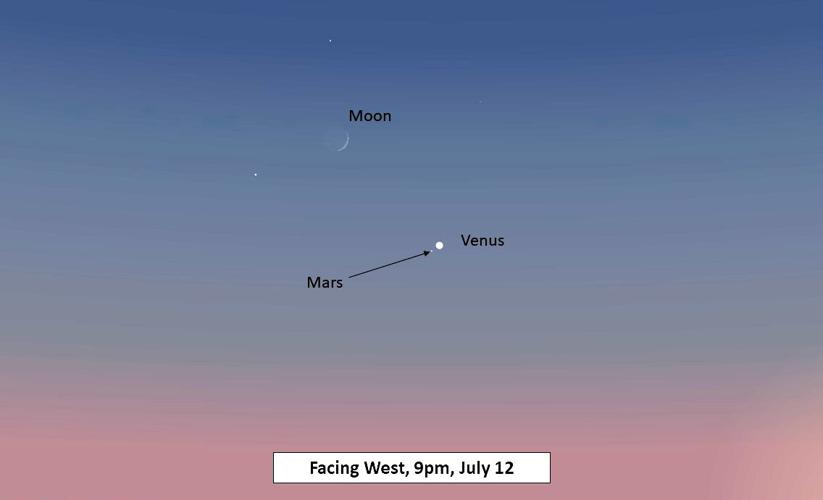
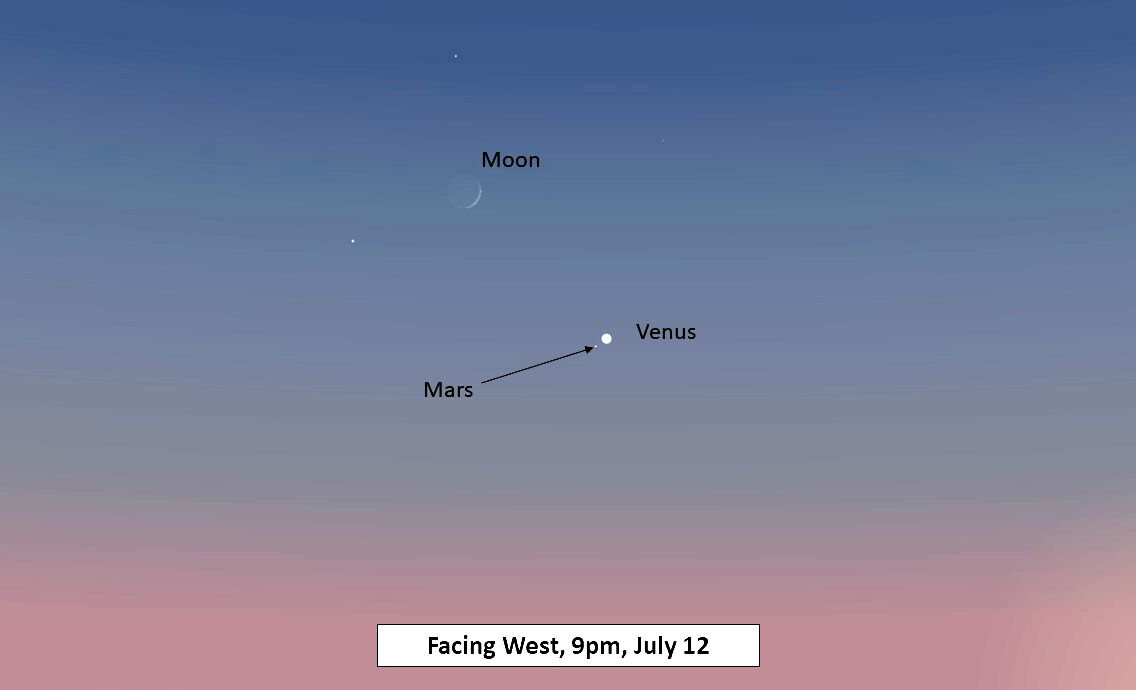
An interesting sight to put on your calendar occurs on July 12. After sunset, look low in the west, and look for bright Venus. The bright planet will be hard to miss, about 15 degrees above the horizon. If you have a pair of binoculars, see if you can spot Mars, located right next to Venus, below and to the right of the bright planet, at about the 7 o’clock position from Venus. Now look above and to the left of Venus, and find the faint crescent Moon, about the width of your extended fist from Venus.
The solar system’s largest planets, Jupiter and Saturn, are moving back into the evening sky in July. They will be quite low at the start of the month, but by the end of July will be above the horizon by 10 p.m. Look for them low in the east after sunset. Early in July they will not rise until 11:30 p.m. or a bit later.
Our Moon will begin the month in the morning sky. On July 5, if you are up early, you may see a beautiful crescent Moon just to the right of the Pleiades star cluster. The Moon will be above the bright star Spica on July 16, and above Antares on July 19. The Moon will be to the right of Saturn on July 23, and below Jupiter on July 26.
Some of you may have been able to visit the Goldendale Observatory in May and June, when the State Park held limited attendance, with afternoon solar viewing. I was able to attend in early June. I enjoyed a presentation about our Sun, and a view of our star through the facilities’ 6-inch refractor. In July, evening presentations (Saturday and Sunday only, 9 p.m. to midnight) will also be started. As with the afternoon solar presentations, attendance is limited, and you must reserve a spot in advance, on the observatory’s web page. Visit www.goldendaleobservatory.com for the latest.
If you are interested in supporting the observatory or one of the other Goldendale-area State Parks (Maryhill, Brooks Memorial, Columbia Hills), a group is being formed to provide volunteer assistance. If this piques your interest, let me know (jwhite.stargazer@gmail.com) and I can provide you with information.
An interesting bright star in the July sky is Altair, the southernmost star of the “summer triangle” and the brightest star in the constellation Aquila, the Eagle. Look for Altair below the bright star Vega, and below the constellation Cygnus, also known as the northern cross. You can use the Milky Way to find Altair — Vega and Cygnus will be on one side of the Milky Way, with Altair on the other.
Altair is the 12th brightest star in our sky, and one of the closest to our solar system, being only about 16.8 light-years distant. Altair is about twice the diameter and 1.7 times the mass of our Sun. Amazingly, the star rotates in about 10 hours, making it bulge at its equator, and thus has an oblate shape, bulging out at its equator. Check out the “eye” of the Eagle!




Commented