
Happy New Year!
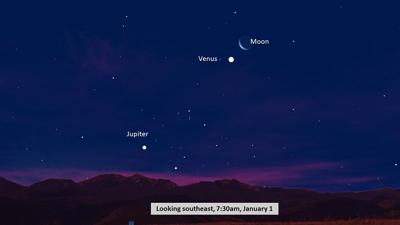
It’s 2019, and we had a great sight to start the year on New Year’s Day morning. The waning crescent Moon was low in the southeast, with bright Venus right below it, and Jupiter below and to the left of both. You had to jump out of bed at 7 a.m. to see it.
Of course, you might not have felt up to rising early after celebrating the New Year. In that case, try tonight, Jan. 2. The crescent Moon will now be between Venus and Jupiter, which also makes for a very nice sight.
Venus and the Moon will have another close conjunction at the end of the month, on the morning of Jan. 31.
Speaking of Jan. 31, some of you may remember that we had a lunar eclipse on that day last January. We’ll have another January eclipse in 2019, but this year it falls on Jan. 20.
The eclipse will technically begin at about 6:45 p.m., although the initial stages are faint and will hardly be detectable. At about 7:45 p.m., the darker, full shadow of the Earth will start to move across the Moon. By 8:40 p.m., the Moon will be fully eclipsed.
As with all lunar eclipses, the Moon will still be visible during the eclipse, although it will be much darker, and reddish in color. At about 9:45 p.m. it will begin to emerge from Earth’s shadow, and the entire event will be over by about 10:45 p.m.
Check it out if skies are clear! Consider going to the Goldendale Observatory’s temporary home at the Stonehenge replica south of Goldendale. I plan to be there.
A note on dates and times: The lunar eclipse will be visible across the U.S., and parts of Europe will also see totality. In Europe, however, it will already be Jan. 21 when the event occurs. Even our own east coast will experience some of the totality after midnight.
Due to this, you may find articles that say the eclipse will occur on Jan. 21. But here on the west coast, the eclipse will occur on the evening of Jan. 20.
The bright planets have deserted the January evening sky — except for Mars. This red planet is moving away from us and growing fainter. Look for it high in the southern sky after sunset.
Early in the month, Mars can be found below the “Great Square” of Pegasus if you recognize that feature; Mars will be the brightest object in that part of the sky. By the end of the month, the red planet will have moved eastwards relative to the stars, and will be located to the left of the Great Square.
Jupiter and Venus are present in the January morning sky, and they will “pass” each other during the month. Early in the month, Venus will be higher in the sky and to the right of Jupiter. Each morning they will appear closer together, until they pass each other on Jan. 22.
Brave the cold on a clear January night and check out the bright winter constellations. Orion with its “belt,” or line of three equally bright stars, is familiar to many. Look just below the belt to find the “sword,” a line of three stars that extends downward below the belt.
Train a pair of binoculars on those stars, and you should be able to make out the hazy cloud of the Orion nebula. See if you can pick it out. The two brightest stars in Orion are Betelgeuse, in the left-side shoulder, and Rigel, in the right-side foot.
Above and to the right of Orion, there is a bright, reddish star named Aldebaran. Aldebaran makes up one of the eyes of Taurus, the bull. The bull’s horns extend above Orion’s head. With a little imagination, you can picture the blood-red eye of an angry bull bearing down on Orion.
Aldebaran means “leader” in Arabic, and the star gets its name because it “leads” the nearby Pleiades star cluster across the sky.
It is a red giant star and is some 44 times the diameter of our Sun.


Commented