November is here, a month noted for rain (a good thing this year), colder weather, and a month not very cooperative when it comes to clear skies. Then again, when it does clear, you don’t have to wait long to view dark skies! Sunset comes early, at 5:51 p.m. on Nov. 1, and 4:22 p.m. at the end of the month.
Highlights in the night sky for November are the annual Leonid Meteor shower, and this year a partial lunar eclipse. Uranus makes its closest approach to Earth on Nov. 2, and both Jupiter and Saturn remain prominent in the southern evening sky. Enjoy night skies when they do clear!
The Nov. 18-19 Lunar eclipse begins at about 10 p.m. on the evening of Nov. 18, and will be at its maximum at about 1 a.m. on Nov. 19. The eclipse will be partial, meaning that not all of the lunar surface will be within the Earth’s shadow. But it will be close, with over 90% of the Moon within the shadow. The Moon should have the distinctive reddish cast that it gets under total eclipses.
The Leonid meteor shower peaks on the early morning of Nov. 17. At that time, Earth passes through the orbital path of the comet Tempel-Tuttle, and some of the debris along the comet’s orbital path falls into our atmosphere. The Moon will be pretty bright, and will wash out many of the meteors. The Leonids have an interesting history, peaking every 33 years when Earth passes through the most dense part of the debris field (the comet has a 33-year orbit around our Sun). In 1833, people witnessed an enormous meteor storm, with an estimated 50,000 to 150,000 meteors per hour!
November’s new Moon falls on the 4th of the month. Full Moon occurs on — you guessed it — the 19th, when the eclipse happens! The Moon starts the month as a waning crescent in the morning sky, in the constellation Leo. On the 7th, look for the waxing crescent Moon just to the right of bright Venus, low in the west after sunset. On the 10th, the first-quarter Moon will be located right between Jupiter and Saturn, low in the southern sky. On the 18th, the night the eclipse begins, find the Moon just to the left of the bright star cluster Pleiades.
The bright planets Jupiter, Saturn, and Venus all continue to be prominent in the evening sky. By the end of the month, they will be in a line, low in the southwest after sunset. Look early, as Venus sets by 7pm. Jupiter and Saturn are growing fainter as they move away from us, but the gas giants still outshine the stars in that area of the sky.
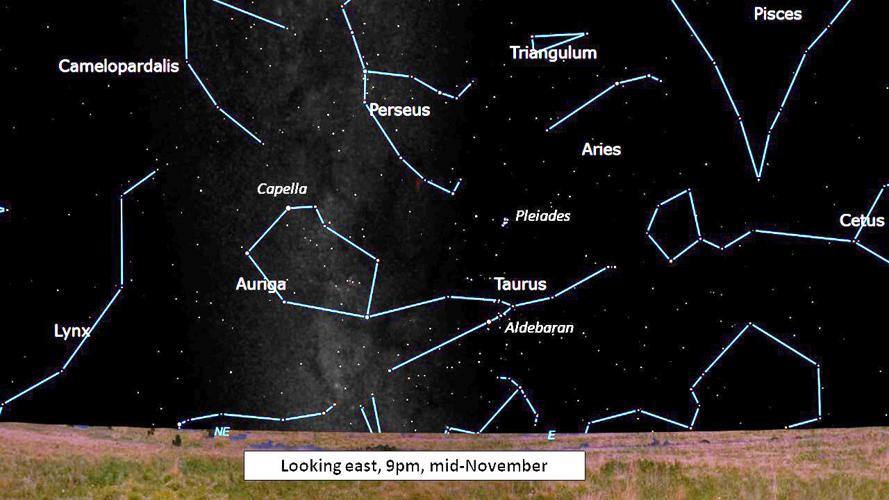
Winter constellations are beginning to peek about the eastern horizon in November. Look for Auriga, the charioteer, and its bright star Capella, low in the northeast. To the right of Auriga, find the prominent star cluster Pleiades. Check out the Pleiades with a pair of binoculars for an impressive view. As I’ve mentioned before, in Japan the cluster is known as Subaru, and the emblem on the vehicle is indeed a representation of the star cluster.
Enjoy any opportunity to view the skies in November!




Commented
Sorry, there are no recent results for popular commented articles.