
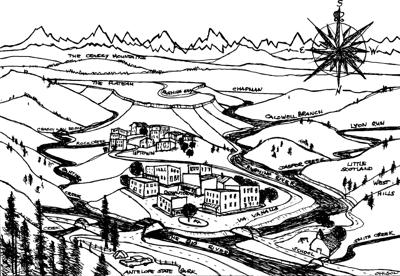
Ronnie’s Roller Rink was a local attraction from 1946 until it burned to the ground in the winter of 71-72. It had been housed in a military surplus colossal Quonset hut Uptown on Fig Avenue. It opened with the optimism of post-war America.
Initially music to skate to was provided exclusively by Wanda Chapman on a robust Wurlitzer organ. Wanda, in addition to this highly visible role, was also a silent investor in this cultural business venture. She had blue hair, loved sweaters, and in the holiday season played heavily on the sleigh bell sound effects with most of the songs she played, carol or otherwise.
Skate rentals were managed by co-owner Vicki Smith while admission and the snack bar were covered by her husband and partner Stuart Smith.
From the start business was good, and it grew better in 1956 when the Smiths leased a juke box with popular songs. Wanda protested at first, but she was getting along in years and her arthritis was painful, so they all agreed she would fall back to a shorter schedule, being Tuesday night’s couples evening and the Sunday matinee.
When rock and roll raised its mighty draw among teenagers, attendance at the Saturday matinee and the Friday night hop exploded. Eventually the Smiths began hiring live bands; the rink became the home turf of the regional favorite combo, Clark and the Upbeats.
There are a million memories from Ronnie’s Roller Rink, where we of Warhaven cruised around in circles, our local caucus race of hope and desire and dashed romances.
As it pertains to the Warhaven City Council, here is one afternoon, Saturday December 12, 1964. Picture the crowded maple floor, the blue lines of loops and figures, the red oval around the infield on which skaters performed the Hokey Pokey, a dance that was just wrapping up. Three skaters of note are present: 18-year-old Gus Chapman, 16-year-old Orin Holman, and 12-year-old George Ansbach. Gus, who is courting Bertie, escorts her off the floor for a cola and fries. George followed, craving popcorn and the attention of his female junior high classmates, optimistic on one count, discouraged on the other. Orin stood there on the red line, stretching, steady on his black leather quad skates, wondering what skateble hits would be played next.
His curiosity was quickly rewarded when the speakers blasted out “I Get Around” by the Beach Boys. Orin stepped onto his left toe stop and pushed off, skating toward the outside wall, but away from the railing, so his laps were longer and his speed was greater to “Round, round, round, round, I get around” and the band’s sharp hallmark harmonies. Orin was an observer, checking out the pretty girls of high school, smiling upon the young ones with arms akimbo, lurching for a grip on the railing, the solitary ones gliding over the circular lines of the infield. Three elementary kids sailed past him, racing, as his father would have said, “hell bent for leather.” In their next turn one of them threw an elbow, and they all went skidding and sliding down, taking George Ansbach down with them, who had foregone popcorn when he heard his beloved Beach Boys.
Orin braked, giving George a hand up.
“Thanks, Orin. Much appreciated.”
The older boy laughed. “Roller skating is one of those sports where you really do need eyes in the back of your head!”
“Yep.” He eyed the kids. “They’re just as wild at school.”
“Wait until they discover girls. You haven’t seen anything yet.”
They skate on at their own pace as the surf song ends and the Beatles’ “She Loves You” begins. The rink seems to bloat with skaters. Everyone comes onto the floor, for the Beatles were the best. It seems to Orin, at school, at church, kids were attempting to replace ‘yes, sir’ and ‘yes, ma’am’ with ‘yeah, yeah, yeah.’ A rebellion was continuing that began with blue jeans.
Bertie and Gus are skating arm in arm, looking each other in the eyes, revising the lyrics,
“I love you, yeah, yeah, yeah,” and they really didn’t care who was hearing their mild spectacle of desire. Immediately as the song ends “Can’t Buy Me Love” begins and the couple throw their heads back and wail along with Paul and John.
George has pulled over to the railing to chat with classmate Sally Clark, who had stopped to tie her bootlace. She wore a rainbow-colored tutu skirt with an orange knit top. Her skates were her own, he noticed, pink suede. “Fancy!” he thought.
Sally looked up at him, part grimace, part smile.
“Hi, Sally. Looks like you have a flat tire.”
“No, it’s just my lace that’s come undone.”
George smiles. Awkwardly searching for conversation, George asks if she’s completed her math homework.
“Oh, yeah. I did that Friday night, so I didn’t have to fret.”
She rose, towering over him. Her dark eyes bore into him. “Well, have a great day,” and skates off. George sighs. He decides it is now time for popcorn, and standing in line, the next song plays, Louis Armstrong performing “Hello, Dolly!”
Lenore Carrington DuMont glides around the rink, graceful, lean in her mid-calf red poodle skirt and maroon pearl button shirt. She veers into the infield where she reverses and performs two perfect circles before continuing her rotation around the rink.
Gus nudges Bertie, “I don’t get that Lenore. So pretty. How come nobody’s snatched her up?”
A genuine question, yet Bertie elbows him. “Because maybe she’s not dopey enough like me to fall for the first sap who smiles at her! Maybe she has the will to live her own life, not some dude’s in an office with alligator cowboy boots!”
“Those boots are ostrich!”
Satchmo gives way to Roy Orbison and as the guitar riff begins the rink floor is now packed with skaters racing in tempo to “Pretty Woman.”
The roller rink fire was a very hot blaze that went undetected until the shell had melted and all was in ruin. This early-morning disaster happened on a very frigid, snowy New Years Day, shortly after a raucous New Years Eve hop when staff just wanted to get home. The cause was determined to be an electrical short in the heating system. Instead of rebuilding, the Smiths took their insurance money, moved to Cedar Key, Florida and opened a frozen yoghurt shop.
•••
The City Council is a work of fiction, written by Jim Tindall, appearing every other week in Columbia Gorge News.


Commented