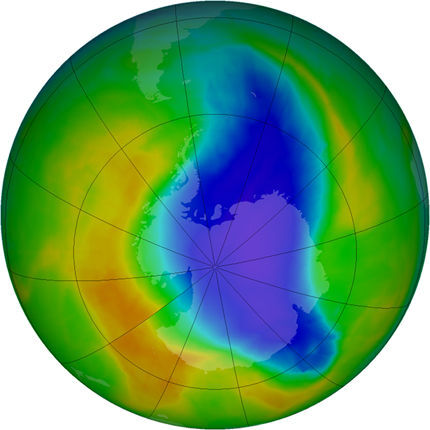
FALSE-COLOR view of total ozone over the Antarctic pole, created by the National Aeronautics and Space Administration. The purple and blue colors are where there is the least ozone, and the yellows and reds are where there is more ozone. National Aeronautics and Space Administration
FALSE-COLOR view of total ozone over the Antarctic pole, created by the National Aeronautics and Space Administration. The purple and blue colors are where there is the least ozone, and the yellows and reds are where there is more ozone. National Aeronautics and Space Administration
This September the United Nations released an encouraging update on the status of the ozone layer and the ozone hole over Antarctica. Evidence of progress in reversing ozone depletion offers good environmental news and some interesting parallels with climate change.
Ninety percent of Earth’s naturally occurring ozone resides in the stratosphere, surrounding the planet in a layer over six miles above the surface. Each molecule of ozone consists of three atoms of oxygen linked together (O3), as opposed to the two oxygen atoms making up every day oxygen we need to breathe (O2). A reactive and toxic gas, ozone accounts for only three of every 10 million air molecules.
Despite the rarity of ozone molecules, the ozone layer blocks most of the sun’s harmful UV radiation from reaching the ground. While atmospheric ozone levels normally vary slightly with the seasons, latitude, sunspots and volcanic activity, a balance is typically maintained between slow formation and breakdown. At least this was the case until the late 20th century.
During this period, a group of chemicals seemingly ideal for use in refrigeration, air conditioning, solvents and fire extinguishers grew rapidly in popularity. The best known of these were chlorofluorocarbons, or CFCs. Non-flammable, inexpensive and of low toxicity, they were also very stable -- so stable that some could linger in the atmosphere for decades or longer, until slowly broken down by solar radiation.
In the early 1970’s, two US scientists published findings supporting their theory that chemicals like CFCs could damage the protective ozone layer. When CFCs break down they release chlorine, a single atom of which can remove over 100,000 ozone molecules from the atmosphere. The release of bromine from other fluorocarbon gases appeared to be even more destructive.
Depletion of the ozone layer allows more radiation to reach the Earth’s surface, raising rates of skin cancer and cataracts, lowering crop yields and disrupting marine food chains among other effects. Industrial groups and conservative think tanks argued the science wasn’t proven, and that any steps to restrict what were now being called Ozone Depleting Substances would only harm the economy.
Despite these protests, the US, Canada, Norway and Sweden signed an agreement in 1978 banning the use of CFCs in aerosol cans.
Additional studies continued to strengthen the evidence. But it was the discovery of the ozone hole, an area of severe ozone loss, over Antarctica in the 1980s that settled the debate. The ozone hole appeared each spring over an area of millions of square miles, while less severe ozone losses were regularly measured over the Arctic and other continents.
Calls for further action accelerated, and in 1987 several dozen countries reached an agreement to regulate and restrict the use of ozone depleting substances.
This Montreal Protocol has been revised and strengthened regularly since, with nearly 200 countries now working towards recovery of the ozone layer.
Despite this relatively rapid response, ozone depletion continued to worsen through the 1990s and into the first part of this century. However, September’s UN report offers encouraging news.
Chlorine and bromine levels in the stratosphere have dropped 10 to 15 percent over the last decade. Ozone depletion has stabilized, with the ozone layer on course toward recovery by 2050 and the ozone hole fading away by — a potentially successfully outcome a mere 80 years after the Montreal Protocol was instituted. The parallels with climate change are unmistakable: a rare atmospheric gas critical to the health of the planet altered by human activity, denial of scientific evidence by special interest groups, and cries of economic harm delaying meaningful action.
Unfortunately, despite climate change’s own “ozone holes” of rapidly rising CO2 levels, melting glaciers and rising sea levels, no coordinated international response like the Montreal Protocol is in sight. The world’s response to ozone depletion is an environmental success story, and should be a role model for climate change.
The necessary steps were challenging, required decades to show an impact, and the outcome wasn’t always certain.
Perhaps most importantly, delaying action could only lead to greater harm and diminishing hopes of eventual success.
Feel free to submit any comments on this article or suggestions for new topics to fcscience@qnect.net.




Commented