
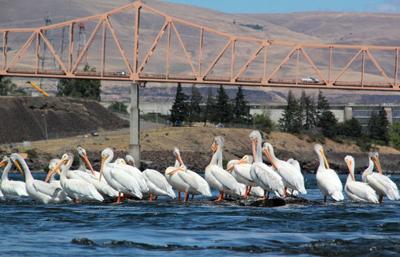
Growing crowds of large white birds on rocks by The Dalles Dam have drawn plenty of notice this year.
They’re American white pelicans, and they were first spotted locally a few years ago by wildlife officials, but this summer, the population has just exploded.
Jeremy Thompson, district wildlife biologist with the Oregon Department of Fish and Wildlife, said he has received plenty of calls about the dramatic increase.
Estimates of how many birds are hanging out by the dam vary, with one caller to the Chronicle estimating there were 200, and others saying they have counted at least 100.
Scott McMullen, who paddles out to the pelicans to photograph them, said about two years ago he only saw five, then about 50-60 last year, and this year another friend counted almost 100.
He’s found them on the islands closer to Riverfront Park as well as the ones by the bridge.
McMullen can get within about 15-20 yards of them before they take flight. “I love all the stoic pristine white they display.”
These are not the brown pelicans that are found on the coast, Thompson said. These are inland pelicans and can be found in places like the Malheur National Wildlife Refuge.
“They’re huge, they have a nine-foot wing span,” Thompson said. “They are much, much bigger than you assume.”
Another caller to the Chronicle said they were a beautiful bird, pure white with black-tipped wings, golden beaks and the distinctive pelican throat pouch.
These pelicans range in what is called the Pacific flyway, which covers the entire western coast of the U.S. and beyond.
The birds found here are non-breeding adults and sub adults, Thompson said. “It was probably six-eight years ago that I noticed the first little group of them setting up shop for the summer.”
But “our summer population’s definitely been on the increase locally.”
“We’re sandwiched between two known breeding colonies that have been on the increase for the last 20 years,” he said. The closest breeding colony is about 50 miles east near Arlington. The next closest is 80 miles away in Portland.
While no local studies have been done, officials in Washington were concerned that increased pelican populations were preying on salmonids and found that wasn’t the case.
Tests are done by scanning pelican droppings for grain-sized metal tags put in salmonids.
“They’re pretty unique for water birds in that they actually hunt as a group,” Thompson said. “Pelicans will get together and actually encircle a school of small fish and push them together and feed on them as they come to the middle,” he said.
“We don’t know specifically what their forage component is here. We haven’t looked at that,” he said.
“But that is potentially a reason they’ve congregated here: they’ve found a ready source of prey and it could be salmon smolts, we don’t know.”
He guesses that meals are made of any schooling of fish in shallow waters. Their main diet in other areas adjacent to The Dalles has comprised of other fish and not necessarily salmonids.
It is a concern that they could feed on salmonids that are disoriented as they come through the races of the dam.
Gulls, terns and cormorants have all targeted salmonids, he said. The U.S. Army Corps of Engineers already has an active avian predator management plan at the dam, he noted.


Commented