
PARIS (AP) — New results from looking at the split-second after the Big Bang indicate the universe is 80 million years older than previously thought, but core concepts in physics about the cosmos — how it began, what it’s made of and where it’s going — seem to be on the right track.
The findings released Thursday bolster a key theory called inflation, which says the universe burst from subatomic size to its now-observable expanse in a fraction of a second. The new observations from the European Space Agency’s $900 million Planck space probe appear to reinforce some predictions made decades ago solely on the basis of mathematical concepts.
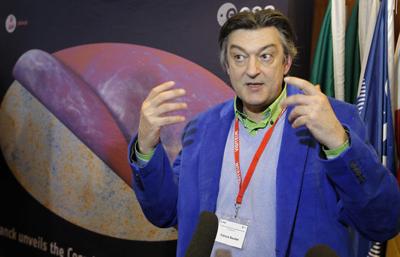
“We’ve uncovered a fundamental truth of the universe,” said George Efstathiou, director of the Kavli Institute for Cosmology at the University of Cambridge who announced the Planck satellite mapping result in Paris. “There’s less stuff that we don’t understand by a tiny amount.”
“It’s a big pat on the back for our understanding of the universe,” California Institute of Technology physicist Sean Carroll, who was not involved in the project, told The Associated Press. “In terms of describing the current universe, I think we have a right to say we’re on the right track.”
The Big Bang — the most comprehensive theory of the universe’s beginning — says the visible portion of the universe was smaller than an atom when, in a split second, it exploded, cooled and expanded faster than the speed of light.
The Planck space probe looked back at the afterglow of the Big Bang, and those results have now added about 80 million years to the universe’s age, putting it at 13.81 billion years old.
The probe, named for the German physicist Max Planck, the originator of quantum physics, also found that the cosmos is expanding a bit slower than originally thought, has a little less of that mysterious dark energy than astronomers had figured and has a tad more normal matter. But scientists say those are small changes in calculations about the universe, whose numbers are so massive.
Officials at NASA, which also was part of the experiment, said the Planck probe has provided a deeper understanding of the intricate history of the universe and its complex composition.
Krzysztof Gorski, a Planck scientist at NASA’s Jet Propulsion Lab, said in a statement that the new results “are giving astronomers a treasure trove of spectacular data, and bringing forth a deeper understanding of the properties and history of the universe.”
The Planck space telescope, launched in 2009, has spent 15 1/2 months mapping the sky, examining so-called “light” fossils and sound echoes from the Big Bang by looking at background radiation in the cosmos. The spacecraft is expected to keep transmitting data until late 2013, when it runs out of cooling fluid.
Scientists not involved in the project said the results were comparable on a universal scale to the announcement earlier this month by a different European physics group on a subatomic level — with the finding of the Higgs boson particle that explains mass in the universe.
“What a wonderful triumph of the mathematical approach to describing nature,” said Brian Greene, a Columbia University physicist who was not part of the new Planck research. “It’s an amazing story of discovery.”
“The precision is breathtaking,” Greene said in an email Thursday after the announcement. “The satellite is measuring temperature variations in space — which arose from processes that took place almost 14 billion years ago — to one part in a million. Amazing.”
Efstathiou marveled at how the Planck data was such “an extremely good match” to the theory of rapid inflation in the split-second after the Big Bang.
Inflation tries to explain some nagging problems left over from the Big Bang, which formed the universe in a sudden burst. Other space probes have shown that the geometry of the universe is predominantly flat, but the Big Bang said it should curve with time. Another problem was that opposite ends of space are so far apart that they could never have been near each other under the normal laws of physics, but early cosmic microwave background measurements show they must have been in contact.
So a few physicists more than 30 years ago came up with a theory to explain this: Inflation. That says the universe swelled tremendously, going “from subatomic size to something as large as the observable universe in a fraction of a second,” Greene said.
Planck shows that inflation is proving to be the best explanation for what happened just after the Big Bang, but that doesn’t mean it is the right theory or that it even comes close to resolving all the outstanding problems in the theory, Efstathiou said.
There was an odd spike in some of the Planck temperature data that hinted at a preferred direction or axis that seemed to fit nicely with the angle of our solar system, which shouldn’t be, he said.
But overall, Planck’s results touched on mysteries of the universe that have already garnered scientists three different Nobel prizes. Twice before scientists studying cosmic background radiation have won a Nobel Prize — in 1978 and 2006 — and other work on dark energy won the Nobel in 2011.
At the press conference, Efstathiou said the pioneers of inflation theory should start thinking about their own Nobel prizes. Two of those theorists — Paul Steinhardt of Princeton and Andreas Albrecht of University of California Davis — said before the announcement that they were sort of hoping that their inflation theory would not be bolstered.
That’s because taking inflation a step further leads to a sticky situation: An infinite number of universes.
To make inflation work, that split-second of expansion may not stop elsewhere like it does in the observable universe, Albrecht and Steinhardt said. That means there are places where expansion is zooming fast, with an infinite number of universes that stretch to infinity, they said.
Steinhardt dismissed any talk of a Nobel.
“This is about how humans figure out how the universe works and where it’s going,” Steinhardt said Thursday. “And it’s kind of a raucous time at the moment.”
Efstathiou said the Planck results ultimately could give rise to entirely new fields of physics — and some unresolvable oddities in explaining the cosmos.
“You can get very, very strange answers to problems when you start thinking about what different observers might see in different universes,” he said.
Borenstein reported from Washington.
Seth Borenstein can be followed at http://twitter.com/borenbears . Lori Hinnant can be followed at http://twitter.com/lhinnant .
Online:
ESA: www.esa.int
NASA: www.nasa.gov
Copyright 2013 The Associated Press.


Commented