After hours
Looking back 100 years, from the archives of The Dalles Chronicle.
Showers this morning becoming a steady rain during the afternoon hours. Potential for heavy rainfall. High 57F. Winds W at 10 to 15 mph. Chance of rain 90%. Rainfall near a quarter of an inch..
Cloudy with periods of rain. Low 37F. Winds W at 10 to 15 mph. Chance of rain 100%. Rainfall around a half an inch.
Updated: March 13, 2026 @ 7:04 am

Delbert Nicholson, John David Johnson, Heather Maurin, Robert Jamack, Karen Brice, Adam Bailey, Jim Shaver, Michelle and Justin Smith, Karen Brice, Terray Harmon, Bill Johnson, Mike Kilkenny, Andy Clark, Marla Budd, Ruth Pullen, Teresa Cummings and Cheryl Ortega contributed to this report.
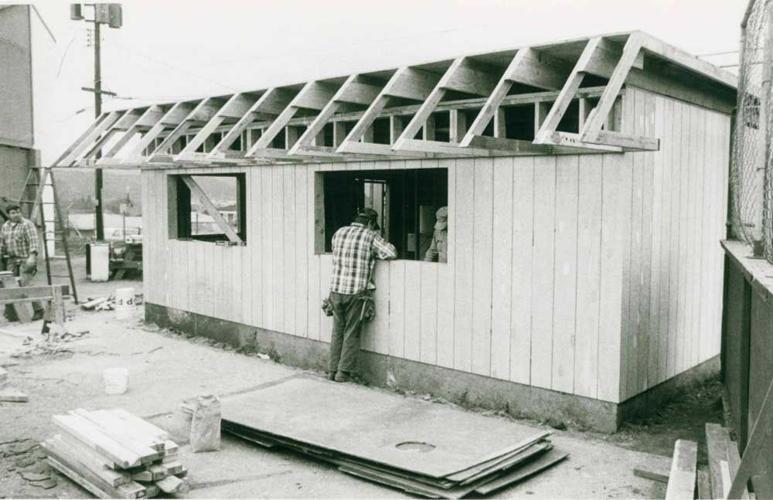
Last week’s History Mystery, above, was published in the March 3, 1983 edition of The Dalles Weekly Reminder. The caption under the photo reads, “Volunteer union carpenters Ray Chrisman and Rick Jackson are hard to work constructing the Babe Ruth Association’s new concession stand at Quinton Ball Park, part of a project started about two weeks ago. All labor on the project is voluntary, along with a good percentage of the material. Those donating time or materials include Tum-A-Lum Lumber, The Dalles Concrete, Rockline Sand and Gravel, Brown’s Roofing, the Lions Club, East Cascade Electric, Coca-Cola, Lumberman’s, The Dalles Disposal, Your Rental Center, Gordon Helyer Insulation and Bill Bliss with drywall and taping. The facility is used by high school, legion and Babe Ruth teams, and this year will enhance the Babe Ruth state tournament hosted by The Dalles.”
Callers almost universally agreed the mystery photo involved the “best burgers in town,” although one caller referenced Big Jim’s.
Bill Johnson said that growing up, the 16th Street and Quinton ball park was the only ball field in town.
Andy Clark said, “I live out in left field, been there 57 years. I don’t remember it being built, it’s been there a long time.”
Karl Vercouteren has written a blog about the ball field as part of the All Together The Dalles mural project, which features a building or location pictured on the mural destined for the south wall of The Dalles Chronicle building at 811 E. Second Street. He writes that according to C.H. Urness, John Lundell and Bob Bailey, the field was created in the mid 1950s when their fathers decided a new ball field was needed. The boys helped build the field, which incorporated salvaged materials from the Vaughn Street Field in Portland, which was demolished in 1956-57. The full article is online at www.alltogetherthedalles.com, click blog in the menu.
Sherrin Ungren and Gary Conley contributed to this report.
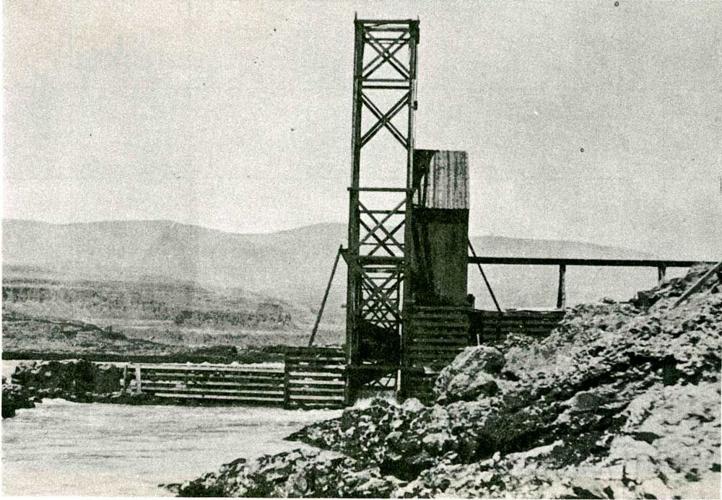
Last week’s History Mystery, above, was scanned from a glossy print labeled “Seufort Fishwheel #3” from the archives of The Dalles Chronicle.
Gary Conley noted it looked like the one on the river just above where the Shilo Inn is now. At one time, there were 51 fish wheels on the river, but they were outlawed in 1927 and “that was the end of that,” he said.
According to Wikipedia, “A fish wheel, also known as a salmon wheel, is a device situated in rivers for catching fish which looks and operates like a watermill. However, in addition to paddles, a fish wheel is outfitted with wire baskets designed to catch and carry fish from the water and into a nearby holding tank. The current of the river presses against the submerged paddles and rotates the wheel, passing the baskets through the water where they intercept fish that are swimming or drifting. A strong current is most effective in spinning the wheel, so fish wheels are typically situated in shallow rivers with brisk currents, close to rapids or waterfalls. The baskets are built at an outward-facing slant with an open end so the fish slide out of the opening and into the holding tank where they await collection. Yield is increased if fish swimming upstream are channeled toward the wheel by weirs.”
A fishwheel can be viewed at the Columbia Gorge Interpretive Center Museum in Stevenson, Wash.
The fish wheel has become a culturally-embedded tool for self-subsisting communities and Indigenous peoples of the Northwestern area of North America, and on the Columbia River there has been discussion of revising their use for their ability to live-catch salmon, allowing for retention of only hatchery-raised fish.
Delbert Nicholson, John David Johnson, Heather Maurin, Robert Jamack, Karen Brice, Adam Bailey, Jim Shaver, Michelle and Justin Smith, Karen Brice, Terray Harmon, Bill Johnson, Mike Kilkenny, Andy Clark, Marla Budd, Ruth Pullen, Teresa Cummings and Cheryl Ortega contributed to this report.
Last week’s History Mystery, above, was published in the March 3, 1983 edition of The Dalles Weekly Reminder. The caption under the photo reads, “Volunteer union carpenters Ray Chrisman and Rick Jackson are hard to work constructing the Babe Ruth Association’s new concession stand at Quinton Ball Park, part of a project started about two weeks ago. All labor on the project is voluntary, along with a good percentage of the material. Those donating time or materials include Tum-A-Lum Lumber, The Dalles Concrete, Rockline Sand and Gravel, Brown’s Roofing, the Lions Club, East Cascade Electric, Coca-Cola, Lumberman’s, The Dalles Disposal, Your Rental Center, Gordon Helyer Insulation and Bill Bliss with drywall and taping. The facility is used by high school, legion and Babe Ruth teams, and this year will enhance the Babe Ruth state tournament hosted by The Dalles.”
Callers almost universally agreed the mystery photo involved the “best burgers in town,” although one caller referenced Big Jim’s.
Bill Johnson said that growing up, the 16th Street and Quinton ball park was the only ball field in town.
Andy Clark said, “I live out in left field, been there 57 years. I don’t remember it being built, it’s been there a long time.”
Karl Vercouteren has written a blog about the ball field as part of the All Together The Dalles mural project, which features a building or location pictured on the mural destined for the south wall of The Dalles Chronicle building at 811 E. Second Street. He writes that according to C.H. Urness, John Lundell and Bob Bailey, the field was created in the mid 1950s when their fathers decided a new ball field was needed. The boys helped build the field, which incorporated salvaged materials from the Vaughn Street Field in Portland, which was demolished in 1956-57. The full article is online at www.alltogetherthedalles.com, click blog in the menu.
Sherrin Ungren and Gary Conley contributed to this report.
Last week’s History Mystery, above, was scanned from a glossy print labeled “Seufort Fishwheel #3” from the archives of The Dalles Chronicle.
Gary Conley noted it looked like the one on the river just above where the Shilo Inn is now. At one time, there were 51 fish wheels on the river, but they were outlawed in 1927 and “that was the end of that,” he said.
According to Wikipedia, “A fish wheel, also known as a salmon wheel, is a device situated in rivers for catching fish which looks and operates like a watermill. However, in addition to paddles, a fish wheel is outfitted with wire baskets designed to catch and carry fish from the water and into a nearby holding tank. The current of the river presses against the submerged paddles and rotates the wheel, passing the baskets through the water where they intercept fish that are swimming or drifting. A strong current is most effective in spinning the wheel, so fish wheels are typically situated in shallow rivers with brisk currents, close to rapids or waterfalls. The baskets are built at an outward-facing slant with an open end so the fish slide out of the opening and into the holding tank where they await collection. Yield is increased if fish swimming upstream are channeled toward the wheel by weirs.”
A fishwheel can be viewed at the Columbia Gorge Interpretive Center Museum in Stevenson, Wash.
The fish wheel has become a culturally-embedded tool for self-subsisting communities and Indigenous peoples of the Northwestern area of North America, and on the Columbia River there has been discussion of revising their use for their ability to live-catch salmon, allowing for retention of only hatchery-raised fish.
After hours
Looking back 100 years, from the archives of The Dalles Chronicle.
Information from the News and our advertisers (Want to add your business to this to this feed?)
Success! An email has been sent to with a link to confirm list signup.
Error! There was an error processing your request.
Sign up to receive notifications when a new Columbia Gorge News e-Edition is published.
Would you like to receive our news updates? Signup today!
Receive weekly updates on obituaries and death notices.
Oregon Capital Press presented by Columbia Gorge News
Receive updates on upcoming promotions and special sections.
Receive weekly updates on local sports news.


Sorry, there are no recent results for popular videos.


Sorry, an error occurred.
Already Subscribed!
Cancel anytime
Thank you .
Your account has been registered, and you are now logged in.
Check your email for details.
Submitting this form below will send a message to your email with a link to change your password.
An email message containing instructions on how to reset your password has been sent to the email address listed on your account.
No promotional rates found.
Secure & Encrypted
Thank you.
Your gift purchase was successful! Your purchase was successful, and you are now logged in.
| Rate: | |
| Begins: | |
| Transaction ID: |
A receipt was sent to your email.


Commented
Sorry, there are no recent results for popular commented articles.