
New at the Wasco County Fair in Tygh Valley this year are the All Alaskan Racing Pigs, kiddie peddle tractor races, Fun Jumpers, BRN4D Barrel Racing, and farm tractor rides.
The Babe Ruth softball girls 14U team, which went to the World Series in Florida, will ride in the Saturday night rodeo grand entry.
New in the show barns will be peacocks.
Thursday, Aug. 18, is free family day, sponsored by The Dalles Disposal. Highlights on Thursday events include a free senior citizens lunch at 11:30 a.m., entertainment by Karen Quest, and a kid’s cookie contest for those 12 and under, with bragging rights and $100 to the winner of “The Best of Wasco County.” The 4-H fashion show begins at 7 p.m.
Friday, Aug. 19, is a Best of Wasco County cake contest, open to all ages, with a $100 prize. Benny the Beaver will be on hand at 10 a.m. for photo ops. A farmer’s fun day starts in the arena at noon, and a rodeo begins in the arena at 7:30 p.m. At 9 p.m., TLS Journey, a tribute band, featuring 80s rock, will play.
Saturday, Aug. 20, includes barrel racing at 8 a.m., the Wasco County Fair run/walk at 9 a.m., and a cherry pie contest, open to all ages, in “The Best of Wasco County” contest. A goat obstacle course is at 3 p.m. The rodeo begins at 7:30 p.m. and the band Dirty Voltage, featuring 80s rock, takes the stage at 9 p.m..
Sunday, Aug. 21, starts with a free breakfast from 6:30 a.m. to 9 a.m. The 4-H and FFA livestock auction starts at 9 a.m., and the demolition derby takes place in the arena, with time trials at 11 a.m. and the derby at 1 p.m.
Everyday fun includes Fun Jumpers, available for free, fair food and vendors, farm tractor rides around the fair, exhibits and livestock. The racing pigs and peddle tractor races also take place daily Thursday through Sunday.
Cost for the fair is $6 for those 13 and over; $4 for kids 6 to 12, $4; and kids under six years are free. Season pass is $15 for 13 and over and $9 for 6-12 year olds.
For Greg and Kim Johnson, the Wasco County Fair is not only their passion, it’s their “how we met” story.
It was 28 years ago, and Kim’s mom, Mary Jo Taylor, was in charge of open class textiles at the fair. Her duties kept her late at the fairgrounds, and orchardist Ken Polehn offered to give 18-year-old Kim a ride home.
Also hitching a ride back to town with him was Greg. “I sat in the middle of a little Nissan truck,” Kim recounted, with Ken and Greg on either side, “talking about motorcycles the whole way.”
“It was a Mazda,” Greg interjected.
“And that was it,” Kim finished.
She’d been working at Dairy Queen then, and she recounted that Greg came in maybe one or two weeks later for ice cream. “I doubt it was that long,” Greg said.
A year later, on fair weekend, they were married. “Not on purpose,” Greg said. “They moved the fair.” So, that meant setting up the fair on Thursday, and getting married that Saturday.
“We always tell Ken Polehn every year that it’s his fault we’re married,” Kim said.
Only twice since their marriage has their anniversary not fallen during fair.
Sometimes, the reminder is a sweet one, like on their 10-year anniversary when there was a banner and balloons in the barn, wishing them a happy anniversary. Or the times people like Polehn and Ed DePaepe have cooked dinner for them.
Other times, they’d be scarfing fair food at 8 p.m., and the significance of the date suddenly dawned on them: “Oh yeah, happy anniversary.”
Both had grown up at the fair, Kim with the textiles and Greg watching as his grandfather, Dick Renken, oversaw open class produce. Greg inherited that duty from him.
The Johnsons haven’t missed a fair since then. As their children, Laura, now 24, and Mark, now 20, were born, they brought them along too. When they got old enough, Laura showed pigs and Mark showed pigs and goats.
As for the magic of the fair, Kim said, “I think it’s a great view into small town America.”
“It’s community,” Greg said. “It’s like having a small town all together for a week.”
“When I was a kid I’d go out to the fair with my grandpa and I got to know all the old timers and you’d see them every year,” he said. “You’d get to visit with them and catch up with their lives.”
If you go to the big fairs, that sense of community is missing because nobody knows each other, he said.
“Even the city people used to go to the fair,” Greg said. Now, “not so much.”
Kim, though, thinks that’s picking back up. “I think people are looking for that small town community more and more.”
Greg said, “A lot of people like to complain because we don’t have a real good carnival,” which he said is because a competing larger fair draws the larger carnival vendors. “But the fair isn’t really about the carnival. It’s about all the fun things and showing your animals and artwork; all the things you’ve sewn. That’s what the fair is about.”
Fair-going “is who we are, it’s what we do,” Greg said.
And the Johnsons are far from alone in this dedication, they say. “I think there’s quite a few people out at the fair that have been doing it forever who will keep doing it,” he said.
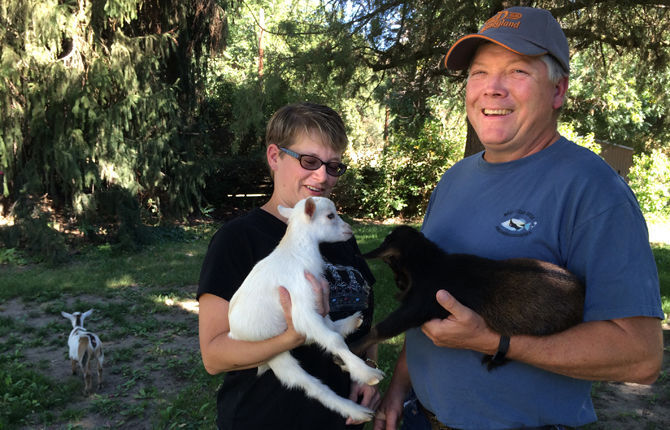
The Johnsons are superintendents of the goat barn and Greg still oversees open class produce, which includes fruits, vegetables, herbs and land produce, which also includes small grains and alfalfa. He’s also the “board man” in the pig show ring, where he keeps the peace by dropping a board between two pigs who look like they may be ready to rumble.
They first got into goats years ago when they bought a pair from Annie and Guy McAllister with hopes the goats would eat the invasive blackberry bushes at their property, Renken Farms, on Threemile Road. “They never did eat our blackberries,” Kim said.
But they were utilitarian in other ways: “I remember riding them,” offers Mark.
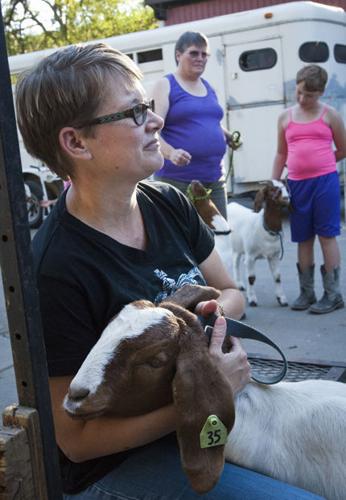
The Johnsons also bring their goats out to the fair. The comedians of the barnyard, the adorable and rambunctious baby goats serve as a huge draw to the goat barn. The Johnsons also let anybody who wants to — usually it’s little kids — show their goats, after giving them a few pointers first.
“Our main goal at the county fair is to let the little kids have fun,” Greg said.
The Johnsons show their own goats at the county fair, but also show them at eight American Dairy Goat Association sanctioned events each year, including the Oregon and Washington state fairs. This year, for the first time ever, they have won best in show twice, once with their goat Poker and once with Pepper.
In the show barns, there’s a pecking order. The goat people playfully talk smack about pigs, and everybody else makes fun of the goats, Kim joked. But it’s all done in good fun.
“Pigs are way more intelligent than goats,” Laura chides her mom, falling easily into the banter.
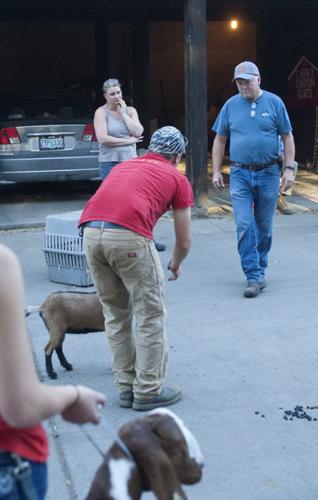
During fair week, the Johnsons park their trailer in the superintendent’s section, which is closest to the show barns. Asked for tales of excitement at the fair, they recount the drunk guy who broke into the goat barn and unpenned them all. Greg was alerted to the incident and then they had to figure out which basically identical-looking goat went where.
Another time a water main broke and suddenly a dozen “fair dads” were scrambling to repair it. Asked if they got it fixed, Greg gives a swift response: “Of course we did.”
As superintendents, they set up and decorate the barn, serve as clerk for all entries, and ensure things run smoothly. The only thing they don’t do is judge entries.
Well, actually, there’s another thing Kim won’t do. “I don’t clean out barns. That’s what Greg and Mark are for. That’s why I had children.” But there is a tradeoff: Kim is in charge of decorating Greg's exhibit area in open class produce.
Even though their kids have long outgrown 4-H, “we still spend the week out there,” Greg said.
They’ve even served as chaperones to the state fair for other kids.
Kim said, with understatement: “We like fairs.”
A week at the fair sounds like a long haul. “It’s a lot of work but it’s not a lot of work. It’s not like on the farm when you have to go out and change water,” Greg said.
“We were involved with it long before we were married, long before we had kids, and after. It’s just something we’re passionate about.”


Commented