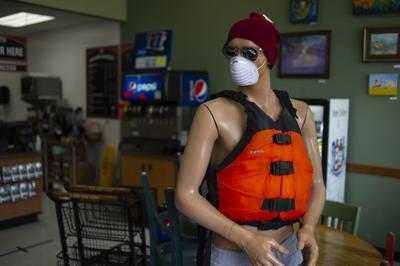
Masked as protection against the coronavirus pandemic, a "rafter" greets visitors at Maupin Market, where shoppers were asked to sanitize their hands before entering the store. Camping along the Deschutes River downstream from Maupin was open Memorial Day weekend, including the Lower Deschutes River Wildlife Area downstream from Shearer's Falls.
Masked as protection against the coronavirus pandemic, a "rafter" greets visitors at Maupin Market, where shoppers were asked to sanitize their hands before entering the store. Camping along the Deschutes River downstream from Maupin was open Memorial Day weekend, including the Lower Deschutes River Wildlife Area downstream from Shearer's Falls.
Some ODFW wildlife areas that allow overnight stays reopened to camping beginning May 20. Lower Deschutes Wildlife Area and White River Wildlife Area, both in Wasco County, are among those reopened.
Western Oregon wildlife areas don’t allow overnight camping so the change applies only to some eastern Oregon wildlife areas.
Among those opened statewide, only Elkhorn, Wenaha and Summer Lake maintain established campgrounds; the other wildlife areas offer dispersed camping.
Wildlife areas open to visitors at 4 a.m.
If restrooms are present, they may not be maintained daily and are not supplied with hand sanitizer, so visitors are reminded to bring their own supplies.
Open area include:
Bridge Creek Wildlife Area, Umatilla and Morrow counties
Elkhorn Wildlife Area, Baker and Union counties
Lower Deschutes Wildlife Area, Wasco County
Lostine Wildlife Area, Wallowa County
Philip W Schneider Wildlife Area, Grant County
Prineville Reservoir Wildlife Area, Crook County
Summer Lake Wildlife Area, Lake County
White River Wildlife Area, Wasco County
Wenaha Wildlife Area, Wallowa County
Visitors to wildlife areas and other outdoor recreation sites in the state are reminded to:
Stay home if you are sick.
Check for access before you go. Even if fishing and hunting are open, the boat ramp or natural area where you want to go might be closed. ODFW does not control access to land or facilities it doesn’t manage, so check with the land manager or facility owner where you want to go about what’s open before you leave home.
Stick close to home. Don’t travel far to hunt or fish. Wildlife areas are opening to camping but other lodging/campgrounds may not be.
Be prepared. Restrooms and other facilities may be more limited. Bring your own soap, water, hand sanitizer, toilet paper, food, etc. Buy your license online before you go.
Avoid crowds. Go someplace else if your destination looks crowded.
Practice social distancing. Keep six feet between you and anyone who doesn’t live in your immediate household, including while on a boat or at a fish cleaning station.
Wash your hands often. Keep up on personal hygiene and bring your own water, soap and hand sanitizer with you.
Pack out what you pack in. Take any garbage with you, including disposable gloves and masks.
Wildlife areas never closed to day-use, but overnight camping was closed on March 22 as part of COVID-19 precautions.
Visitors to wildlife areas are reminded they need a parking permit at many of these wildlife areas, which can be purchased online. The permit also comes with the purchase of an annual hunting license. Note that black bear and turkey hunting seasons continue until May 31 on many of these eastern Oregon wildlife areas.



Commented