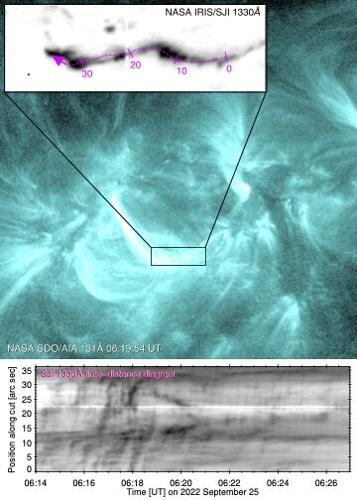
Observations of the slip-running magnetic field line reconnection in the sun's atmosphere, as seen by the IRIS (inset) and an overview of the flare by the AIA telescope on board the NASA Solar Dynamic Observatory mission. The evolution of individual ``footpoints” along the flare is depicted in the time-distance diagram (bottom plot, inverted color scale where darker is brighter), where moving bright features produce slanted traces.
Photo courtesy Vanessa Polito, OSU College of Science.
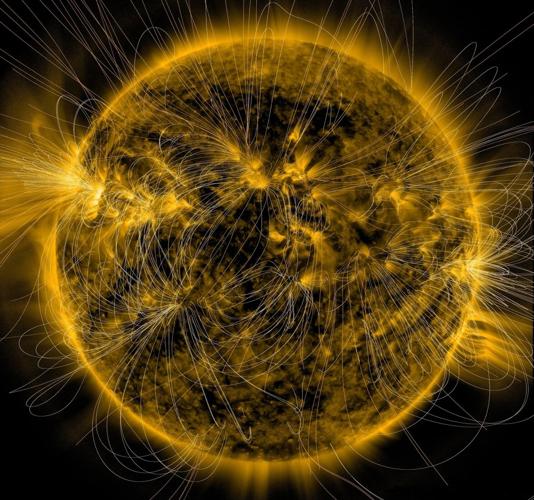
A depiction of the Sun’s magnetic fields is overlaid on an image of the Sun captured in extreme ultraviolet light by NASA’s Solar Dynamics Observatory on March 12, 2016.
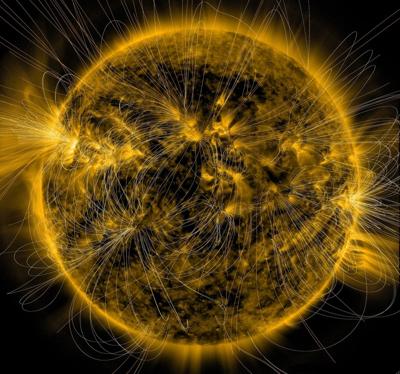
A depiction of the Sun’s magnetic fields is overlaid on an image of the Sun captured in extreme ultraviolet light by NASA’s Solar Dynamics Observatory on March 12, 2016.
CORVALLIS — A phenomenon, likened to the quick-footed movements of iconic cartoon predator Wile E. Coyote, recently proved a 19-year-old theory regarding how solar flares are created. It was identified by an international collaboration that includes an Oregon State University (OSU) astrophysicist.
Understanding solar flares is important for predicting space weather and mitigating how it affects technology and human activities, said Vanessa Polito, a courtesy faculty member in OSU’s College of Science.
“Solar flares can release a tremendous amount of energy — 10 million times greater than the energy released from a volcanic eruption,” Polito said. “Flares and associated coronal mass ejections can drive beautiful aurorae but also severely affect our space environment, disrupt communications, pose hazards to astronauts and satellites in space, and affect the power grid on Earth.”
The “slip-running” reconnections of the sun’s magnetic field lines – the term was inspired by Wile E. Coyote’s mad scrambles after the Road Runner — were observed via NASA’s Interface Region Imaging Spectrograph, or IRIS, a satellite used to study the sun’s atmosphere.
The observation of tiny, brilliant features in the atmosphere of the sun moving at unprecedented speeds — thousands of kilometers per second — opens the door to a deeper understanding of the creation of solar flares, the most powerful explosions in the solar system.
Guillaume Aulanier of the Paris Observatory, a collaborator on the research, developed the slip-running reconnection concept in 2005.
But measuring the speed of solar flare kernels had been elusive, Polito said. Kernels are small, bright regions within the larger flare ribbons that mark the location of magnetic field reconnection, areas known as footpoints where intense heat and energy release occur.
However, recently designed high-cadence observing programs, which capture images about every two seconds, revealed the slipping motions of kernels moving at speeds of up to 2,600 kilometers per second.
“The tiny, bright features observed by IRIS trace the very fast motion of footpoints of individual magnetic field lines, which slip along the solar atmosphere during a flare,” said Polito, the deputy principal investigator of the IRIS mission.
“Flares and magnetic reconnection are phenomena that occur in all stars and in different astrophysical objects throughout the universe, such as pulsars and black holes. On the sun, our closest star, we can study them in great detail as demonstrated by our study.”
A solar flare occurs when the sun’s atmosphere emits a sudden, intense burst of radiation via the rapid release of built-up magnetic energy. The energy output of a single flare is equivalent to millions of hydrogen bombs exploding simultaneously and covers the entire electromagnetic spectrum, from radio waves to gamma rays.
Observations of the slip-running magnetic field line reconnection in the sun's atmosphere, as seen by the IRIS (inset) and an overview of the flare by the AIA telescope on board the NASA Solar Dynamic Observatory mission. The evolution of individual ``footpoints” along the flare is depicted in the time-distance diagram (bottom plot, inverted color scale where darker is brighter), where moving bright features produce slanted traces.
Photo courtesy Vanessa Polito, OSU College of Science.
Flares are often associated with large expulsions of plasma – gas so hot that electrons are separated from nuclei – from the sun’s corona, phenomena known as coronal mass ejections. A flare can last from minutes to hours.
Findings of the study led by Juraj Lorincik of the Bay Area Environmental Research Institute were published in Nature Astronomy.
Joining Polito, Lorincik and Aulanier on the study were scientists from Astronomical Institute of the Czech Academy of Sciences and the Lockheed Martin Solar and Astrophysics Laboratory, where the IRIS satellite operates.



Commented
Sorry, there are no recent results for popular commented articles.