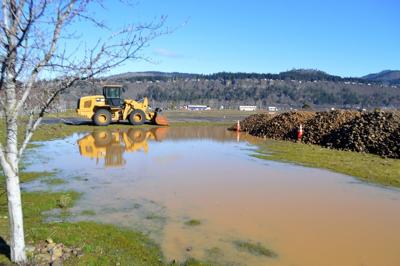
Rock piles are forming at Lot 1 in Hood River, one way the port is helping haulers offset potential increased costs of using the Hood River-White Salmon Bridge.
Rock piles are forming at Lot 1 in Hood River, one way the port is helping haulers offset potential increased costs of using the Hood River-White Salmon Bridge.
The Oregon Department of Transportation (ODOT) will impose a lower load rating on the Hood River-White Salmon Interstate bridge effective March 3, the Port of Hood River announced in a press release.
As one response to the restrictions, piles of rock and other building material are now being placed on Lot 1, the property owned by the Port of Hood River adjacent to exit 63. The port is allowing rock haulers to temporarily stage, at no cost, the piles at that location now, as a way of avoiding higher costs of hauling the same amount of material once the new weight restrictions go into effect, according to Port Communications Director Genevieve Scholl-Erdman. She said some haulers had figured contracts for trucking the material across the bridge based on one set of weight allowances, and the increased numbers of trips would cause those costs to go up. So in some cases, the material is being stored in advance at Lot 1 or at the port-owned Lower Hanel Mill property in Odell. So far, the port has four such contracts, according to Scholl-Erdman.
The new load rating is the result of a directive by the Federal Highway Administration (FHWA) requiring all states to evaluate the structural capacity of all bridges to carry Specialized Hauling Vehicles (single-unit trucks with closely spaced, multiple axles) and other load factors. Extensive structural analysis was carried out by ODOT’s engineers in 2020 on the bridge as part of this nationwide effort. The bridge is a steel truss structure that is nearly 100 years old. ODOT’s structural evaluation identified deficiencies in some bridge components that required the lower load rating.
The current maximum vehicle weight for the bridge is 80,000 pounds, or 40 tons. The updated load rating will affect most classes of trucks. It will be posted at 24 tons for Type 3 vehicles, 32 tons for Type 3S2 and Type 3-3, 22 tons for the SU4, 24 tons for the SU5, and 25 tons for the SU6 and SU7 vehicles.
The port’s bridge engineering firm, HDR, will immediately begin a detailed analysis of ODOT’s structural evaluation to identify strengthening measures needed to restore the current weight limit, and the potential cost of such measures.
“The engineering effort to determine if repairs are possible will take several months,” said Port Director Michael McElwee. “The port commission will then need to determine whether it is financially feasible to carry out those repairs.” HDR may also recommend live load testing portions of the bridge which may reduce the extent and cost of structural upgrades.
Port staff have been in contact with local commodity haulers and shippers and will work to ensure that businesses impacted by this new weight limit are kept informed as the port’s response actions are carried out.



Commented
Sorry, there are no recent results for popular commented articles.