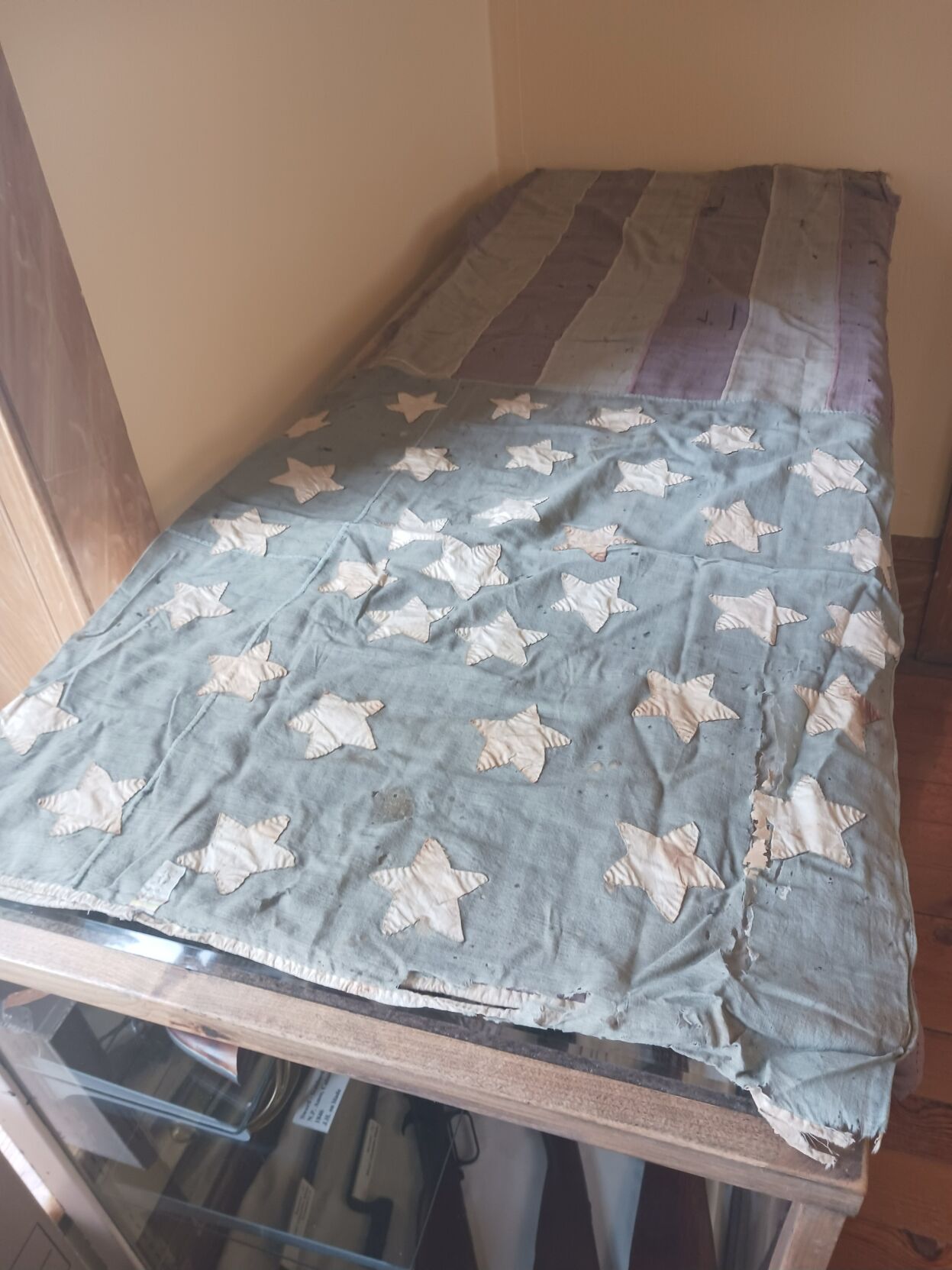
A U.S. flag, hand-sewn in 1868 by wives of “Grant Club” members in The Dalles, has been part of the Fort Dalles Museum collection since the museum's early days. The museum is working to preserve and frame what is known as the Grant Flag and is in the process of raising the needed $6,000.
A U.S. flag, hand-sewn in 1868 by wives of “Grant Club” members in The Dalles, has been part of the Fort Dalles Museum collection since the museum's early days. The museum is working to preserve and frame what is known as the Grant Flag and is in the process of raising the needed $6,000.
CORRECTION: The original article incorrectly identified the writer of the museum's historical piece quoted in this article. It should have credited Fort Dalles Museum Coordinator and Lead Historian Bob Pollock.
THE DALLES — A U.S. flag, handsewn in 1868 by wives of “Grant Club” members in The Dalles is slated to become a prominent display at Fort Dalles Museum.
But first, the Grant Flag needs professional conservation and suitable framing. And for that, museum members are raising funds through Sept. 11. As of now, the museum is halfway to its goal of $6,000. Once its preservation has been completed, museum members and visitors will be able to clearly view the flag.
The flag will serve as an important historical item at the museum and used in a variety of ways, from teaching fourth graders about Oregon history to adult descendants of those who came across the Oregon Trail.
Tax deductible donations can be made to Fort Dalles Museum / Anderson Homestead Foundation (FDMAH), mailed to Fort Dalles Museum Foundation, PO Box 591, The Dalles, OR 97058. For credit card donations, contact the museum at 541-296-4547.
The flag’s history is tied to the eventual election of President Ulysses S. Grant.
“Between 1861-1865, Civil War had convulsed the United States, and President Abraham Lincoln was one of the war’s last casualties,” said Coordinator and Lead Historian Bob Pollock in an article he wrote about the flag for the museum. "Andrew Johnson’s elevation to the office of president changed the political landscape of reunion and reconciliation between the North and the South. Johnson’s policies did not endear him to the majority of the Republican Party. By 1868, it was clear the party needed a new standard bearer. They turned instead to Ulysses S. Grant, victorious general of the Union Armies.”
He continued, “Meanwhile, in The Dalles, regular Army units had returned to Fort Dalles after the war, but by 1867 the Army decided Fort Dalles was no longer needed. However, by this time the city of The Dalles was firmly established. The Dalles tended to be politically Democratic, but there was support in The Dalles for Ulysses S. Grant, a Republican, for president in 1868.”
Pollock said that throughout the year, “Grant Clubs” were springing up around the country, often by young men who would conduct torchlit parades and other activities to promote their favorite candidate. Such a club formed in The Dalles, according to an Aug. 26, 1868, article in the Oregonian.
“According to Lulu Crandall, one of the earliest historians of The Dalles, it was her father, Z. Donnell, who organized the club, along with C.C. Crandall, C.M. Grimes, and C.H. Reed of Dufur, who were also members,” he said. “Their wives’ hand-sewed a very large American flag for their use. Lulu stated, ‘Their flagstaff and rallying point stood on the knoll just west of the hospital.’”
Crandall donated the flag to the museum in the early 1900s.



Commented