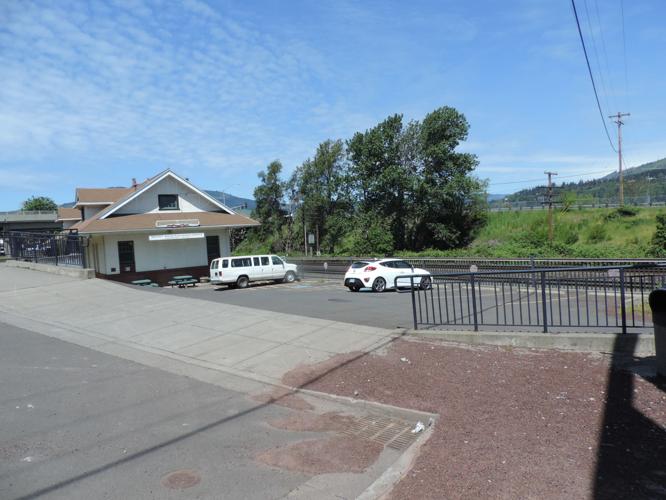
REMEMBERING: Hood River train depot today, the scene of the 1942 evacuation of Japanese-American citizens, and a commemorative sign marking the event. Several local efforts are underway to recognize important historic people of the area.
REMEMBERING: Hood River train depot today, the scene of the 1942 evacuation of Japanese-American citizens, and a commemorative sign marking the event. Several local efforts are underway to recognize important historic people of the area.
Kirby Neumann-Rea
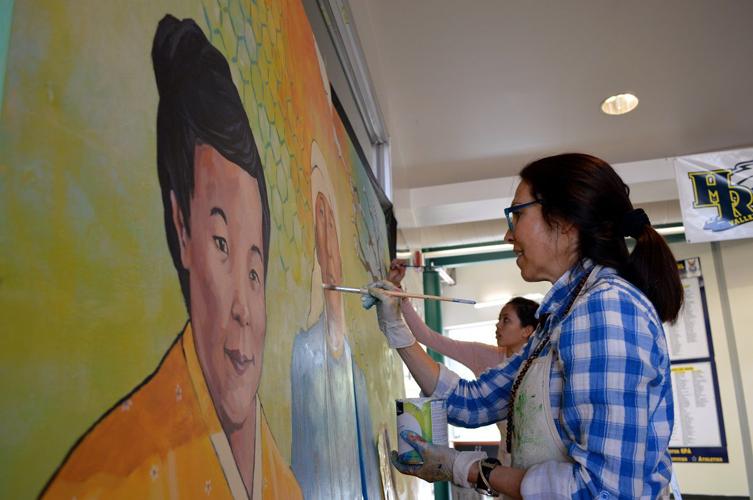
HRVHS students, with artist Michelle Yamamoto, are creating a new mural honoring Issei poet Shizue Iwatsuki and tribal elder Indian Martha.
Patrick Mulvihill
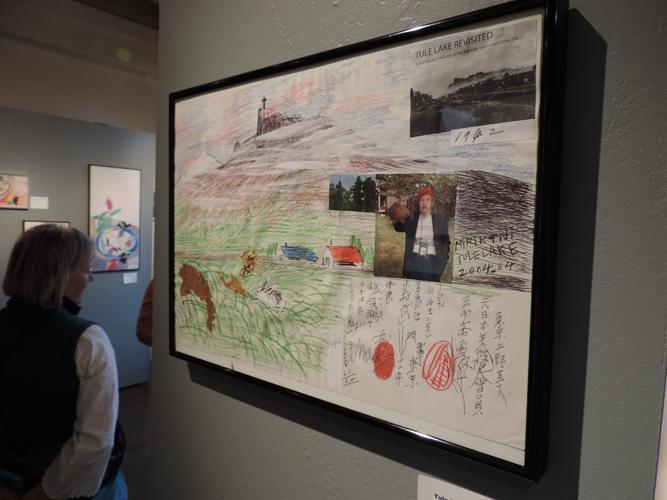
Tule Lake internment camp remembered by artist Jimmy Mirikitani, at Columbia Center for the Arts.
Where today eager riders board trains to see the scenic splendor of the Hood River Valley, an event Saturday will recall a darker time at the downtown train station in Hood River.
The noon “Train of Tears” ceremony will look back at the day hundreds of local citizens — people who happened to be of Japanese heritage — were forced on trains at the same location and taken hundreds of miles away to desert internment camps. This was commemorated in 2007 with a “Train of Tears” plaque installed on the east wall of the depot by The History Museum of Hood River County and the Gorham Babson Fund of the Gorge Community Fund.
“This was truly a heart-breaking moment in Hood River history,” states the plaque.
“Train of Tears” event starts at noon Saturday at First and Cascade streets; parking is available at the MHRR and Springhouse lot, and at the Hood River News lot, Sixth and State.
The public, and Mid-Columbia Gorge Nisei in particular, are invited to attend the gathering to honor the memory of what happened on May 13, 1942, at the Hood River train depot (now Mount Hood Railroad).
That day, authorities forced 503 people onto a train and sent them to Pinedale and other camps, where most would live for the next four years. This was the result of President Franklin Roosevelt’s Executive Order 1066 — that thousands of people of Japanese heritage, most of them U.S. citizens, were to be removed from “military areas” extending 100 or so miles inland and be housed as prisoners in desert detention camps.
“Seventy-five years ago, a total of 503 residents — including 334 American citizens — were forced to leave the Mid-Columbia valley during World War II. They were uprooted simply because of the color of their skin,” said Dr. Linda Tamura, a Pine Grove resident whose parents were among those sent away.
On Saturday, Tamura will provide the welcome and introduction. There will be a reading of letters written in the 1940s by Nisei students in the camps to teacher Vienna Annala in Hood River.
County Commission Chairman Ron Rivers and Mayor Paul Blackburn will read resolutions commemorating the evacuation.
“The community has joined in the efforts of affirming that this will never happen again to any person, of any gender, faith, ethnicity, culture or country of origin,” said organizer Maija Yasui. “The county commissioners and city council have shared those beliefs through resolutions affirming the rights of all human beings, which will be read at the ceremony.”
Hood River Valley High School students have organized an annual award honoring a high school senior for their activism in work throughout their young lives. The first recipient of this annual award will be announced at the Hood River train station. A stone with their name, class year and word that describes their activism will be placed in the Yasui Legacy garden on the north library lawn (Georgiana Smith Gardens) when the legacy garden is completed this summer.
In addition, the leadership class at HRVHS has been working on the identification and making of the tags which will be flown at the train station on Saturday. Each tag has the name, the identifying number and the age of the person of Japanese ancestry who was forcefully removed from Hood River County 75 years ago.
“These students have learned about the forced evacuation, the injustice suffered and represent the next generation standing against such discriminatory actions by our governing bodies,” Yasui said.
Kendra Wilkins, the great-grand-niece of Minoru Yasui, will sing the Tom Russell song “Manzanar” at the Saturday event. This folk song captures the loss and suffering of the Japanese immigrants during their removal and imprisonment in concentration camps for over three years. It also captures their belief in the principles of our founding fathers and the Constitution of the United States. This was the guiding principle of Minoru Yasui, who fought for the civil rights of all human beings throughout his life.
Yasui added, “We greatly appreciate the Mount Hood Railroad for providing this venue for the ceremony. We also wish to thank Springhouse Cellars for opening their doors and providing seating for some of our senior citizens.”
The ceremony will include quotations and poetry from local Issei and Nisei. They’ll be read by family members and friends: Sandi Abramson, Sam Asai, Barbara Bellus, Sydney Endow, Gordy Sato, Jerry Sumoge, Neil Watanabe, and Kendra Wilkins.
“Today more than ever, there’s special meaning in reflecting on those horrendous times,” Tamura said. “How can we act on the pledge that we and other school children made each day at school: ‘with liberty and justice for all’? What can we do to protect all citizens today?”



Commented