
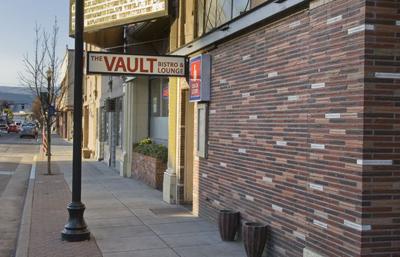
Facing the state’s second recommendation in two years to revoke his liquor license, Vault Bistro and Lounge owner Michael Leash has negotiated a settlement to surrender his license and sell the business.
Leash, who is the corporate principal of Park Avenue Jones, Inc., the named licensee, also accepted a letter of reprimand and has until May 1 to complete the sale or lose the license to operate.
Christie Scott, OLCC spokesperson, said the state appears to be in the process of issuing a new liquor license to SB Harris LLC, which provides its address as 209 E. 2nd St., the same address as the Vault.
According to the Oregon Secretary of State website, the registered agent for SB Harris LLC is Susan Barr Harris of The Dalles.
Leash confirmed Thursday that he is in the process of selling the downtown business to Harris.
“I feel that is the appropriate thing to do,” he said. “This new owner has every intention of being more than compliant while operating under more reasonable restrictions. It is her top priority to save and potentially create new jobs in our community and this sale allows me to focus on other projects.”
Leash said he proposed the alternative arrangement to the cancellation out of a sense that nothing he could do, despite his best efforts, was going to appease the OLCC.
“We self-imposed higher standards than their restrictions and had four people walking around monitoring things, we really were doing the best that we could to make this work,” he said.
His statement is backed up by letters of support from The Dalles Police Chief Jay Waterbury, Wasco County District Attorney Eric Nisley and Gene Parker, city attorney, submitted to OLCC last year.
“I have seen a tremendous improvement in the operations and a willingness to be a good community partner,” stated Waterbury in his Oct. 26, 2015, letter. “The Vault is diligent in managing their role in The Dalles Downtown area and in being one of two bars that is open after midnight.
Waterbury also said: “I have personally seen how Michael and his staff have been very pro-active in trying to improve the operations of the business. Our department has seen a decreased interaction with the Vault over the past four years and has seen a significant decrease in the last 18-24 months. I see no reason to cancel or suspend their license.”
The letter from Waterbury ended by saying that his officers had observed the Vault’s security team outside the bar every weekend night helping patrons get taxi rides home. Because of that diligence, he said there were
fewer DUIs than in past history.
“We regularly hear how the security staff at the Vault asks patrons to take cabs or walk home if they had had more than a couple drinks as part of their responsibilities,” stated Waterbury.
Nisley’s letter dated Aug. 6, 2015, was similar in nature.
“It appears to me that the business is operating within the bounds of the law and is not presenting any larger public safety issue than any other similar business in town,” he wrote.
“Given the significant improvement, I would encourage the OLCC to continue to permit the operation of this business.
“ It is refreshing to see an owner of a business step up and work hard to meet and exceed expectations.”
Parker wrote on Aug. 10, 2015, that Leash had “worked diligently” to address liquor license
and law enforcement issues.
“It is my understanding that, as a result of Michael’s efforts, and his cooperation with law enforcement personnel, that these issues have been addressed and the business is operating successfully within the parameters of Oregon law, which regulates establishments that serve liquor,” he said.
Leash said OLCC never responded to the letters submitted by these officials.
OLCC recommendations to cancel liquor licenses are a rarity, according to Scott.
The state first recommended Leash’s liquor license be cancelled in May 2013, when OLCC alleged a history of “serious and persistent problems” with the bar.
That cancellation was averted with a settlement when Leash accepted a $4,950 civil penalty and restrictions on his liquor license in May 2014.
Then, in March 2015, the state again recommended the license be cancelled, citing four violations, including two violations of the 2014 restrictions.
The violations of the restrictions were reported just two months after they were put in place, according to OLCC records.
The restrictions barred giving patrons more than one container of alcohol at a time, and also forbade customers from entering or re-entering the bar after 1:30 a.m. on Friday or Saturday nights.
Leash said one of the incidents the bar was disciplined for involved a Samoan man who had difficulty speaking and understanding English coming back inside after 1:30 a.m. to get an answer for why he had been asked to leave.
“I felt like I owed that to him,” he said.
An OLCC report stated that on July 27, 2014, multiple patrons were observed having more than one container at a time and multiple patrons were allowed to enter or re-enter the bar after 1:30 a.m.
The March 2015 letter said those were the “second and third violations of this type within two years.”
Those violations are Category I, considered the most serious.
The third violation was allowing people to provide private security without a needed state certification. That is a lesser Category III violation, and was the second of its type in two years.
The fourth violation was for allowing a visibly intoxicated person to consume alcohol, as observed on July 27, 2014.
That is also a Category III violation and constituted the third such violation in that category.
Scott said selling to a visibly intoxicated person is a hard case to make. “We have to prove that they knew they were visibly intoxicated,” she said.
After Leash got the recommendation to cancel in March 2015, he requested a hearing.
The settlement occurred before the hearing took place, Scott said.
“The benefit of not having your license cancelled is that it makes your ability to sell your business better,” she said.
If the liquor license had been cancelled “the new person coming in would have a lot more hoops to jump through to get a liquor license,” she said.
Leash said that he could refute many of the allegations of wrongdoing made by OLCC but, in the interest of not creating future problems for the Vault, he declined to do so.
Scott said the state has safeguards in place to ensure a former licensee who has surrendered a license cannot still maintain
a role in the new busi-
ness.
For example, the new applicant goes through a thorough background check and investigation. The OLCC also looks at the management structure and who has a financial interest in the business, and the person who surrenders a license cannot have a management or financial interest in the new business, Scott said.
She said surrenders of licenses are not that common.
Other bars in The Dalles have had more limited trouble with the OLCC. In 2013, the Windy River received a letter of reprimand for serving to a visibly intoxicated person, Scott said.


Commented
Sorry, there are no recent results for popular commented articles.