
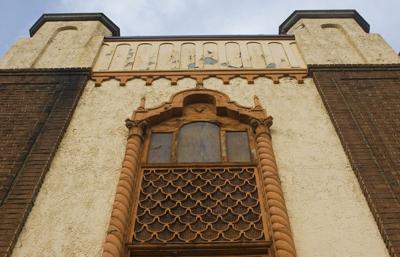
City officials are reviewing three proposals for revitalization of the Granada block; one for a hotel conference center, another for a cultural/performing art facility and the third establishing an archeological dig site for tourism and education.
The review team includes: Mayor Steve Lawrence; Gary Rains, the city’s development director; several staffers and Greg Weast, a member of the advisory committee for the Columbia Gorge Urban Renewal Agency.
Rains said there were initially five proposals but two were pulled so there are now three on the table.
“None of the proposals are complete so we are in the process of gathering other information before we move them forward, probably with some type of recommendation,” he said. “I think the city may be interested in working with more than one developer and there may be several.”
He said all of the proposals seek to have three vacant buildings owned by urban renewal turned over for developed little to no cost, which is unlikely to occur.
“I don’t think we are going to give these properties away,” said Rains.
“Urban renewal looks at the future, so the challenge is figuring out how to fit the pieces of the puzzle together to create more economic opportunity, bring more people into downtown, and bring in more taxes.”
The urban renewal board, comprised of city councilors, purchased the Granada theater several years ago for $365,406, paid $380,000 for the Blue Building and $475,315 for the Recreation Building, all in the same block of Second and Washington streets.
“If we can take buildings that are sitting empty and turn them into something that brings more people downtown and encourages other business growth then we will have done everything we were supposed to do,” said Rains.
Once he and other staffers believe the proposals are ready to be vetted, they will be forwarded to the agency’s advisory board, possibly with a recommendation about how to proceed.
“I’m hopeful that will be later in February,” said Rains.
HOTEL REVISTED
Michael Leash, previously lead of Rapoza Development, is back with a new proposal for a hotel/conference center complex under the new name Granada Block Hotel Development, LLC.
The city decided last year to not extend Rapoza’s agreement for exclusive negotiations due to missed timelines tied to Leash’s quest for funding. Instead, the elected body opened the door for other proposals to revitalize the “blighted” area.
Leash’s new proposal, like the old, centers on a $25 million project and financial documents show a signed term sheet for $14 million in debt and $8.5 million in funding through a federal immigration investor program known as EB-5.
His team is comprised of Walsh Construction, LRA Architects, JRA Architecture, Urban Resources, Inc., Wave Hospitality Advisors, Inc., Venture Entertainment, Hilton Hotels, Granada Hilton Investors and Permier Capital Associates, LLC.
Leash outlines that Walsh is listed by the Portland Business Journal as the 11th largest general contractor and construction firm in the region, and LRS Architect as the third largest firm in the region and specializes in historic renovation, restoration and adaptive re-use.
Phase one of the proposal involves construction of a 117-room Hilton Garden Inn in a convention center with a rooftop terrace overlooking the Columbia River and city. Also included is a contemporary restaurant and bar in a casual setting with mid-range prices.
Hilton has indicated in a letter dated Dec. 17, 2015, its interest in having a presence downtown.
PLAN DETAILS
The hotel footprint of about 32,698 square feet would be located in the Recreation building next to the theater.
The conference and activity space of about 7,000 square feet would be built on the Blue Building site and accommodate about 500 people for conferences and 350-375 for banquets.
The total complex has an estimated square footage of about 135,000 square feet.
When the hotel is at full capacity with double occupancy, GBHD envisions nearly 340 guests.
Also planned is about $1.5 million in renovation and restoration of the Granada, which was built in 1929. Plans included façade repair on the full exterior, refurbishing of the lobby, care and seating area, with the addition of a state-of-the-art sound and visual systems for movies, music and live performances.
Phase two centers on a mixed-use project within the complex that includes retail, commercial and/or residential development with some parking on the lower level of the building.
Additional parking would be provided in a structure built on First street that will be built by the city and provide spaces for hotel guests, as well as members of the public and other development downtown, such as residents of apartments planned for the former Tony’s Town and Country building.
To get started, GBHD wants to use $1 million in state funding (Rep. John Huffman has offered to ask the Legislature for these dollars) and additional urban renewal dollars for demolition, façade restoration, asbestos removal and relocation of the alley, as well as a continuation of the First streetscape, and parking garage.
Leash projects the cost of the parking structure as $6.4 million and wants $3.7 million of urban renewal dollars used to cover the public portion of the project. He wants to see the $2.7 million shortfall paid for by a revenue bond with the debt repaid over 20 years by room taxes from the hotel, which he estimates will bring $9.4 million in revenue to the city during that time.
GBHD also proposes a daily or hourly fee for parking, or possibly a small tax per seat for people using spaces to attend events at the Granada and nearby Civic Auditorium.
BUILD TEAM
Construction of the hotel would be facilitated by Urban Resources, Inc., which is led by Randy Boehm of Portland, who has more than 35 years of coordinating design and building plans for large developments.
Some of Boehm’s previous projects include the Columbia Gorge Discovery Center, Portland Japanese Garden, Crocker Art Museum in California and Hampton Inn in Portland’s Pearl District that will be completed in 18 months. Walsh Construction of Portland will supervise building activities.
The company’s area of expertise is high-end complex renovation and hospitality construction, including Skamania Lodge in Stevenson; Tetherow Resort in Bend and the Bandon Dunes Resort in Bandon.
Wave Hospitality Advisors, headquartered in southern California, will help to get hotel, restaurant, spa and leisure facility services set up. Like Boehm, Wave’s resume includes a long list of references, including the Esperanza Resort in Cabo San Lucas, Mexico, Hotel Grand Union in Manhattan, N.Y., and the St. Regis Aspen Resort in Aspen, Colo. JRA Architecture and Planning, Inc., of Coeur d’Alene, Idaho, will take the lead on drawing up plans for the in-fill development.
Joining LRS is Dale Johnson of JRA Architecture and Planning, Inc., of Coeur D’Alene, Idaho, who is an experienced and Hilton-approved architect.
GBHD is evaluating three management companies to oversee operations of the complex.
The proposal outlines that interviews will be held for the top job 16-18 months from the opening of the hotel, which is anticipated for January of 2018.
Cultural plan
Charles Gomez and Debra Liddell of Watseka, Ill., have also submitted a proposal for renovation of the block.
They want to establish a cultural/performing arts center in the theater and convert the Recreation and Blue buildings into shops and eateries.
Their plan is to keep all three structures intact and recycle material removed during restoration as art, either in a community garden established on First Street behind the Granada or on the outside walls of the Blue Building.
They are offering to make an immediate $25,000 local bank deposit to initiate the project and said they have $135,000 of working capital on hand.
A $1 total purchase price to the city for the properties, which is negotiable, allows rents at retail shops in the Recreation and Blue buildings to be lower than average in the area and that, in turn, will solidify new businesses, according to Gomez/Liddell.
“We are focusing on re-usage and repurposing of this property,” they said.
FESTIVAL SITE
Their budget for the Granada work will cover non-structural restoration of the theater, including installation of state of the art sound, lighting, projection, staging, props, marquee and services.
They envision user-funded raised flower and vegetable beds and seating that possibly includes benches from the bowling alley. The parking lot at First and Court streets would become the site of community fairs and other types of festivals and celebrations.
“Maybe an artist would want to design a bowling ball plein art structure for placement in the gardens (to be discussed later). Soliciting of local artists will be made in offering materials resulting for demolition for use in their art,” is outlined in the Gomez/Liddell plan.
Gomez/Liddell anticipate having the gardens in place within the next couple of months and the festival area ready by summer. The theater would open by July and the café and ice-cream parlor on site by September.
Two dollars per ticke for every national act performing at the theatre would be donated to the city in perpetuity under their proposal. By the holidays of 2016, Gomez and Liddell expect to have the Recreation repurposed and ready for parties.
Liddell and Gomez have received accolades, including being named Watseka “Citizens of the Year” for work renovating a similar 375-seat historic theater in Watseka, Illinois, and boosting tourism.
Heritage Site
Eric Gleason, a local architect with 37 years of experience and co-owner of the structure known as the Chinese Building (named for early business occupants) at 201 East First Street is proposing in-fill of six tax lots on First, three on the east side of his building and three to the west, a total of about .60 acres.
He wants to systematically develop some of the now vacant lots with buildings of similar size, scale and function as those present in the 1880s, while at the same time retaining some off-street parking.
The first order of business from spring to fall of 2016 under Gleason’s proposal would be negotiating with urban renewal for purchase, acquisition and redevelopment of the now abandoned parking lot at the northeastern corner of the Granada block.
Gleason said he has funds “in hand” to complete the initial phase of redevelopment.
He envisions additional private funds, urban renewal dollars and other grants being sought to complete subsequent phases of development. He then wants to improve parking lots on the remainder of the block, with expenses offset by the lease of spaces, and income generated by utilizing the lot for commercial and community function, such as vendor booth space during Cherry Festival.
“As business conditions improve (on Second and Third streets) and additional parking becomes available, the parking lots can gradually be redeveloped with the construction of compatible commercial and/or residential buildings,” he said.
EARLY HISTORY
Gleason wrote that, during the early days of The Dalles, First was the main street, the commercial core of town.
He said the street was lined with large hotels and many commercial ventures, including restaurants and saloons. After the business base relocated to Second and Third streets to get farther away from the railroad noise and hazards, Gleason said First Street entered a period of gradual marginalization and decline.
He said the Granada block frontage became a concentration of Chinese owned and operated businesses. As the structures were lost to fire or demolition, they were not replaced.
“This proposal offers an opportunity to reverse nearly 100 years of decline by gradually, sympathetically and systematically rebuilding portions of the vacant northern half of the Granada block, while at the same time renewing and retaining adequate off-street parking,” stated Gleason.
He said a unique opportunity would be provided at the site to integrate active publicly accessible archaeological excavations with an ongoing public archaeology/heritage tourism program.
On Gleason’s project list is façade restoration and interior improvements to his Chinese Building so it can be put back into commercial use.
If enough funding is found, phase two of Gleason plans — from spring 2017 to fall of 2019 — include reconstruction of the Chew Kee and Company store, built in 1879 and demolished in 1958.
Phase three focuses on the western parking area with public archaeological test excavations are part of the tourism project and timed to coincide with cruise ship visits.
Information gained during this time, said Gleason, could be used as part of a larger study focused on the feasibility of reconstructing buildings in the area as a separate phase of work.
Gleason has worked on excavations throughout the western United States He plans to bring in professional architects and engineers as needed.


Commented
Sorry, there are no recent results for popular commented articles.