
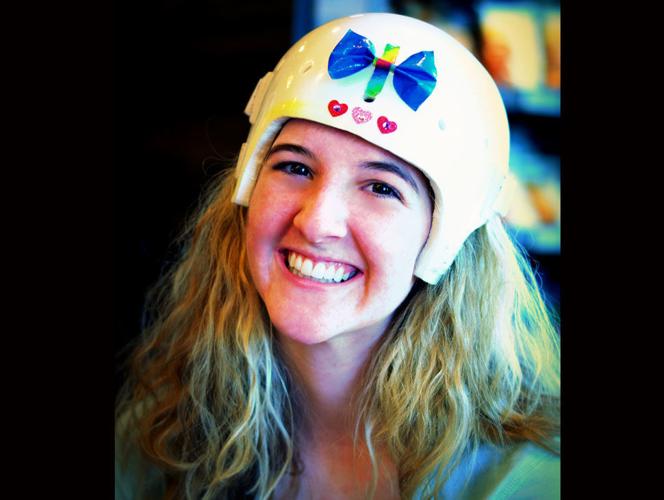
Traumatically brain injured in a New Year’s Eve ski accident, The Dalles-Wahtonka High School grad Maya Barnard-Davidson will soon reach an important milestone in her recovery.
Not long after her accident, a section of the front of her skull was removed to allow her brain to swell, preventing further injury. She’s had to wear a helmet to protect her brain ever since.
This week, on Thursday, May 7, she will have the skull piece put back and can finally ditch the helmet.
It’s an important step psychologically, said her mom, Candy Barnard-Davidson. Doctors say “It just makes them feel so much better, mentally… Maya is very aware of it, she doesn’t like to wear the helmet all the time; it’s hot.”
One astonishing fact Candy learned is that most insurance companies consider replacing the skull bone as non-covered cosmetic surgery, but fortunately, Maya’s family’s insurance covers it.
The surprisingly large piece of skull has been stored in a bone bank.
Maya is excited for the surgery, saying, “I’ll look normal again and I’ll have all the bones back in my skull.”
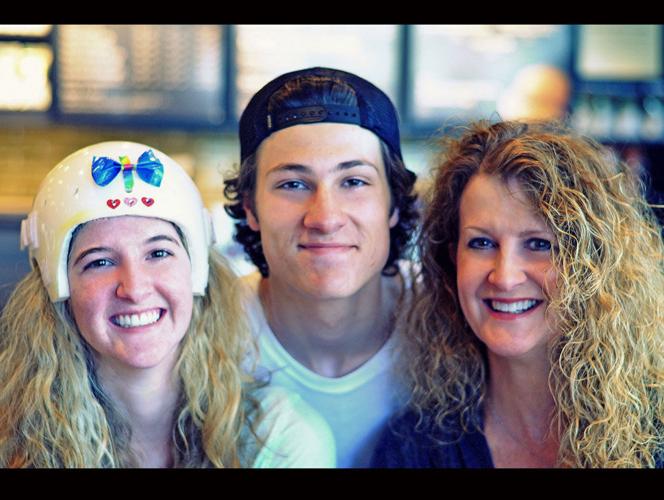
Maya talked to the Chronicle recently at one of her favorite haunts: Starbucks, where she’s partial to the white chocolate mocha.
As is typical on her outings, on her way into Starbucks she ran into somebody she knew. Her mom, who accompanies her everywhere, asked Maya if she knew who he was, and she did, rattling off his name. They chatted for a bit and promised to keep in touch.
Inside, Maya is seated with her beverage and her radiant smile rarely leaves her face. She tells a reporter, “I’m really glad to see you.”
“Maya just loves people and people love Maya,” her mom said. A trip to Fred Meyer will often involve meeting someone new who has been praying for her and following her story on her mother’s Facebook page.
A hug is bound to factor into the occasion. “I think she really enjoys getting hugs and giving hugs,” Candy said.
“The whole community has been so great with Maya, just the outpouring of care, and kind words and well wishes and prayers, it’s so nice,” she said.
Maya was finally able to attend her church, Gateway Presbyterian, on Easter Sunday. She hopes someday to become a pastor, a decision that came about because of her accident. “When I was in my coma,” she said, “I did talk to God. It was very comforting.”
She wants to become a pastor to “share the happiness of God with everyone.”
The family hopes she can resume college in the fall, taking at least one class.
Maya, who turns 20 in June, was a champion skier in high school, ASB president and salutatorian of her class of 2013. She was interested in pursuing biology before her accident.
On New Year’s Eve, in icy, socked-in conditions, she plunged off an embankment on the Reynolds Run at Ski Bowl, hours after another expert skier died on the same run. Another skier saw her fall and she was lifeflighted to OHSU in a coma.
She was in a coma for three weeks, and in the hospital for a month. She spent another six weeks in a rehab facility before coming home for outpatient therapy.
She sees three different therapists — physical, occupational and speech — twice a week in The Dalles. In a month or so, they’ll see if she’s progressed enough to take intensive day-long therapy several days a week in Portland.
She said of her therapies, “I do enjoy them, but they don’t ever put me through tough things.”
Her mom wonders if that’s a bit of a stretch. Therapy is exhausting for Maya, she said — and even for Candy as a bystander. The cognitive work is more draining than the physical work.
That cognitive strain is called “brain fatigue,” and comes as she works to relearn everything from days and months to how to make toast.
She gets “super confused,” she said, about how to go about everyday things.
Maya has a symptom called “brain neglect” in which things on her left don’t register with her. For example, when she first wrote the numbers on a clock face, they all bunched up around the 4 o’clock spot. Therapists said it would gradually improve, and now, the numbers have stretched to where the rest get clustered at 8 o’clock.
She’ll also do math problems, but not the ones on the left page, for example. If she’s touched with her eyes closed on her right or left side separately, she can recognize each, but if both sides are touched at once, her brain only recognizes the right side.
Her mom asks her what frustrates her the most about her situation, and she said, “The fact that I got in the accident in the first place.”
Maya needs someone to walk with her everywhere because she’s still at risk for falling. Her physical therapy works on her coordination, movement and strength by giving her challenges like talking and walking, or bouncing a ball while walking.
Occupational therapy involves everyday living matters like making change, cooking, and remembering what you set out to do. One memorization trick Maya has learned is to say the plan out loud, and write it down as she says it.
Speech therapy is working on multiple things, including strengthening her voice, which remains soft and a little hoarse.
With a frontal lobe injury, there is “no filter” to the things a patient says, Candy said. Therapists have told Candy “It takes a lot of self-esteem to work with brain injury patients because they will tell you exactly what they think.”
But in Maya’s case, exactly what she thinks tends very much to the positive, and sometimes veers toward zany. Once she said, “It sure is nice to wear clothes,” but usually she’ll lavish compliments on her mom. “She’ll tell me I’m a professional cook, a professional driver.”
“She’s so sweet, just really sweet. Which I’m really thankful for,” Candy said. “I guess a lot of times head injury patients are very angry; bad language.”
If Maya lets a bad word slip, “she smiles and apologizes right away if she thinks she’s done something wrong. She wants to be helpful all the time.
“She’s always in such a happy mood, always very positive about things,” Candy said. She’s aware of her brain injury and talks about how she wishes she could heal faster. But “her therapists and doctors are just astonished at how much progress she’s made. She still has a long road ahead of her, but she’ll get there.”


Commented
Sorry, there are no recent results for popular commented articles.