
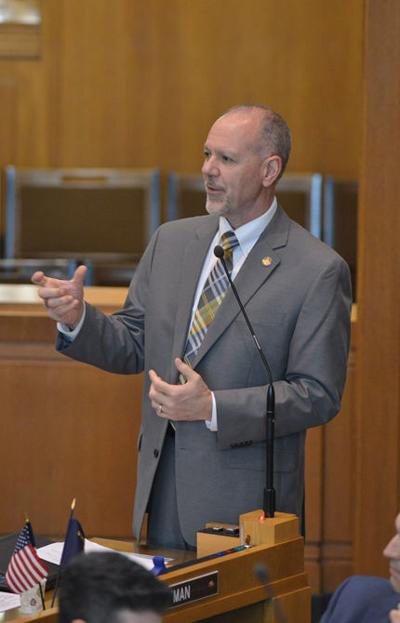
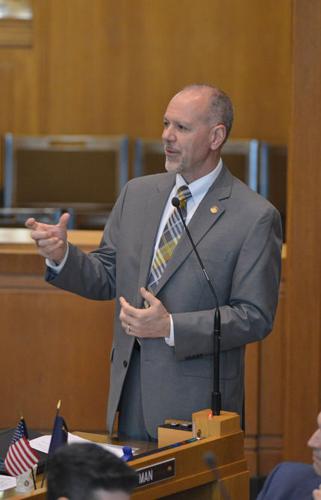
Rep. John Huffman, R-The Dalles, has made headlines in recent weeks for being the chief sponsor of a bill to stop citizens from weaponizing drones, which is also prohibited for law enforcement agencies.
The debate on House Bill 4066 begins Monday, when the 78th Oregon Legislative Assembly convenes for the 2016 session of about 35 days.
“This bill will be a product of my permanent UAS (Unmanned Aerial Systems) work group, which is always trying to find the balance between nurturing an industry that brings economic benefits and protecting people’s privacy, as well as public safety,” said Huffman.
Receiving less attention is Huffman’s proposal that Oregon join a national initiative to amend the U.S. Constitution for campaign finance reform.
He wants to stop elections from being influenced, and even decided, by big money interests from outside the state.
“This is another issue with bipartisan support,” said Huffman. “In polls, nine out of 10 Americans have identified the influence of political donors and special interest groups as being detrimental to our election system.”
House Bill 4066 will prohibit operation of drones that are capable of firing a bullet or other projectile, directing a laser or otherwise being used as a weapon.
A person who violates that rule will be charged with a Class A misdemeanor and subject to penalties.
It will also be unlawful for a person to use a drone to direct a laser at a manned aircraft in flight, crash into the plane or interfere with a takeoff or landing.
To protect citizen privacy, Huffman is also seeking to have public agencies establish policies and procedures for the use, storage, accessing, sharing and retention of data recorded by a drone.
Agencies have to set limits on how long data will be retained and how it will be handled.
These guidelines have to be posted on the agency’s website so they can be reviewed by the public.
Drones used by law enforcement, land management entities and others have to be registered with the Oregon Department of Aviation, which may impose a penalty of up to $10,000 per violation.
A warrant must be sought for images or other information obtained through use of a drone to be admissible in court. Pictures and data obtained without the warrant cannot be used to establish reasonable suspicion or probable cause to pursue a judicial proceeding against an individual.
The state Fish and Wildlife Commission is charged under HB 4066 with adopting rules that prohibit the use of drones for angling, hunting and trapping, or interfering with others engaged in these activities.
“Last summer, we had some problems with drones that made it clear more rules were needed,” Huffman said. “Every year, my work group looks at how unmanned systems are evolving across the U.S. and in Oregon and we want to make sure that we are keeping up with challenges that are occurring.”
House Joint Memorial 201 on campaign finance reform calls for Congress to hold an amendment convention as allowed in Article 5 of the U.S. Constitution.
“I don’t think the founders ever intended to have special interest groups and big political donors override our democratic system,” said Huffman.
He said similar measures have passed in California, Vermont, Illinois and New Jersey. Twentyfive other states will be considering the same resolution this year.
Huffman said the Supreme Court ruling in Citizens United versus Federal Election Commission in 2010 — along with other high court decisions before and after -- removed restrictions on the amount of independent political spending.
He believes the problem of campaigns being steered by huge donors has gotten worse — and it is time for action.
“These decisions have resulted in powerful economic forces having unjust influence that supplants the will of the people by undermining our ability to choose political leadership, write our own laws and determine the fate of our state,” is written in HJM201.
Article V provides two methods for adding amendments. Congress can introduce them or states can initiate a convention.
The state-initiated review has never been successfully used. Two-thirds of the states, or 34, must petition Congress for action, which federal officials are obligated to do.
Any amendments approved at the convention must be ratified by three-fourth of the states.
Congress decides whether state legislatures or state conventions will ratify these amendments.
Under the Congressional method of amendment, a two-thirds majority vote in both the House of Representatives and the Senate is needed.
Approved amendments must then be ratified by three-fourths of the state legislatures or special state conventions, as Congress determines.
Over 10,000 amendments have been introduced into Congress since 1789. Only 33 have been approved. Of these, 27 have been ratified and added to the Constitution, according to Wikipedia.
In addition to pursuing passage of these bills, Huffman will be kept busy as a member of Attorney General Ellen Rosenblum’s Public Records Task Force.
He said the amount of money now charged by some public agencies for administrative costs associated with records requests from citizens has become unaffordable.
“We want to see some uniformity in process and cost,” he said of the group’s mission.
Huffman, who was in broadcasting for 22 years, said members of the media are represented on the task force, which he views as a good thing because they will be proponents of First Amendment rights.
He is also serving on a task force under the Oregon Department of Forestry that is charged with looking at ways to change forest practices to prevent catastrophic wildfires while still protecting resources.
“We will be looking at how to do a better job of prevention and how best to allocate funding,” said Huffman.


Commented
Sorry, there are no recent results for popular commented articles.