
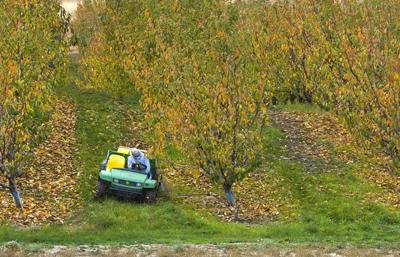
Last fall’s devastating frost reduced the 2015 cherry harvest by 50 percent overall but Megan Thompson, field representative for Oregon Cherry Growers, said some experts expected the return rate to be much lower.
“I think it went better than expected overall,” she said.
The year began with thousands of trees that had been killed by an early fall freeze, followed by an unusually warm spring — which caused a labor shortage.
As if that wasn’t enough to deal with, orchardists then faced a mite infestation. The insect known as the two spotted spider mite sucks vital juices from leaves, which can lead to an early leaf drop and stunt the growth of the tree.
Thompson said trees had to be sprayed with a pesticide to take care of the insect problem.
“It’s not such an uncommon flare-up but it made for a challenging end to the season,” she said.
Trees have also been sprayed in recent weeks with a nitrogen and boron mix, which increases winter hardiness and improves growth and cherry production during the next growing cycle.
Fruit trees accumulate carbohydrate and nitrogen reserves in the buds, bark and roots prior to leaf drop.
These remobilize as flower buds, new shoots and expanding spur leaves, according to a report by the Oregon State Extension Service.
Boron helps trees in dry soils with natural deficiencies, such as those found in Wasco County, develop a stronger system to produce higher quality fruit.
In a recap of the year, Thompson said farmers who lived on Threemile and part of Mill Creek Road had several thousand trees killed or heavily damaged by the November 2014 cold spell, so they suffered crop losses.
Most affected were Sweetheart and Regina cherries because these varieties ripen at the end of the harvest season so the trees had not yet gone dormant when the cold spell hit.
Trees damaged by frost had weak fruit buds and produced cherries about half the ideal size needed for the export market.
Thompson, who serves as a liaison between OCG and 60 farm families, said harvest also turned out better than expected given the hot dry weather that moved up harvest.
“This is the earliest that I’ve seen,” she said of her 16 years in the business. “We had some struggles because of the stress caused by heat on some varieties.” The risk of an early harvest had the potential for late-spring rains, said Thompson, and farmers were relieved to get through May and early June without that damage added to their winter fallout.
“We had a couple of scares but it all worked out okay,” she said.
The extreme heat stopped the growth process because trees went into a type of drought survival mode, which resulted in very little photosynthesis or nutrient uptake.
Thompson said local farmers and their workforce did a good job of getting fruit off the trees as quickly as they could in hot dry weather and that helped keep the quality up.
When harvest started in May, some of the 5,000 laborers coming from California still had children in school and were not ready to move because it was too late in the academic year to get them enrolled in area schools.
The situation had Migrant Education administrators scrambling to get programs up and running.
Overall, Thompson said growers managed to overcome the obstacles in their path and had a decent harvest in 2015.
Area orchardists and their crews are now busy pruning trees to keep the canopy open next year so light can penetrate and feed nutrients into the system through leaves that will sprout in the spring.


Commented
Sorry, there are no recent results for popular commented articles.