
Pete Shepherd, interim director of the Oregon Department of Environmental Quality, said one of the most important things he’s learned in his more than 23 years of public service is “the importance of listening to people speak from their heart in the place where they live.”
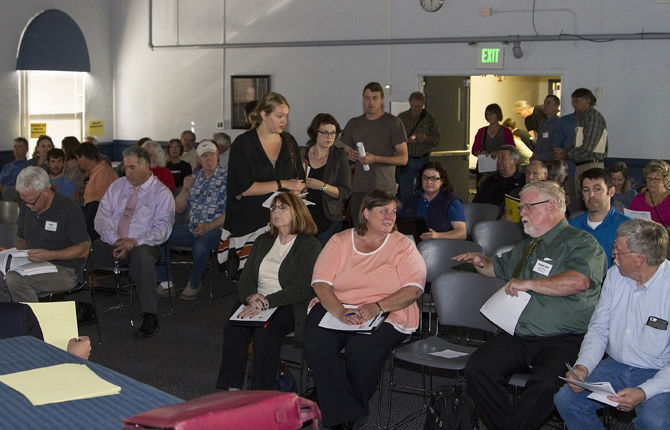
He got plenty of that Tuesday evening as around 120 people packed into the Columbia Gorge Community College lecture hall to discuss a Mutual Agreement and Order between DEQ and Amerities West—the railroad tie plant in The Dalles.
Representing The Dalles Air Coalition, Rachel Najjar and Michael Byrne led off the meeting.
Najjar, who lives on the bluff above the tie plant, choked up as she talked about her two young daughters who have become “violently ill” when exposed to naphthalene — a chemical in creosote, which Amerities uses to treat railroad ties.
“My children and the people of The Dalles have a right to be healthy and not to be poisoned,” she said. “It’s not up to me to prove to you that this is an imminent public health threat, it’s up to you to prove that it’s safe and protect all of the public. We all deserve environmental justice, am I right, Pete Shepherd?”
Najjar believes her kids have gotten sick because of a gene variation called G6PD that destroys red blood cells and causes hemolytic anemia, which she said can occur from high levels of
naphthalene exposure.
On May 16, Najjar said she was told by a G6PD specialist to move.
“To deny testing to children of color and allowing the risk of fatality to occur to anyone with G6PD that comes to The Dalles makes this an issue of environmental racism,” Najjar said. Her children are of African descent.
“The MAO does not come close to addressing these health issues that are related to the toxic chemical cocktail creosote and the suggestions made to Amerities to reduce odors are laughable,” Najjar said. “It’s not just an odor nuisance when you’re taking care of sick kids. This is a public health emergency. As a mother, my deepest concern is that this could end up killing my children.”
Byrne, who opened with “Remind me not to follow Rachel,” also spoke against the MAO.
“The MAO being revealed tonight only recycles what Amerities told us they’d do seven years ago,” he said.
Byrne also said he had a sample of naphthalene for anyone who wanted to smell for themselves what had triggered all of the odor complaints.
The rest of the public meeting was supposed to be presentations by DEQ followed by a question and answer session but those in the crowd couldn’t wait to have their voices heard.
Less than a minute into welcome and introductions, Rep. John Huffman, R-The Dalles, who coordinated the meeting, was asked, “Don’t you take money from the railroads?”
Sen. Ted Ferrioli, R-John Day, who was also in attendance, got the same question later in the evening.
Huffman responded that he’d received more than $8,000 from the railroad industry in his nine years in the state legislature but around $1 million from citizens, including many in the room.
“We’re not talking about citizens,” a man in the crowd shouted. “We’re talking about the railroad. We’re talking about creosote and railroad ties.”
Huffman responded, “If you want to attack me personally, that’s fine. I represent you guys.” He added, “Not a single donation has ever affected my vote.”
“Of course it wouldn’t,” another man said sarcastically. “Are those people giving you money because they’ve got nothing better to do?”
Ferrioli responded, “I’m certain that I have received contributions from the railroads but probably not as much as Mrs. [Hillary] Clinton has received from Wall Street,” which drew laughter from the audience.
Linda Hayes-Gorman, eastern region administrator for DEQ, presented the MAO and the different measures Amerities has agreed to take to reduce odors.
She said the MAO was entered into voluntarily because DEQ hasn’t made the determination that Amerities is a nuisance. DEQ wanted a public meeting before the order was signed but Amerities declined. Hayes-Gorman said DEQ agreed so it could begin working on the problem.
Even though the MAO was entered into voluntarily, it is now mandatory and Hayes-Gorman noted this is the first time DEQ has entered into a forcible agreement with a facility to reduce odors since the odor reducing strategy was adopted in 2014.
“I’ve heard from some of you that it’s too little too late,” Hayes-Gorman said. “I want to assure you DEQ takes odor complaints in The Dalles seriously as well as any area.”
“Then why do you think we are lying?” someone in the crowd fired back.
Sarah Armitage, DEQ air toxic specialist, went over relevant benchmarks, including the .03 micrograms per cubic meter for naphthalene, which is based on a one in a million excess cancer risk, exposed over a lifetime.
After someone in the audience interrupted with, “It’s a guess,” Armitage said the benchmark is based on scientific data and was set by an advisory committee in 2006. DEQ has 52 benchmarks for cancer and non-cancer but they are not regulatory standards.
Brian Boling, lab manager for DEQ, began to present data from air monitoring done in The Dalles on Sept. 7, 2011 and Feb. 7, 2012, but was also interrupted.
“Were they [Amerities] processing the normal amount of railroad ties at the time or were they processing less?” someone in the crowd asked.
“With all due respect, we live here 365 days a year,” another man in the audience said. “I think this is rather meaningless. I think we should get on to what you are going to do.”
When Huffman tried to get the presentation back on track and said the audience would get their questions answered later in the meeting, a woman replied, “that’s how you control it,” and a man followed with, “Exactly, break us into smaller groups and dilute everything.”
Boling said the previous study was done by Amerities, which drew more groans from the crowd, but said the air monitoring by DEQ beginning next month would be a “much longer and more robust study.”
Boling showed that naphthalene concentrations measured in residential areas in The Dalles ranged from .88 in 2012 and 13 micrograms per cubic meter in 2011. Levels measured directly adjacent to Amerities’ cooling pad ranged from 53 in 2012 to 290 in 2011.
And then he was interrupted again.
“The data is meaningless,” said a man in the crowd. “It’s like oranges and apples. How does it compare to the benchmark?”
After Huffman said the presentation was moving forward, the man responded, “He [Boling] is presenting data. He should present it properly.”
Boling then gave details for new air monitoring that will begin the first week of June at two locations near the plant—the Wasco County Public Works office on 2705 East Second St. and an east bluff site directly above the drip pad at Amerities—as well as a third location at St. Mary’s Academy to determine background measurements.
Boling said the samples will be pulled every third day over 90 days and then for two weeks straight.
When someone asked if Amerities knew these dates and how they could be sure the tie plant wasn’t skewing the results, Boling responded, “The 90-day period of time is just the start. It allows us to look at that data and if we need to, change up how we do our monitoring.”
Najjar then asked Boling, “You don’t think the results that were taken in 2011 and 2012 were enough to prove a health threat?” Boling responded, “Those samples aren’t enough to assess it against an annual benchmark. It [new samples] allows us to look at what a long term health exposure is going to be because that’s what we need is a long term.”
“For my kids, it’s short term,” Najjar said.
In the final presentation of the evening, Leah Feldon, DEQ manager of compliance and enforcement, showed a timeline of Cleaner Air Oregon, which kicked off in April and over 20 months will create guidelines to allow the DEQ to take into account human health when issuing permits.
Currently, permits are solely based on emissions.
For more information, go to cleanerairoregon.org.
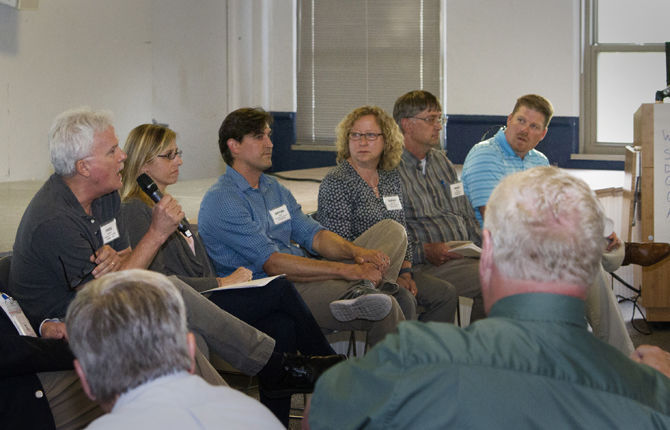
After the presentations, a group of experts that included Feldon, Boling, Armitage, Shephard, Air Quality Manager Mark Bailey and Dr. Fred Berman, of the Oregon Institute of Occupational Health Sciences, answered questions from the audience written on notecards for nearly an hour.
Huffman said Oregon Health Authority toxicologist David Farrer had planned to be at the meeting but got “rerouted.”
The question that got the biggest applause from the crowd came from Najjar: “Why has DEQ allowed creosote, a hazardous air pollutant that has been banned by EPA for every other application, to be used by the railroad industry with little or no consideration for public health?”
As the experts looked at each other wondering who would respond, Byrne said, “Nobody can answer that question.”
Shepherd then took the microphone.
“This is a core question that frustrates us as much as probably some of you,” he said.
“You don’t live here,” a man from the crowd shouted.
“Fundamentally, what we can do is enforce the law,” Shepherd continued. “We are not in power simply to say we think it’s a bad idea to have creosote on railroad ties, unless the law authorizes us to do that.
“None of you would want us in power to do that. We have to obey the law. If your objection is that railroad ties should never be allowed to be treated with creosote, then there’s a remedy for that—a law that says that, and when that law comes down to us, we’ll enforce it.”
Some of the answers from the panel were hard to hear, particularly those from Bailey, who the crowd constantly told to speak clearer and louder. Huffman apologized for the sound system.
Huffman was asked why air monitors were so hard to get. He said it was a prioritizing of the state budget and that he supported getting an additional $2.5 million for more monitors.
“For those of you who think I’ve been standing by doing nothing, I’ve been doing a lot of work behind the scenes to move this process along,” Huffman said. “We got this accomplished in February and that’s why we are getting additional monitoring out here this summer.”
When asked how the results of the new monitoring would be posted, Hayes-Gorman said there would be news releases and another public hearing.
“We need to get the information to as many people as we can,” added Huffman.
“Or we just need action,” a woman in the crowd shouted. “You come into the room and tell us not to infight. We’re not infighting. We have nothing against each other. Industry can work together with citizens. Filter their emissions, we all work happy together and no one loses a job.”
“And that’s exactly what we are working on,” Huffman said.
“With zero public input,” someone else in the audience replied.
Since the benchmark is 0.3 and the median naphthalene level found in urban areas throughout the United States due to freeway emissions is .95, Kris Cronkright asked for another number.
“All we’ve heard is we can’t enforce the benchmark because it’s too conservative,” she said. “Can we have another number please that we can use?”
Shepherd said that would be the job of Cleaner Air Oregon.
When Cronkright pointed out Cleaner Air Oregon wouldn’t have a benchmark until the end of 2017, she asked, “What is the point of our 90-day study? What scientific numbers are you going to use to show us that the numbers you are receiving is or is not a health risk for us? What’s the number? What’s the benchmark?”
One of the DEQ experts pointed to a benchmark of 3.75 set by the Centers for Disease Control.
Shepherd said the MAO allows DEQ to “amend the schedule and conditions in this MAO upon finding that such modification is necessary to protect public health,” and he said that would be determined by the air monitoring.
One of the final sets of questions was, “Why does Huffman accuse residents of falsifying DEQ reports?” and “Why would residents do this?”
Huffman said he didn’t know why residents would falsify reports but told Cronkright in an email he was concerned because Amerities received a complaint last week from someone on the west end of town when northwest winds were blowing 25 to 30 mph.
“I’m sorry,” Huffman said. “That’s not possible. During 25 to 30 mph winds, when you’re half a mile west of the plant, it’s not possible.
“My comment to Kris was I just want to make sure the reporting that we’re doing is honest so that we can come up with the right conclusions.”
Although every question wasn’t answered during the meeting, Huffman said all the note cards would be kept and gone over again to make sure every question was addressed.
Representatives from DEQ also stayed in the lecture hall an additional 30 minutes after the meeting to answer questions one-on-one.


Commented
Sorry, there are no recent results for popular commented articles.