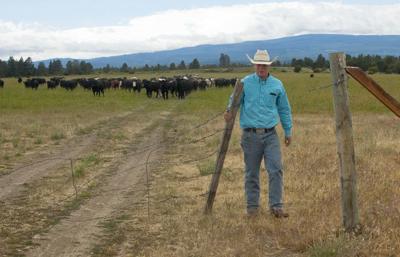
BRENDON JOHNSON shuts a pasture gate after checking his herd of stocker cattle. He trains each new group to follow his feed truck, which eliminates the need for a second cowhand.
BRENDON JOHNSON shuts a pasture gate after checking his herd of stocker cattle. He trains each new group to follow his feed truck, which eliminates the need for a second cowhand.
The “Grass is always greener…” adage has been proven true on the Wamic ranch of Brendon Johnson where cattle will follow his truck out of a lush pasture in hopes of getting an even tastier meal.
“It takes about two weeks to train them; they are very curious and once one of them is moving, they’ve all got to move,” he said.
Teaching several hundred steers – castrated males — to associate his vehicle with prime forage pays off for Johnson when it comes time to sell the 420-head herd.
On a hot August day, his grandfather, Jack Stevens, maneuvers 203 steers from the pasture to the corral by using a truck. Walking in a line behind the vehicle to round up strays is Johnson, his hired hand, Jacob Mueller, Hervet Martinez and Manuel Hernandez.
Martinez and Hernandez work for Stevens, who has run a nearby ranch for 25 years.
“This is how we like a cattle drive,” said Johnson about the relaxed movement of the herd, which will soon be transported to Easterday Farms, a feedlot in Pasco, Wash.
He and his father, Jim, partnered last year for the stocker cattle operation at the White River Ranch on Woodcock Road.
Occasionally, a curious steer will stop in its tracks to watch Johnson and his crew or one of the animals will make a mad dash for freedom.
“Hey, hey” is called softly by Mueller, or another cowboy, when a steer refuses to cooperate, but mostly the men are silent.
Johnson quietly explains that each of the steers defecate an average of 12.2 times per day and even more when stressed.
That becomes a serious issue when a steer can lose 1 percent of its body weight per hour under duress. Johnson’s sale contract with Easterday estimates a total of 3 percent “shrinkage,” during the handling process.
“We don’t want them to lose weight if we can prevent it,” he said. “Keeping everything calm is important on days like this but it is also something we try to do in everyday operations because reducing stress also lowers mortality and sick rates.”



Commented
Sorry, there are no recent results for popular commented articles.