
The Dalles City Council is lighting up to the idea of making it a little bit easier for businesses to find a place where they can sell recreational marijuana.
On Monday, the council agreed to move forward with new language in a proposed general ordinance that regulates “the time, place and manner” of marijuana sales in the city.
The changes would increase the amount of land potentially available for the sale of recreational marijuana by allowing retail marijuana outlets not only in industrial zones, but also in areas of the city zoned for commercial/light industrial uses.
It will revisit the issue at its July 25 meeting.
Proposed “buffer zones” that would prohibit sales of recreational marijuana within 1,000 feet of churches, schools, day care centers and parks have placed severe limits on the areas where marijuana businesses could be located.
“It’s an interesting thing about The Dalles,” said Dick Gassman, the city’s planning director. “Because it’s a linear city, we don’t have a lot of distance between parks and schools and the commercial areas. It would be hard to get 1,000 feet away from some of these facilities.”
Councilor Russ Brown said he did not see why cultivation and processing of marijuana should be subject to the same buffer zones as retail sales outlets.
“It doesn’t seem that it would have any bearing on anything,” Brown explained. “I don’t see it (production and processing) as having an impact on schools. There is little traffic for processing and growing. It’s not like there’s a big picture window with kids at the window watching plants grow.”
“You could have a buffer for retail but not for growing and processing,” Gassman said. “This is an opportunity to decide.”
Another issue that has complicated the discussion revolves around whether the Salvation Army facility at 623 E. Third St. qualifies as a church because it holds worship services.
Mayor Steve Lawrence said that question could have a big impact on Columbia River Herbals, an existing marijuana store in the downtown business district at 609 E. Second St.
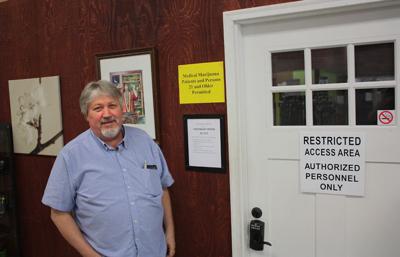
Norm Brock, owner of Columbia River Herbals, opened his business last September, selling medical marijuana. He recently began selling marijuana for recreational use as well, but he would not be allowed to continue to sell recreational marijuana after the end of the year if the Salvation Army were categorized as a church and the 1,000 foot buffer remained in effect.
“It’s problematic if Salvation Army qualifies as a church,” Lawrence said. “If a buffer is there, then basically it would stop his (Brock’s) retail operation.”
Lawrence said he did not believe the Salvation Army should be considered a church.
“It’s a thrift store,” Lawrence said.
Gene Parker, attorney for the city of The Dalles, suggested dropping churches from the ordinance as a way to get around the problem.
“My recommendation, because of the difficulty to ultimately make that determination as to if it’s a church or not, is for churches not to be included,” Parker said.
Parker added that if Columbia River Herbals wants to sell recreational marijuana, “it’s only a problem if the Salvation Army challenges it.”
“There could be a challenge either way. It’s probable it will be challenged no matter what we decide,” said Gassman.
The council reached a consensus to revise some of the language in the proposed marijuana ordinance and bring it back for a vote on July 25.
The council requested three main revisions. First, to drop licensed day care facilities and churches from inclusion in proposed buffer zones for retail marijuana operations; second, to allow production, processing and wholesale marijuana operations in commercial light industrial districts as well as in industrial zones, as long as they are at least 500 feet from schools and subject to a conditional use process; and, third, allow the hours of operations of retail dispensaries of marijuana to be from 10 a.m. to 8 p.m. instead of from 10 a.m. to 6 p.m.
On Tuesday, Brock said he was pleased the city seemed to be responding to concerns he raised regarding the viability of his business.
“The interaction between the city council and us has always been positive,” Brock said.
Brock pointed out that his business would suffer greatly if it were to be prevented from selling recreational marijuana.
“I’m happy they don’t want to prevent us from progressing,” he said. “I realize this is a tough decision for them, with a lot of deep emotions. But the city has been great to work with, and if the vote in July goes this way, it’s a great thing.”
Parker said the July 25 council vote is likely to be the final vote on the ordinance.
Only four of the five councilors were on hand for Monday’s discussion. The missing councilor, Dan Spatz, has opposed marijuana issues in the past, Brock said.
“We are still researching an issue related to whether the vote to adopt the ordinance would have to be unanimous for the ordinance to be approved on July 25,” Parker said.
“If the ordinance is finally adopted on July 25, it would become effective 30 days after its adoption.”


Commented
Sorry, there are no recent results for popular commented articles.