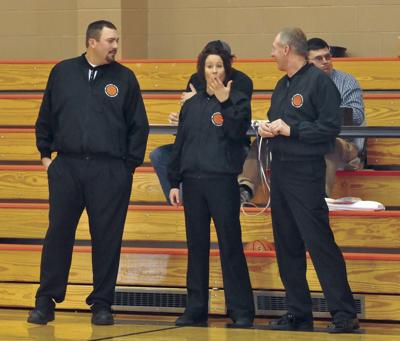
Basketball officials (pictured from left to right), Brad Carnine, K'Lynn Lane and Eric Shrum have a discussion moments before the start of a Sherman girls’ basketball game.
Basketball officials (pictured from left to right), Brad Carnine, K'Lynn Lane and Eric Shrum have a discussion moments before the start of a Sherman girls’ basketball game.
There are many positives to having more officiating eyes on the field or court for various youth, middle school and high school games — call accuracy, player safety and having a better-flowing game are just a small part of what could be a successful transition in Oregon hoops athletics.
The state of Washington has implemented three referees on the hardwood since 2005 and 35 other states have been utilizing a bigger crew.
Dufur High School Athletic Director Jack Henderson said Oregon has used three officials on an emergency basis for several years, but it has not been widespread.
Overall, Henderson, who is the Dufur girls basketball coach, has been supportive of this change.
“As the high school game has become a quicker paced game, three people can cover the floor without quite as much sprinting, so that is a positive, as well as the fact that the vision of the floor should be better with three people,” Henderson said.
This 2015-16 experiment will be re-evaluated after the season in regards to making it a permanent move or going back to the original two-official system.
Quality and safety will be taken into consideration before next season, and whether this move hurts athletic program budgets is also a major factor as to whether this will be an ongoing mandate.
According to a story from the Oregonian, Oregon high school basketball officials are paid $63 per game at the 6A, 5A and 4A varsity levels, and $56.75 for games at the 3A, 2A and 1A levels.
A referral from the OSAA’s Fee Review Committee recommended officials work for 85 percent of those numbers through a four-year period with gradual raises each year. The OSAA’s Delegate Assembly has determined that the increases would be 2.25 percent in 2016-17, 2.5 percent in 2017-18 and 2.75 percent in 2018-19, a total of 7.5 percent over the next three years. In 2015-16, an official working in a three-person crew would make $53.50 per 6A/5A/4A varsity contest.
A large school could expect to spend around $160 per varsity contest for a three-man officiating crew, an increase of about $40 from last season. A school could expect to spend over $2,000 for both boys and girls varsity games over the course of a season.
More than the money aspect, current official Jeff Justesen said having the extra set of eyes on the court can clean up some of the off-ball contact.
He added that coaches, fans and players worry that an additional official turns any game into a foul-fest.
“The result is that the game is played how it was intended and how the NFHS rule book says it should be called,” Justesen said. “The state of Washington went to three-man crew a number of years ago. Studies showed that fouls increased the first year or two, but decreased over time.”
Another positive is there will be less wear and tear on officials, especially since organizations across the nation have some difficulties retaining officials long-term.
Henderson is a proponent for this move, stating that the continued implementation to three-person crews will be a positive, both for schools and the officials associations.
Justesen agrees with that sentiment, adding that it has taken some acclimation, but that training is critical.
“Some guys can officiate at the varsity level a few years beyond the time they may have been finished in the two-man system,” Justesen said. “While it still takes conditioning, reactions, judgment, etc., a three-man crew is a little easier on the legs. But, just because it’s a little less taxing doesn’t mean it is easy.”
Right now, the 6A classification’s Portland Interscholastic League, the Metro League and the Southwestern Conference, along with the 5A Columbia River Conference and the Midwestern League, and some 1A games have used this method, when the schedule requires it.
The Dalles High School Athletic Director Mike Somnis said the CRC decided this would be a beneficial move this season.
“Referee numbers around the state are down and have been down for a few years,” Somnis said. “One of the biggest benefits to three man crews is instead of using four people for a JV and Varsity game, you only need three to cover both games. Games tend to be a little cleaner, as more angles are covered by the extra referee on the court.”



Commented