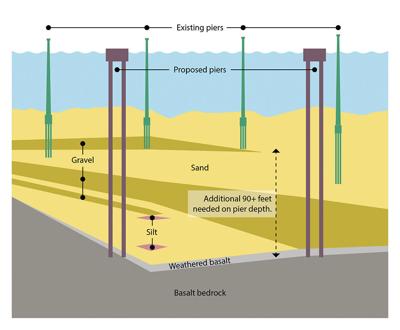
The diagram shows the layering of materials in the riverbed, the positioning of the piers of the existing bridge, and the proposed piers of the new bridge, which must reach bedrock to meet modern seismic standards.
The diagram shows the layering of materials in the riverbed, the positioning of the piers of the existing bridge, and the proposed piers of the new bridge, which must reach bedrock to meet modern seismic standards.
HOOD RIVER — On Oct. 15, the Hood River-White Salmon Bridge Authority (HRWSBA) released updated estimates that the new bridge between Hood River and Bingen will cost $1.12 billion — nearly double the previous figure of $520 million.
A press release from the HRWSBA gave a few reasons for the new price tag: Spiking inflation, a completed geotechnical site evaluation, and bridge strikes. Inflation in the heavy highway construction sector has risen 51.3%, according to the latest data from U.S. Department of Transportation. Earlier this year, a study revealed lower-than-expected bedrock that will require “foundations on the new bridge to be around 90 feet deeper, requiring more advanced and sensitive construction techniques,” according to the release.
At the Oct. 15 Port of Hood River regular meeting, Commissioner Mike Fox, who is also on the board for the HRWSBA, gave a more detailed update. He said that the construction of the new bridge will require crews to dig into the bedrock and will add approximately $200 million to the project cost. He added that the HRWSBA made several changes to design plans that included a change to the construction materials. Fox said that they made the decision to build the new bridge with fewer foundation stands and build those stands with steel, rather than concrete. Fox said the changes would save an estimated $50 million.
Project Director Mike Shannon said those were “liberal” estimates and acknowledges that prices could change again.
The HRWSBA also announced they have filed a request for $532 million from the federal Bridge Investment Program (BIP), a U.S. Department of Transportation program that awards grants to large bridge projects around the country and could meet the total cost of the new bridge.
The release stated: “A successful grant, in addition to funds already raised and outstanding targeted commitments, would secure a total of $1.12 billion in project funding.” Project staff also confirmed the construction — originally anticipated to begin in 2025 — has been delayed one year, but Shannon is confident the new bridge will open Oct. 1, 2029.
Also bridge related, the commission heard an update from Port of Hood River Executive Director Kevin Greenwood about height limitations for vehicles crossing the bridge and ways port staff can enforce the potential restrictions. In response to the incident in June when an excavator struck several portal bracing members, the port contacted HRD Engineering and issued a task order to inquire about the feasibility of implementing a new system to “reduce incidences of bridge strikes caused by oversized vehicles and reduce the frequency of unanticipated repairs to the bridge.”
In a memo to the commission, HDR Inc. presented three alternatives: A flexible vertical clearance bar, a dual beam overheight vertical detection system or a LiDAR Vehicle Detection System. No decision was made, but Fox suggested the two detection systems would be too expensive and the clearance bar would not deter larger vehicles. The commission will further discuss the issue at their fall planning session scheduled for Nov. 19.
Ken Jernstedt Airfield Manager Jeff Renard was in attendance to answer questions about a new door for the Streich Hangar and development on the North Apron. When longtime port commissioner Hoby Streich retired, the port renamed the hangar at the airport in his name to honor his service to the port. As part of the consent agenda, the commission approved the purchase of a new hangar door for the Streich Hangar in an amount not to exceed $38,437.92.
Related to the North Apron, commissioners discussed building additional access points and hangars. Fox proposed numerous ideas such as building more hangars, changing the orientation of current hangars and potentially building onto existing hangars to create more space for more tenants.
In a letter from the Oregon Department of Transportation (ODOT), the port has submitted a land use request for two additional parking lots near Lot 1 and the waterfront. The proposal lists requests for a 59-spot parking lot at Anchor Way and a 76-spot parking lot at Portway.
Intended to serve as “overflow,” ODOT has requested the port commission conduct a “parking management study demonstrating the existing trips/parking spaces and the potential increase and its effect on the transportation system.”
The executive director’s contract was also up for consideration, and the port commission decided to move forward with an extension for Greenwood through Sept. 2027 and a one-time bonus of $10,000.
Port Commission President Kristi Chapman said, “Kevin has been tasked to evaluate and modify all aspects of port operations in preparation for July 1, 2026, when the commission has committed to limiting use of toll revenues to either maintain the current bridge or support construction of the new bridge. He is in year two of the effort showing the insight, leadership and experience that is needed for this undertaking.”



Commented
Sorry, there are no recent results for popular commented articles.