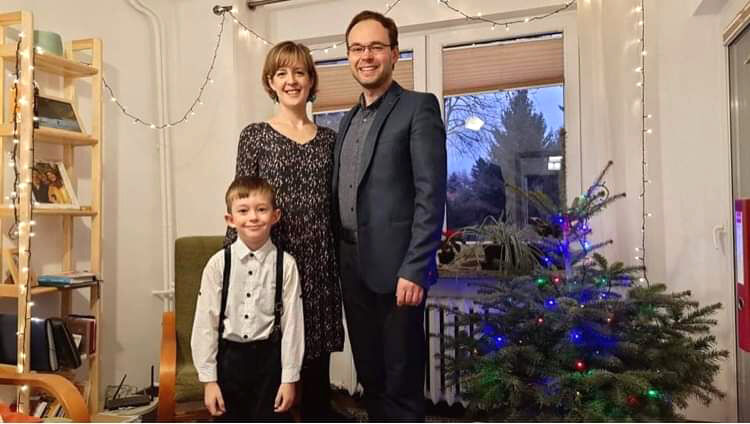
Anya and Michal Kawka stand with their son Bodgan at their home in Zakliczyn , Poland.
Contributed photo
When Colleen Ballinger of The Dalles sees the gut-wrenching news from the war in Ukraine, she thinks of her 7-year-old grandson in nearby Poland.
“Every image I see of a refugee child, I put into the context of my young Polish grandson: The terror of suddenly leaving everything, never to return, along with the trauma of leaving a young father behind. It is so hard to feel so helpless.”
Colleen and Mike Ballinger’s daughter, Anya, married native Pole Michal Kawka, who she met while attending Willamette University.
Anya, a 2002 graduate of The Dalles High School, and Michal and their son Bogdan have lived in Zakliczyn, a rural town about 120 miles from the Ukrainian border, since 2020.
As for Michal, his normally somewhat lively morning bus commute took on a deeply somber tone on Thursday, Feb. 24.
That morning, the driver turned on the radio. The riders were silent — no chatter, no one on their phones — as the news was announced: Russia had just attacked Ukraine. Multiple cities were being bombarded. People were dying.
That morning, Kawka deeply felt a solidarity with his fellow Poles, and the shared pain of 200 years of suffering Poland has endured at the hands of Russian regimes.
Like his fellow riders, he was “frozen in thought.” He and other riders were glancing at the older passengers.
“I can’t escape the thought that for them, it’s not just news. They have lived in communism, their parents were in the Second World War, they were directly impacted by violence from the Russian Army. And just to see that group in that bus.”
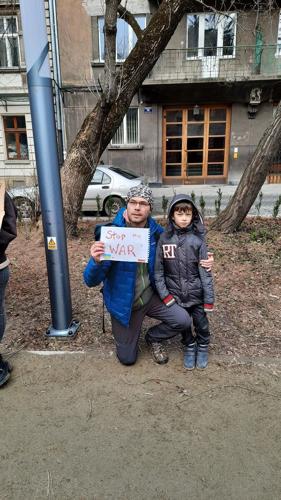
Michal and Bodgan at a protest in Krakow, Poland, in front of the Russian consulate.
Contributed photo
His grandparents were teenagers during World War II, when Russians killed thousands of Poles. His parents grew up under oppressive Soviet-sphere communism. His first eight years of life were spent under communist rule, but it didn’t affect his happy childhood.
The initial shock of the war news soon morphed into a powerful desire to help, or “project mode,” as Michal put it. He took Bogdan to a protest in Krakow at the Russian consulate there and then organized a benefit concert for refugees held this past Sunday.
Anya, who teaches English part-time at a private school, is starting a “Musical English” class for refugee children. So far, their small town has few refugees, since they usually stay in large cities with more jobs and resources.
Her co-worker is taking in a family. The Kawkas have a small apartment so they can’t host a family, but they are making financial contributions.
Rhymes and songs
Anya’s class will be like a library storytime, with rhymes and songs in English. The overt intention, she said, is to teach children English, an international language, but it also can serve as a support group where Ukrainian families can come socialize and drink tea while their kids play.
Anya is most worried about the mental health crisis refugees will face, since they are stuck in a foreign country for the next months, perhaps years.
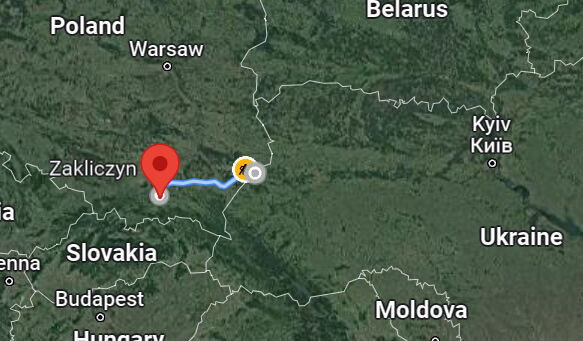
A map indicates Zakliczyn, Poland, in relation to the Ukrainian border.
Contributed photo
“No one knows how long this war will last, and the psychological toll that will have on the refugees, and the people who host them, is going to be hard,” she said.
As a teacher, she specifically worries about the wellbeing of Ukrainian children, who will not only have to learn a new language, but in a different alphabet.
Ukrainian uses the Cyrillic alphabet.
“How difficult will that transition be for them?” she said. “How frustrating will it be for the classroom teachers who were not expecting this influx of traumatized children? These children cannot speak Polish and they cannot read the alphabet. They never wanted to come here: This is not a fun adventure, this is a terrifying ordeal.”
Michal said donations of food and clothing for refugees “became so massive that people can’t process it.”
His own family members, like many across Europe, have offered to transport refugees from the border and to host refugees.
“I have not seen this level of unity in Europe for awhile and that’s kind of the silver lining of this situation,” he said.
The hardest part to bear is knowing that the conflict will inflict much more death on both sides, Michal said.
“Apartments are being bombed, cities are being surrounded by armies and starved and massacred,” he said. “It’s so shocking that this is happening in the middle of Europe. We thought there would be no more after World War II, where we inflicted one of the worst catastrophes on ourselves in the history of the species.”
Over a million people — mostly women and children — have left Ukraine already, the largest European migration since World War II.
Like many people, Kawka did not actually expect the invasion. “I thought this was all political theater.” His Ukrainian friend, who lives in Poland, also didn’t expect it. His friend explained that they have been dealing with the threat of war from the Russian regime for so long that it didn’t register as anything new.
For years, Ukraine has leaned more westward toward Europe rather than Russia. That has been an important factor for Russian Federation President Vladimir Putin to be afraid of, Michal said.
Some people fear the war will eventually engulf Europe, he said. Others think it’s just a matter of standing up to Putin in Ukraine. Others are in denial and don’t think about it at all.
“There is no panic, that’s what I can tell you. There is more like an attitude of getting together and organizing and doing something about it, some constructive action to protect, to pressure the government to do more.”




Commented