
Candid, funny, insightful, class of 2026 sextet concludes a 13-year project

HOOD RIVER — “Tracks to ‘26” began in June 2014 this way:
“Meet Jess Aubert, Diego Bustos, Sofie Rodriquez Estrada, Trinity Evans, Jack Miller and Nicholas Tuttle, all age 6, graduates of kindergarten this week and members of the high school class of 2026. What will ‘Tracks to ‘26’ be? An experiment, really. As Sofie intuits, a metamorphosis.”
Every year for the next 12 years, this newspaper would interview these same children. Now seniors, all sat down for their final interviews in November and December, and inside are their concluding comments.
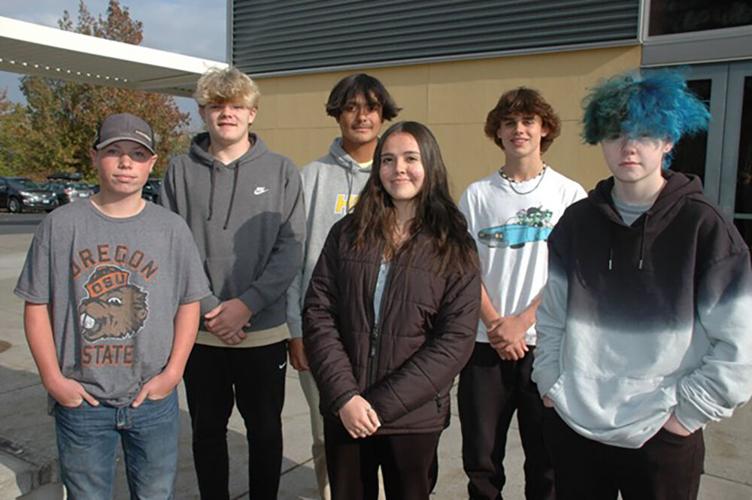
A group photo was taken that spring 2014 afternoon on the grounds of May Street Elementary, in the northeast corner of campus where the main building used to be. It is now the playground ballfield. Changes also came for these six budding adults. (Trinity has transitioned, and is now Jayden.)
The future “is kind of cool. ‘Cause you don’t know what you’re going to do,” Jack said in 2014.
Jess said, “It might be fun because when you grow up and you’re done with your job, you get to retire and don’t have to work anymore.”
Now, Jess is looking at a career in welding and starting his own farm.
We reported in 2015 that “in 2014, Sofia mentioned that a hard word she was trying to learn was metamorphosis. She gave her 6-year-old version (mettemorfess) of the synonym for change and when asked to spell it this month recited ‘M-a-t-a-m-o-r-f-i-s-e-s.’ When she heard the correct spelling she said, ‘It’s from using the f not the ph, in Spanish.”
As a kindergartner, Sofia explained how her teacher had introduced the word metamorphosis and asked the students to say what they thought it meant. “We guessed. It’s the egg and the chrysalis and the butterfly. It’s the world of the butterfly.”
One standard question was what had they learned that week. Others included what they thought of school, what they enjoyed doing, what was a challenge for them, what they wanted to be when they grow up, and what they thought about the future.
Here are their kindergarten answers, as they appeared in 2014, to the question of what was a good thing that had happened that day:
Nicholas: “Learning. I know how to read.”
Diego: “I played with my brother.” (Jorge, who is three years older.)
Jayden: “Art. We made shape people.”
Sofia: “We get to watch ‘Jack in the Beanstalk’.”
Jess: “At school, we made a necklace. A string and beads. It was fun.”
Jack: “I went to the library.”
What did they say over the years about what they want to be when they grow up? Their answers, 2025 and 2014:
Nicholas: plans to attend trade school and/or become a firefighter; wanted to be a baseball player.
Diego: will pursue mechanical engineering; in kindergarten, he wanted to “drive an ambulance.”
Jayden: plans to become a child psychologist, probably at a University of Houston; had thought to be a doctor.
Sofia: will study biology or chemistry as preparation to become a pediatrician; said in 2014 she wanted to be a teacher. (Sofia learned on Dec. 3 that she has been accepted for a full ride at Pomona College in California.)
Jack: plans to attend a four-year school and compete in track and field; had wanted to be a policeman.
Jess: will study welding or other metal work, likely at a school in Montana, and plans to farm or raise cattle; in 2014 he said, “the Easter bunny — no, ambulance driver.”
•••
I spoke in November with five of the Tracksters at Hood River Valley High School, where all attend. Nick Tuttle had a family matter that day and I returned on Dec. 10 to talk with him. As a McMinnville resident now, I look for chances to visit friends in Hood River, and so it was with Nick, Jayden, Diego, Jack, Jess and Sofia.
We asked the elementary principals in 2014 to suggest the students, and as a first step, we asked the parents and then spoke with the kindergartners about talking to the newspaper every year. Two of the Tracksters have actual recollections of that conversation.
It was understood from the start that, potentially, at least one of the six would move away, opt out, or be unable to continue. But it worked as hoped and planned: one of the delights of the project is that all six remained involved and committed. I have certainly looked forward to the annual interviews, and will miss my regular contact with these bright, engaging, confident people. Over the years, these kids have often made me laugh, long and loud. We’ve cried once or twice, and at other times they have made me consider big questions and impressed me with their insights.
Our “final” interview (we’ll revisit the group in spring 2026 just before they graduate) was kept conversational, the only repeat questions being what they planned to do after graduation, and what they think of the future.
All are now, or about to turn, 18. So, to varying degrees of specificity, I pressed them on that last question; understandably, they are generally unsure about the future or what to say about it.
As I have come to know all six Tracksters over the years, they have opened up to me in ways that reflect their comfort — which, remarkably, has always been there.
There was early and intermittent shyness, but all six have candidly taken to the Q-and-A since they started doing this. As I wrote a year ago, “that they are readily, and happily, responsive is also a mark of their maturity: they have more ideas and are each year better able to articulate often complex concepts. Seeing this happen is, of course, the basic purpose of this 13-year project.”
What follows below are the 2025 conversations with these seniors, edited for length. We’ll gather for a group photo and a summation in May 2026.
And all six said they would be happy to speak with Columbia Gorge News in coming years. The Tracks story does not have to end.


Commented