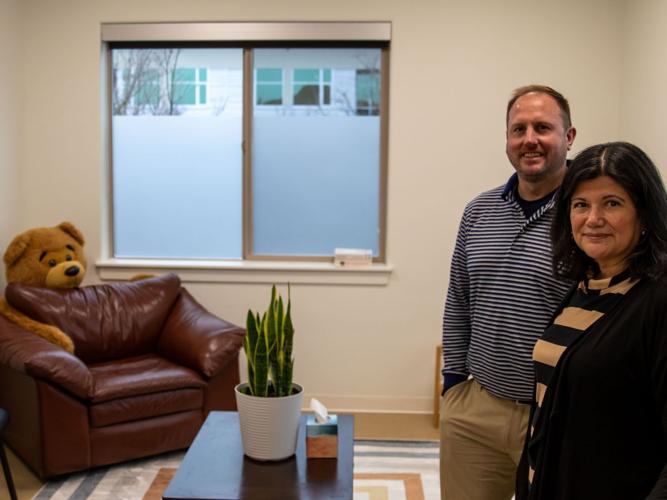
Drew Eastman and SafeSpace Executive Director Beatriz Lynch share a sneak peek of the children’s waiting area the new SafeSpace location in Hood River. The waiting area is complete with television, playhouse, coloring books and a large teddy bear to greet new patients.
Drew Eastman and SafeSpace Executive Director Beatriz Lynch share a sneak peek of the children’s waiting area the new SafeSpace location in Hood River. The waiting area is complete with television, playhouse, coloring books and a large teddy bear to greet new patients.
The community is invited to tour the new facility, located at 206 Wasco Loop, for an open house today, Wednesday, March 20 from 4-6 p.m. Visitors will learn about the services of SafeSpace as they walk through the 8,400-square-foot facility. Staff and volunteers will lead tours approximately every 15 minutes. Light refreshments will be served.
Founded in 2009, SafeSpace provides a single point of contact for child abuse victims, offering trauma-informed care in a child-friendly environment. It’s the Columbia Gorge’s only childcare advocacy center, coordinating the efforts of child protection staff, law enforcement, family advocates and medical experts under one roof. Its service area covers five counties: Hood River, Wasco, Gilliam, Wheeler and Klickitat.
Its former 1,350 square foot facility was not big enough to provide all services needed under one roof.
“When there is concern that a child’s been hurt, usually the second call is to us; first call is either to law enforcement or child protective services,” SafeSpace Executive Director Beatriz Lynch said. Children had to travel for services, including the hospital and police department.
The new space means children are able to receive services in one place. There are two waiting rooms — one for younger children, and one for teens, meaning less trauma for children and their families as they wait for interviews. It also means SafeSpace can serve two separate cases privately, and at the same time, while providing multiple services.
Lynch said interview rooms are just off the waiting areas. “The forensic interviewers have special training to be able to elicit the story in their own words,” she said. “It’s really important that we use their language, and they are able to tell their story in their own words.” Interviews are recorded with special cameras, so if an agency needs to hear the story again, they don’t have to go back to talk with the child.
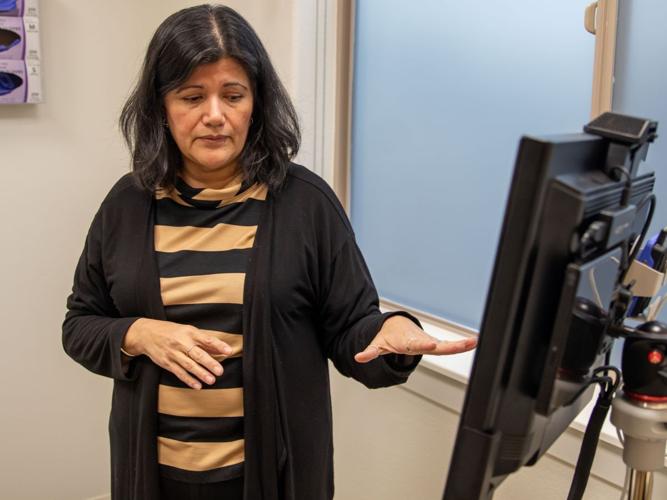
SafeSpace works with babies and very young children as well as teens. Medical exams, rape kits and pediatric rape kits are available and performed at the facility, unless the injury requires a hospital or outside doctor. Special cameras are installed here, too, that capture the details related to any injuries.
“The exams are a little bit more in depth than just a real child exam because the doctors are really looking at every part of the child’s body, documenting an injury that they see and really asking those follow-up questions to see if the injury matches the explanation,” Lynch said.
The cameras are expensive, but important equipment that can determine specific injuries to the child’s body — it can distinguish specific bruises and how many days the child has had it, which can be important to their case.
“Doctors do a lot of skeletal surveys for injuries that have healed before,” Lynch said. “And this is important, because we’ve discovered where bones have healed on their own. We can really discover some past history of abuse for these exams, and this is why it’s so important to see every child. Some of the kids that we see, we call historical abuse, like it happened two years ago. It’s still important for them to see the doctor — for one, they need to make sure that their bodies are healthy. So, a lot of the times, it’s just a big relief to say, ‘You know, this horrible thing happened to you, but your body’s healthy, you’re going to be okay,’” Lynch said.
SafeSpace Executive Director Beatriz Lynch gives a tour of one of the center’s examination areas.
Noah Noteboom photo
The facility currently has three medical providers — Nurse Practitioner Lynn Frost, Dr. Glenn Patrizio and Dr. Robin Hanson — which is good news for a facility that at one time had no available providers. Lynch said it isn’t that providers don’t want the job, but that it takes specialized training for the exams and can also require the provider to testify in court on behalf of the child, which can be a barrier to the job.
Karis Northwest,a regional CAC regional Children’s Advocacy Center that supports smaller centers like Safespace and is based out of Randles Children’s Hospital, provides the specialized training to providers. The larger center also offers opportunities for consulting as needed — if the exam shows something the provider is not sure about, they can consult with Karis Northwest for a second opinion.
The new facility also includes laundry room and bathroom, complete with shower. Lynch said that children can be picked up from unsafe places, and being able to shower or have freshly washed clothing and a snack can be a big comfort.
And it includes observation rooms. “This is where our community partners, law enforcement and Child Protective Services — everybody can be a part of the assessment team is able to watch the interview in real time, they can listen to the exam,” said Lynch. “We don’t report or take pictures of the exam at all, but they’re able to listen to the exam. And that’s really important because sometimes in the interview, as you can imagine, sometimes it’s these kids have kept this secret for a really long time. And they’re not going to tell us everything right away.”
Exam providers and interviewers have different rules for talking with children, and it’s the team who provides feedback of both the interview and the exam when they listen in.
The new SafeSpace location has room to grow. They plan to add therapy services in the upstairs area in the future, as there is not currently a therapist on staff. Children’s mental health services are “very much needed right now,” she said.
“So much mental health [service] is needed for kids,” Lynch said. “Coming out of this pandemic has really affected how kids interact with school, like social cues … so, it’s important for us to develop that mental health [piece]. And part of mental health is also creating drug and alcohol programming.”
As of now, the first floor offers a comfortable place for children experiencing trauma. The overall message that she hopes to get across, Lynch said, is that anyone in the community can be the person to make a child’s abuse stop.
“Because a lot of people say, ‘Well, I don’t want to cause any problems. I don’t know if this is really happening.’ And it’s okay,” she said. “You don’t have to know for sure. That’s why there’s a whole team of people that’s our job to investigate this.”
Even if a person makes a call and it turns out the child just fell off of their bicycle, “isn’t it wonderful that our community is looking out for this child,” she said.
The SafeSpace campaign is raising the final $100,000 to reach its $5 million goal. All contributions of $250 or more will be permanently recognized on the donor wall adjacent to the SafeSpace community room. More information is available at www.safespacecac.org.



Commented
Sorry, there are no recent results for popular commented articles.