
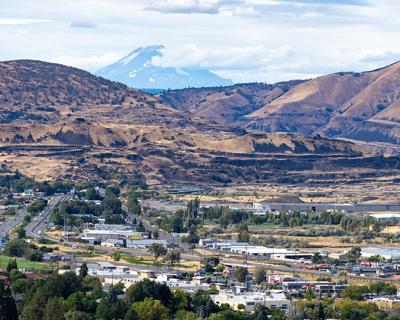

THE DALLES — Housing, prosperity, bilingual disaster relief and the hardship of running poop plants: All problems for Nate Stice, Regional Solutions team leader.
Locals heard him explain what Gov. Tina Kotek’s prosperity roadmap could mean for them at a recent The Dalles Community Affairs meeting, hosted by The Dalles Chamber of Commerce.
Stice leads two regions, one of which includes Hood River, Wasco, Sherman, toward Gilliam and Wheeler.
Regional Solutions is housed in the governor’s office. It coordinates state and local governments, Tribal sovereign nations, business, philanthropy, and community-based organizations on local solutions.
They connect resources, outreach — sometimes getting multiple agencies to brainstorm solutions with a community at once — prepare projects,- identify funding, and help with disaster recovery.
“I work for the highest elected official in the state and I go to communities and ask them what I can do for them,” Stice said.
Each region has a committee of locals (ours includes Mayor Rich Mays and Debra Whitefoot of Nch’iWana Housing), a team of state agency and local partners (including Business Oregon, Department of Environmental Quality, Department of Land Conservation and Development, Oregon Housing and Community Services, ODOT, and others as needed.)
The committee gave their priorities to Kotek in late 2025. “If you have an issue that you want to bring to the attention of the state and the governor, I’m your conduit for that. You’re always free to call or email me,” Stice said.
Stice can help when people run into barriers with a regulatory agency, and worked a lot on the Dog River Pipeline replacement project. He can also connect people with local and state resources — and federal resources, “if they exist anymore.”
He’s served through two governor’s administrations, though “I really enjoy working with this governor because she’s not afraid to address hard questions and barriers.”
Disaster relief and poop plants
Around the state, housing, resilience and infrastructure loomed large. Locally, the committee picked economic opportunity for future generations, bi-state opportunities, and strengthening regional housing collaboration.
That includes the bridge replacement, Dallesport’s industrial land and airport, community resilience for “Latino/Hispanic population and at-risk populations,” for ag and small business; childcare; support for the nonprofit sector, and workforce development; “human infrastructure, capacity and governance.”
The housing priority is eyeing lands on both sides of the river.
Another priority is “making sure we’re communicating with vulnerable populations and in particular underserved populations like the Latino/Hispanic population when we’re in disaster situations and we’re thinking about recovery,” like Spanish-language communication.
Small businesses, too. “You know, every time theres a fire or an ice storm ... small businesses tend to suffer the most without a lot of reserves and really living on thin margins.” Resources include Stice, SBDC, MCCED.
Another local concern: “You know, our poop has to have physical places to go, and has to have people who want to operate the poop plants and the water plants and keep that infrastructure flowing. Just getting the human resources, the people in there, who can take those jobs — and it’s becoming harder and harder to find operators ... We’ve had a couple communities who say Jacob’s Engineering has just come to them and said, ‘We can’t support your community anymore.’”
Relatedly, the capacity to write grants, plan and fund big projects is limited in little communities and special districts — “Oregon has an ungodly number of special districts compared to other states that run water and wastewater operations” — and these are having trouble too “Often they can’t find people who want to serve on their boards because it’s a pretty thankless job.”
Economic priorities included diversity in work and supply chains, supporting nonprofits, and “of course, you can’t go out and talk to businesses or nonprofits or any employer without hearing about the shortage we have in workforce.”
He works with many Washington agencies and joked that he should ask Governor Inslee to pay half his salary so he can just formally work across the river.
Prosperity roadmap
Steep economic headwinds face Oregon: slowing population growth, higher unemployment, businesses leaving the state. “As an aside, Oregon’s always had this problem: we incubate businesses like Dutch Bros here,” Stice said. “They grow up and they leave us.”
But Oregon’s economic slowdown is part of a national trend.
So the plan’s goals are to keep businesses in the state and grow them, reduce barriers to investing, strengthen partnership, encourage job creation and speed up economic growth.
To do this, they’re going to appoint a chief prosperity officer, “hopefully someone with strong private sector background,” to chair a new “prosperity council” made up mostly of business leaders, with a single workforce representative and a single higher education rep. This council will advise Kotek at “everything ... everything’s on the table. Tax policy, incentives; you name it, this group will be talking about it.”


Commented
Sorry, there are no recent results for popular commented articles.