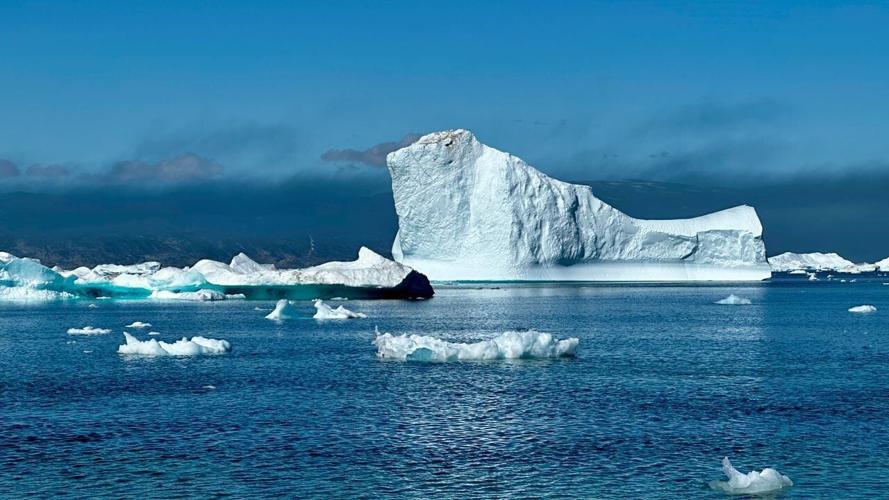
More icebergs are carrying huge loads of rock and other debris deep into the ocean, reveals new research.
The trend is not only a "considerable risk" to shipping but is also reshaping deep-sea habitats, say scientists.
Their findings show that the number of icebergs in the Arctic has increased "sharply" since the 2000s.
They say the rise is due to the destabilization of large glaciers in northeast Greenland and parts of the Russian Arctic as well as the increasing mobility of sea ice.
Stones are raining down from the melting icebergs, forming new hard-substrate habitats for marine life on the soft seafloor, gradually altering existing deep-sea communities.
The team explained that most icebergs in the Arctic bear traces of their origin.
When large glaciers calve, not only are huge blocks of ice released, but also debris and sediments that have been carried along in the ice for years.
Photo by Koen Swiers via Pexels
By Talker
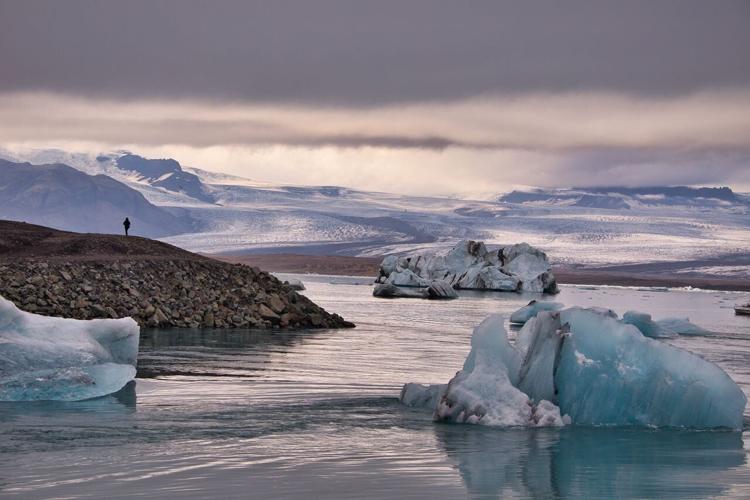
As a result, rock fragments become embedded in the icebergs — visible as dark patches and veins on the surface and along their sides.
But what researchers observed on several icebergs in the Fram Strait in 2021 surprised even experienced expedition participants.
Dr. Melanie Bergmann, a biologist at the Alfred Wegener Institute, spotted the icebergs from a helicopter aboard the Polarstern research icebreaker.
She said: "Some of the icebergs were carrying unusually large amounts of debris and looked almost black from above."
To investigate this unusual finding, the expedition team documented the rock distribution and collected samples.
Bergmann said: "We immediately realized that tons of rock were drifting through the Arctic Ocean, hundreds of kilometers away from any glacier."
The researchers found clues to the origin of the icebergs around 2,500 meters (8,200 feet) below.
The stones that rained down from the melting icebergs had already left a clear trail on the deep-sea floor.
Dr. Kirstin Meyer-Kaiser, a scientist at Woods Hole Oceanographic Institution, analyzed deep-sea photos from the region taken on expeditions in recent years.
She said: "Where previously there were only isolated stones of various sizes, we are now finding much larger accumulations, frequently in small groups.
"And with each new stone, a permanent settlement is created on the seabed.
"Sponges, anemones and other animals that favor hard substrates can settle there.
"As a result, biodiversity in the deep sea is increasing."
Photo by ArtHouse Studio via Pexels
By Talker
She said a comparison of the observations from the iceberg and the deep sea proved that the stones on the seabed actually originate from the icebergs.
Meyer-Kaiser added: "The stones show a clear match in both size and mineralogical composition."
The team assessed whether it was a regionally limited phenomenon or a consequence of climate change, which is causing glaciers to melt ever faster and increasing the number of icebergs.
Bergmann said: "Such puzzles can only be solved in an interdisciplinary manner.
"That's why we biologists have joined forces with experts from glaciology, oceanography, geology, deep-sea and atmospheric research and have been exchanging ideas over the years."
Study lead author Dr. Thomas Krumpen, a sea ice physicist at the Alfred Wegener Institute, said: "In order to prove that climate change is intensifying the process, we had to show that the frequency of icebergs in the region has changed.
"Smaller icebergs and their fragments in the pack ice can hardly be recognized by satellite.
"That's why no one has been able to say whether there are more icebergs today than in the past."
The team analyzed observations that had been carried out from the bridge of the Polarstern for around 40 years.
The observations document whether and how many icebergs can be seen in the vicinity of the ship.
Krumpen said: "This data set is actually a byproduct of the regular weather records, but it turned out to be crucial for this issue.
"The analysis clearly showed that, since the early 2000s, more and more icebergs have been passing through the Fram Strait and increasingly in larger groups — an indication that the deposit of stones follows a systematic, climate-related pattern."
By way of a satellite-based method for reconstructing the movement of ice in the ocean, the researchers were able to trace some of the observed icebergs back to their place of origin.
Photo by Arina Dmitrieva via Pexels
By Talker
Many come from two large glaciers in northeast Greenland as well as from parts of the Russian Arctic.
The researchers said the Greenland glaciers in particular have lost stability since the early 2000s and are now calving much faster.
They say the timing of the destabilization "closely matched" the observed increase in the frequency of icebergs further south in the Fram Strait and is a consequence of global warming.
The team used a sea ice-ocean model to investigate the extent to which the rapidly melting Arctic sea ice could have contributed to the accumulation.
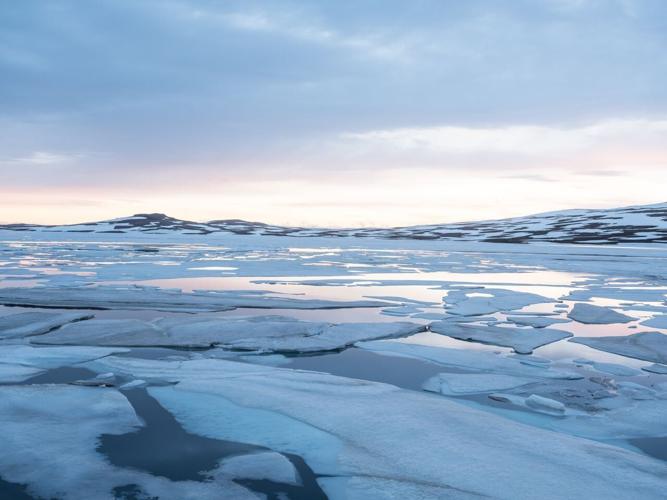
The simulations show that icebergs in increasingly dynamic and retreating pack ice are transported faster and more efficiently toward the Arctic outflow and have more contact with open water overall, which in turn accelerates their melting.
The researchers say the results underscore how closely processes on land and in the deep sea are intertwined — and how sensitive and far-reaching this Arctic system is in its response to progressive warming.
They said the findings are not only relevant for climate and biodiversity research, but also hold "direct significance" for maritime safety and planning.
Krumpen said: "An increasing presence of icebergs in certain regions of the Arctic harbors considerable risks, for example for cruise ships and cargo ships, which are traveling in ever greater numbers in the ice or near the ice edge, as well as for exploration activities for oil and gas."
He added: "As fishing moves further north, newly deposited stones in shallower areas could also become a risk for bottom trawling in the future."



Commented