Columbia Land Trust is working to preserve about 75,000 acres of forest land in Trout Lake and White Salmon sold by SDS Lumber Company in 2021. SDS gave the conservation owners time to raise funds for the project.
Columbia Land Trust is working to preserve about 75,000 acres of forest land in Trout Lake and White Salmon sold by SDS Lumber Company in 2021. SDS gave the conservation owners time to raise funds for the project.
WHITE SALMON — Another 29,800 acres of timberland just got conserved under easement as working forest, the third phase in Columbia Land Trust’s project of protecting about 75,000 acres, sold by SDS lumber company in 2021.
Columbia Land Trust hopes to conserve almost everything except the mill itself, buying the most important 15,000 acres of habitat outright. They hope to put the other 60,000 under conservation easements. In this case, Washington’s Department of Natural Resources will hold some of the rights over the 29,800 acres of land. It can be sold, but never developed; it must always remain working forest. This is the trust’s biggest project to date.
Director Meg Rutledge said the project also supports Tribal values of “being able to access from mountains to the river.” The easements protect more than 1,000 jobs and access for recreation, according to Columbia Land Trust.
SDS Lumber was the last family-owned, vertically-integrated (meaning it owned and operated most stages of its own supply chain) timber company in this part of the Northwest.
Rutledge said the purchase “is a really incredible opportunity to ensure that the values of working forest [are preserved] — which includes recreational access, economic benefits to the communities” in a crucial ecological zone.
“If we weren’t able to conserve this piece of land, and allowed it to get sold off piecemeal into smaller bits, that wasn’t just going to be the breakdown of a working forest — it was going to be the breakdown of a significant part of the community and the history of the area,” Rutledge said.
SDS, a willing seller, gave the conservation owners time to raise the necessary money. Partners like the Conservation Fund helped out. And recently, bipartisan support gained the project a Forest Legacy grant of $36 million to put easements on this largest group of parcels yet — 29,800 acres near White Salmon, in Klickitat and Skamania counties.
Previously, 6,300 acres near Trout Lake, and 11,800 acres near White Salmon, were preserved by $8.2 million and $14 in Forest Legacy funds, respectively.
The Forest Legacy Program is funded through the Inflation Reduction Act (IRA) and the Land and Water Conservation Act. It aims to preserve working forests through easements or puchases, which prevent them from being subdivided and developed for any other use.
“We appreciate the bipartisan support that we’ve received from lawmakers in southwest Washington,” Rutledge said. “We’ve had that bipartisan support, recognizing the importance of protecting jobs, wildlife habitat and the quality of life for rural communities.” As of Feb. 10, the contracts were signed but the money not yet paid out. Rutledge does not anticipate any changes or delays in the funding or contracts, she said.
“We’re always prioritizing areas that retain the connectivity and function and resilience of our most valuable ecosystems,” she added, meaning high-quality, still-intact habitat that’s connected to other areas of intact landscape, so animals can move around.
The parcels they’re conserving as working forest lie along the east-west transition between wet coastal forest and dry eastern oaks, making them especially rich in diverse species of plants and wildlife. A lot of the timberlands have oaks on them.
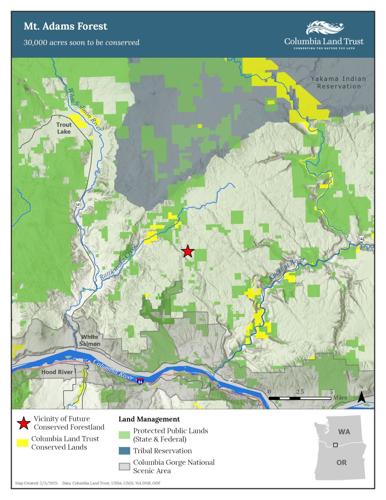
A map from Columbia Land Trust showing the general area of the 30,000 acres conserved under the latest easements.
Contributed graphic
Native white oak, Quercus garryana, is a “keystone species,” meaning it plays an unusually big role in keeping habitat healthy, keeping forests functioning, and feeding wildlife. Oaks are important for the migratory birds that move east to west across mountains, Rutledge said.
This area is in the Pacific flyway, a route used by many bird migrants who follow the West Coast from the far north, in many cases all the way to South America. This migration area crosses 19 countries, and is used by 343 species around the world — including familiar ones like Hermit Thrush and Great Blue Heron — according to Birdlife International.
If the forest were developed, “a bunch of isolated fragments” would have much less value for wildlife, Rutledge noted. The parcels under this easement are not all adjacent. “But when you zoom out, [they] really fill in this transition zone,” Rutledge said.
The often small, scrubby oaks that support these hungry migrants are the same species that grow “huge” and “leafy” in the Portland area. But here, when just 6-8 feet tall, they can be hundreds of years old. The scrub oaks on these timberlands have not been cut. Rutledge said she has no reason to expect they will be.
Columbia Land Trust hasn’t done surveys on the ground to determine what species live in these parcels. However, the kind of habitat and location means they could contain critters like the northern spotted owl, endangered steelhead, Pacific fisher, and western gray squirrel.
The project to save them started sometime in 2020, when Cherie Kearney — forest conservation director for 34 years — started connecting dots. Rutledge said she expects work to last through 2028 or 2029. “It is the kind of thing that seems common, but ... the sort of thing that quickly becomes difficult to replace or restore ... Once the land is lost, it’s almost never restored or returned back to forestry,” she said, admitting that given the other entities who were interested in buying SDS land, it seemed “very likely” to be developed for non-forest uses.
Do the individual easements on parcels in this last 30,000 acres require any new restrictions on logging? In general, Columbia Land Trust did not dictate just how the logging would be done. Mainly, it simply means the forest can’t be converted, or fragmented.
Green Diamond, who now owns much of the 29,800 acres under these easements, is a family-owned company that claims a commitment to responsible management, and maintaining the ecosystems they log, according to their webpage. Rutledge said these particular stands are under longer rotations than some other companies would allow.
The easements would allow Green Diamond to sell this land in the future; however, the conservation restrictions remain “forever,” Columbia Land Trust said.
These acres “might be your backyard” if you live in the White Salmon area.
“I have been so impressed and heartened and optimistic ... it has taken so many people to come together, and to bring together the shared values and the understanding of the importance ... And being able to bring all of those things together for a positive outcome is extraordinary,” Rutledge said.
“... It’s encouraging, it’s motivating. It’s the kind of conservation I care about.”



Commented
Sorry, there are no recent results for popular commented articles.