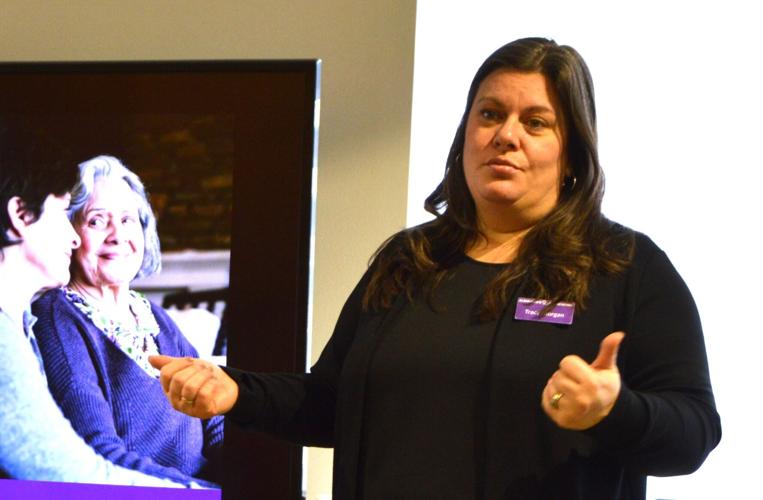
A slide from the Feb. 2 presentation by Tracy Morgan, executive director, and Andie Shepard, program manager, Alzheimer’s Association of Oregon and Southwest Washington.
A slide from the Feb. 2 presentation by Tracy Morgan, executive director, and Andie Shepard, program manager, Alzheimer’s Association of Oregon and Southwest Washington.
A slide from the Feb. 2 presentation by Tracy Morgan, executive director, and Andie Shepard, program manager, Alzheimer’s Association of Oregon and Southwest Washington.
A slide from the Feb. 2 presentation by Tracy Morgan, executive director, and Andie Shepard, program manager, Alzheimer’s Association of Oregon and Southwest Washington.
Trisha Walker photo
A slide from the Feb. 2 presentation by Tracy Morgan, executive director, and Andie Shepard, program manager, Alzheimer’s Association of Oregon and Southwest Washington.
Trisha Walker photo
A slide from the Feb. 2 presentation by Tracy Morgan, executive director, and Andie Shepard, program manager, Alzheimer’s Association of Oregon and Southwest Washington.
THE GORGE — The Alzheimer’s Association of Oregon and Southwest Washington has one simple goal: Developing partnerships that help families living with Alzheimer’s and dementia.
Tracy Morgan, executive director, The Alzheimer’s Association of Oregon and Southwest Washington.
Trisha Walker photo
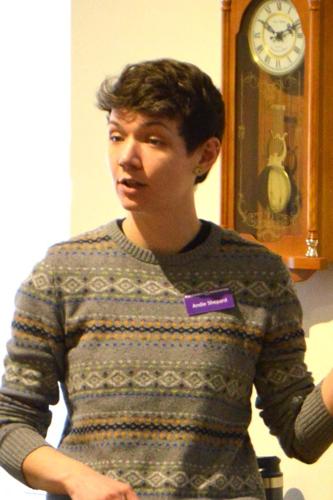
Andie Shepard, program manager, The Alzheimer’s Association of Oregon and Southwest Washington.
Trisha Walker photo
Tracy Morgan, executive director, and Andie Shepard, program manager, Alzheimer’s Association of Oregon and Southwest Washington, came to the Mid-Columbia Senior Center in The Dalles Feb. 2 to talk about the work the association is undertaking over the course of the next two years in seven selected rural counties — Hood River, Wasco and Sherman included — thanks to a $1 million grant from an anonymous donor.
“Our goal over these next two years is to develop some really great partnerships and help families in your community that are living with Alzheimer’s and dementia,” Morgan said. “On top of that, it’s also to look at those families that are not living with this disease but to talk about brain health and what we can do promote brain health.”
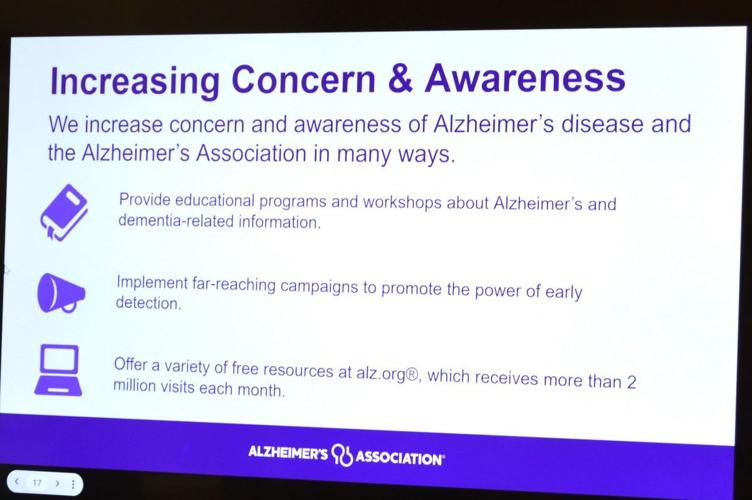
To that end, Morgan and Shepard welcome invitations from any community group, public or private, interested in learning more about the association’s work and/or forming a partnership.
“If the senior center or library or another area wanted to host one of our [free] classes, we want to get this information out in the community so people can learn more about communication styles, behaviors, what are the 10 warning signs and to really know the difference between Alzheimer’s and dementia,” Shepard said.
“Two years is just to start,” Morgan said. “That’s just getting us into these communities, and then, what can we do from there … We’re here to hear what you want from us.”
Dementia is the umbrella term for an individual’s changes in memory, thinking or reasoning that are severe enough to interfere with daily life, she said. There are 69,000 persons aged 65 and older with Alzheimer’s in Oregon alone; across the country, they number more than 6 million. The number of Americans 65 and older with Alzheimer’s is expected to nearly double by 2050.
“Brain health is just as important,” she added. “So that’s a lot of the work we’re going to be doing, too, but we will always be there for those families who are living with this disease, and their caregivers.”
The Alzheimer’s Association of Oregon and Southwest Washington, founded by Jerome Stone, focuses on care and support, as well as research. The association is committed to people and science — with accelerating global research, driving risk reduction and early detection, and maximizing quality care and support (alz.org/about).
“That’s why we’re really excited today, to be starting to say that we are in an era of treatment, with some new treatments that are out,” Morgan said. “Those treatments are not a cure; they are simply an opportunity to give families more time. So, there’s a lot still to be done.”
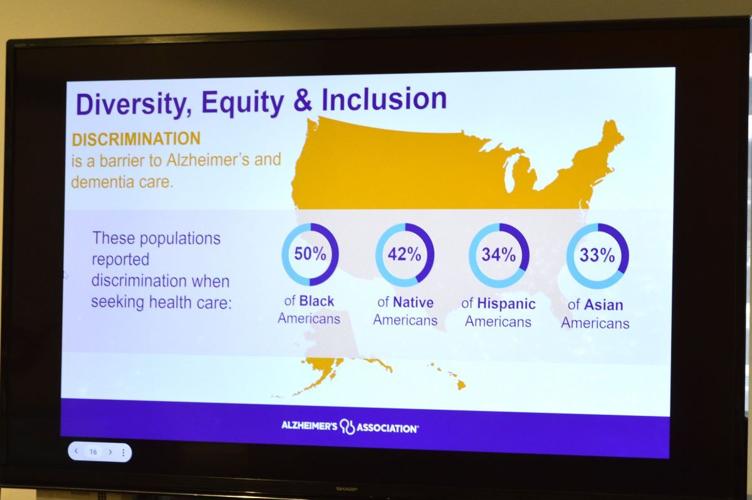
Shepard said Hispanic Americans are one and a half times more likely and Black Americans twice as likely to develop Alzheimer’s or another dementia but are historically under-represented in clinical trials, and face discrimination when seeking healthcare.
“We know that across populations, people from different backgrounds, this is going to affect people differently,” she said. “People from these varying backgrounds have largely been under-represented in clinical trials, and that is something the association is working hard to advance.”
A clinical trial that includes a diverse cohort of participants is getting underway, and “we’re very excited to see what those results are going to look like,” she said.
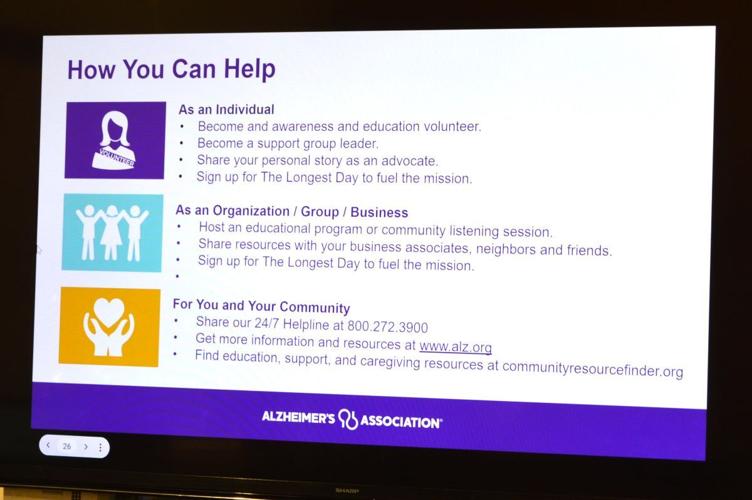
For those who need immediate help, one of the association’s best supports is its 24/7 helpline, 800-272-3900 or alz.org.
“If something is happening at 2 a.m. on a consistent basis, and you need that support, we want you to know we’re there for you,” Shepard said. “This could be a simple question, registering for a class — all the way from care consultations to safety plans. This is one of our best resources and we highly encourage individuals to call this number and even just gather more information for yourself or a friend in the community.”
There is also a local resource finder on its website, in partnership with AARP, that allows users to enter a zip code; a list of classes, support groups and local services are then displayed.
“That’s another thing we’re trying to do here, in The Dalles, Hood River and in Sherman County is to get those providers together and be listed on this resource finder so the community can know more about who is available and what services are needed,” Shepard said.
The Alzheimer’s Association of Oregon and Southwest Washington is looking to recruit volunteers in the Gorge area; those with questions about that work — how to volunteer, become a support group leader, or host an educational program or listening session, for example — should contact Morgan at tmorgan@alz.org or 503-416-0199.



Commented
Sorry, there are no recent results for popular commented articles.