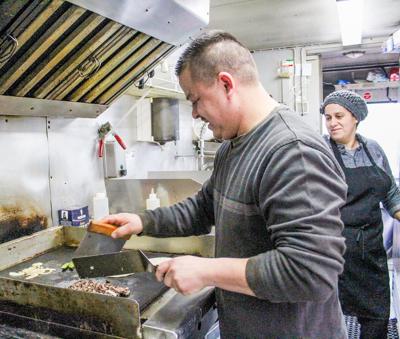
Ricardo and Lola Lopez preparing food in the back of their food truck, El Cuate. The Lopez's also have a sit-down restaurant on the Hood River Heights.
Ricardo and Lola Lopez preparing food in the back of their food truck, El Cuate. The Lopez's also have a sit-down restaurant on the Hood River Heights.
HOOD RIVER — The City of Hood River is moving forward with amending a rule that required food carts to relocate every six months. City staff is also working to make the parklet pilot program a permanent feature for businesses with available parking.
For the last decade and a half, the City of Hood River has regulated food trucks under its transient merchant licensing program. Trucks and carts are allowed in commercial and industrial zones.
The City of Hood River and City Planning Director Dustin Nilsen have held preliminary conversations about the possibility of changing the rule — much to the delight of food cart owners around Hood River.
“I am beyond happy we don’t have to move every six months,” said Mt. Hood BBQ owner Chris Bosse. “Customers don’t want to guess where their favorite food place is.”
According to Nilsen, food carts have been regulated by the city for the last 15 years and certain rules were in place to “differentiate a brick and mortar business and a food cart.” At that time, food carts were part of a seasonal economy and the regulations were fitting, said Nilsen.
In November, the City of Hood River issued a public survey asking for input. They received almost 2,000 responses from residents, business owners, and consumers. Nilsen noted that many survey responses showed support for allowing food carts to be more permanent.
“The food cart and food truck business has changed dramatically in the past 16 years. So that was also an opportunity to not only address how the industry has matured, but maybe take the opportunity to help create a better opportunity for entrepreneurial enterprise,” said Nilsen.
At the Nov. 28 city council meeting, councilors explored alternatives and potential downsides to letting carts stay stationary. Most of the Hood River City Council seemed to be okay with allowing food carts to remain in at a location. Councilors Mark Zanmiller and Megan Saunders raised questions and concerns about changing a rule that had not been contested prior to the pandemic.
Nilsen added that there are potential downsides to a rule change.
“Most of these businesses aren’t connected to water and sewer. So you need to be real mindful of how are they disposing waste,” he said.
In addition to reading surveys, the city spoke directly with the Hood River Chamber of Commerce, the Heights Business Association and, most importantly, the Health Department.
When the COVID-19 pandemic derailed most business, the city adopted new programs to help stimulate the local economy.
At the time, most consumers did not want to shop inside, so the city began to allow brick and mortar businesses with available parking spaces to rent out parking spaces and build outdoor seating areas known as parklets. These parklets of course take away parking spaces, but Nilsen said it is a balancing act.
Council voted on drafting an ordinance amending Chapter 5 as it relates to transient merchants and food trucks and incorporate necessary regulations for licensing of parklets. All councilors, except Saunders, voted in favor of changing regulations.
“I am still in support of parklets and probably still in support of food trucks, I just don’t feel like I have enough information to make a decision,” said Saunders.
With the decision, Nilsen and city staff got to work. They will approach the council again in February with a series of recommendations for changes to the rule.



Commented