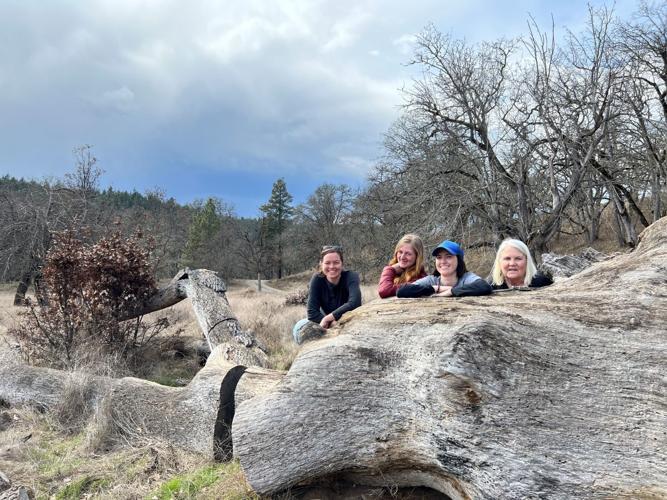
ECOP team members (from left) Lindsey Cornelius, Kat Shephard (grants and communications coordinator), Stacy Simanonok (technical coordinator), and Mary Bushman (past ECOP coordinator, current steering committee member) over the stem of a fallen oak, from which they cut "cookie" for analysis.
ECOP team members (from left) Lindsey Cornelius, Kat Shephard (grants and communications coordinator), Stacy Simanonok (technical coordinator), and Mary Bushman (past ECOP coordinator, current steering committee member) over the stem of a fallen oak, from which they cut "cookie" for analysis.
THE GORGE — Got a white oak grove you’re not sure how what to do with? Wondering how to restore that native plant community? Got questions about funding and management?
After stakeholders from industrial sectors, forest landowners, grazing representatives and just “people interested in natural resources” expressed similar question and conservation concerns, East Cascades Oak Partnership was formed by Columbia Land Trust to address the lack of oak resources in 2015.
“We didn’t have an established approach to its conservation and management,” said Lindsey Cornelius, East Cascades Oak Partnership manager. “No regulating mechanisms.”
“What’s so important about oak, especially in the context of climate change, is that they’re hardy in all the right ways for the anticipated changes in this region,” Cornelius added. “So where we might struggle to grow other types of trees already, white oak might be able to be successful.”
At a 2015 Columbia Land Trust conservation planning event, Oregon white oak, Quercus garryana, came up consistently. There wasn’t a lot of consensus on how oaks, often undervalued and underestimated, should be managed or restored, Cornelius said.
Maintaining connected areas of oak habitat across those gradients may allow other wildlife to adapt to climate change by moving. ECOP’s goal is just to maintain those connectivity corridors, Cornelius said.
Oak is sometimes undervalued, she added. “You hear them called 'scrub oak.' ... And that word ‘scrub’ kind of makes you feel like oh, that’s kind of scrappy, not valuable,” she said. Gorge’s white oak is a uniquely fire-adapted, climate-change-resistant, biodiverse habitat, Cornelius emphasized.
ECOP started with seed money from Pacific Birds, with the goal of learning about and protecting oak. The Land Trust started interviewing potential partners. Thirty or 40 stakeholders showed up to the first meeting, Cornelius estimated. The project was on.
A grant from the Oregon Watershed Enhancement Board helped ECOP create a strategic plan for their roughly 25 core partners to implement.
ECOP now fills in the gaps in service areas, focusing on oak-related needs not addressed by other partners. They try to provide the people who already work with private landowners with support, helping develop additional sources of funding, Cornelius said. “We look for ways we can just amplify or catalyze the work that folks are doing,” she noted.
Now, incoming core partners sign a declaration of cooperation, and implement ECOP’s strategic plan.
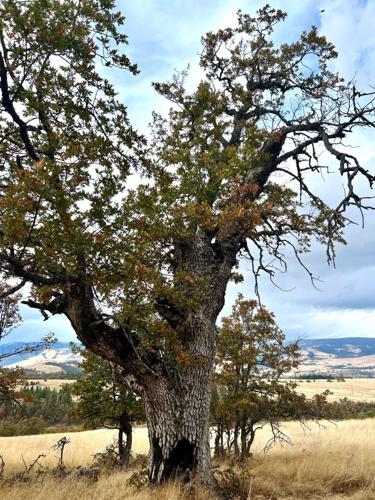
A white oak "living snag."
Contributed photo
Members, who don’t have to sign the declaration, can come to meetings and learn, use the monitoring outcomes on their own property, and access the technical tools ECOP is developing for oak conservation and management, according to Cornelius.
ECOP also channels grant money to oak restoration. “We’re bringing, I’d say, up to around $2 million of restoration funding to a part of the landscape that the Forest Service and NRCS and partners are also making a huge investment in,” Cornelius said. ECOP received a roughly $7 million grant implemented from 2022 to 2027. “It’s almost like an allocation of funding to the partnership,” Cornelius said. “And then we have to bring projects through a review process ... to actually have access to the funding. So it’s almost like you’re applying for grants.” About eight applications have been processed so far, including restoration projects, technical assistance, and a stakeholder engagement grant.
Educating the public about oak is another function of ECOP. “There was just a lot of excitement around learning about oak,” Cornelius noted. So, in a series of meetings, they undertook to “build a base of knowledge” around oaks. Cornelius estimates around 60 panel presenters have talked about everything from oak biology to grazing practices, migratory birds, range land, health, forestry, indigenous first foods and tribal values, and of course, climate change. The partnership focuses on a culture of learning, Cornelius said: “We just acknowledge that science doesn’t have all the answers.” Traditional ecological knowledge, and observational knowledge from the people who live and work with oak, are also important, she said.
“Oak has been a really important part of the human experience in this landscape since time immemorial, and indigenous people were utilizing them for lots of different reasons,” said Cornelius. “All the associated understory flowering plants, a lot of them are important foods and medicines for indigenous people. “This resource that’s been in partnership with people for a long, long time.”
The unique geology of the Gorge is the only thing allowing oak to grow here, Cornelius noted, and is what created this rich plant resource. Wet, warm air flowing from the coast flows through the gorge and creates a plume of wetter, warmer weather that moderates the temperature and dryness of the Columbia plateau. That allows white oak to establish.
Oak also has what Cornelius calls a unique ability to grow in different habitats, soil types, elevations and moisture levels. In the Gorge, elevation gradients fall from 12,000 feet on the Cascade Crest to just 130 feet on the river, and rainfall drops from 100 inches to 10 inches on the Columbia plateau. “If you look at maps of the globe, there are maybe no places where the gradients are that steep in combination,” said Cornelius. “And then you throw in the complexity of that plume of air that’s being blown over the Columbia River Gorge, the only place in the Cascade Range where that’s happening.”
A whole suite of endemic understory plants have co-adapted to this odd climate along with oak, the keystone species holding it all together. But most intact oak forests are degraded. “We haven’t successfully characterized the percentage of habitat we think might still be intact,” said Cornelius. Perhaps 10% of oak forest retains a pristine native plant community, she estimates. Grazing practices and fire suppression are the main culprits.
The fire issue is complicated. Oak’s thick bark, waxy leaves and insulated buds protect it from fire; even if the crown dies, multiple trunks can regrow from the roots. Fire suppression changes what grows where and how aggressively it grows, Cornelius said, allowing the more fire-sensitive Douglas fir to shade out white oak in moister areas. About 60% of East Cascades white oak is at risk for conifer encroachment, according to information from Columbia Land Trust.
For example, driving I-84 between Hood River and The Dalles, the fir-oak transition appears obvious as dark conifers replace broadleaved oaks. “That transition point has kind of ebbed and flowed over time, depending on fire behavior and climate,” Cornelius said. ECOP’s challenge is to find out what strategy best protects the fire- and climate-change-resistant oak forest. Sometimes that’s cutting down the invading firs, or controlled burning. In some groves, thinning is needed; in others, oaks huddle together to withstand the desiccating wind.
“Insects, pollinators ... migratory songbirds and reptiles and amphibians and snakes ... diversity in these systems is just phenomenal,” Cornelius added. Oak is a keystone species holding it all together.
To help restore and conserve this diversity, ECOP provides partners with tools to monitor oak and grants to help partners implement their conservation goals.
A lot of the Columbia Gorge National Scenic area staff are partners, Cornelius said. “The Scenic Area is one of those interesting places where there’s a lot of people who care about it. And so that might be an area where we spend a little bit more time with stakeholder engagement, and community discussions,” Cornelius said.



Commented