
Though the Hood River-White Salmon Interstate Bridge Replacement Project is far from completion, the project team has put together some conceptual images of what the new bridge could look like.
These conceptual images will be forwarded to Oregon Department of Transportation (ODOT) and the Federal Highway Administration for review, and don’t reflect the bridge’s final form.
“We’re presenting this for reaction,” said Anne Pressentin, one of the project leaders with WSP USA, Inc., the engineering group contracted to help finish all of the National Environmental Policy Act (NEPA) requirements for the project. WSP presented the images during an Environmental Impact Study (EIS) Working Group meeting held in the White Salmon Fire Department on Sept. 12. The group’s primary focus is to advise the project team on the EIS — a NEPA-required document that identifies all agencies involved in the project and how they will coordinate with each other, evaluates the impacts and benefits of the project and explores alternatives. A draft EIS was developed back in 2003, so the project team just has to bring that document up to date through what’s called a supplemental draft EIS. While the visual designs of the bridge aren’t required for the supplemental draft EIS and are far from complete, the EIS Working Group spent a sizable portion of their Sept. 12 meeting discussing WSP’s proposed designs.
While the current bridge is flat all the way across the river with a lift span in the middle, all designs for the replacement bridge show it arcing across the river to create the necessary clearance for the navigation channel, negating the need for a lift span. The designs also include adding a bike/pedestrian pathway on the west side of the bridge, to connect to ODOT’s existing pedestrian system on the Oregon side and, potentially, to a new two-lane roundabout with marked crosswalks at the SR-14 intersection on the Washington side.
Aesthetically, three different architectural concepts for details on the bridge deck, such as railings and lighting structures, are under consideration: The Historic concept, which reflects the historic elements of the existing bridge; the I-84 concept, which involves designing elements to look similar to other bridges and roadways along I-84; and the Contemporary concept, which features modern, unique design elements intended to fit in with the landscape and surrounding communities.
“I think there are positive things about each of these designs that make a lot of sense,” said Hood River County Commissioner Rich McBride, and most of the group members advocated for a design that blended pieces of all three concepts.
“At some point, you have to make a decision, and there will always be some people who won’t be happy about it,” said Jan Brending, attending the meeting on behalf of White Salmon Mayor David Poucher. “They (the public) may disagree with each concept … but it gives that visualization of what it could look like.”
Ultimately, the group decided that it was too early to make any concrete design decisions.
There is no timeline for deciding on a bridge design, Pressentin said, because the bridge deck designs aren’t included in the EIS.
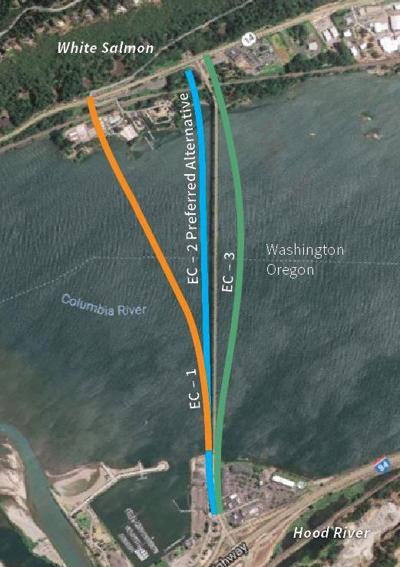
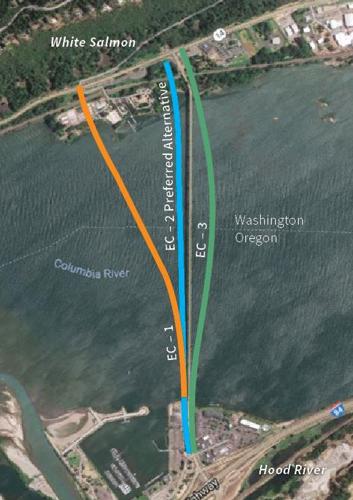
However, the EIS will contain two alternatives for bridge placement: EC-2, which most closely follows the placement of the current bridge, and EC-3, which curves slightly east of the current bridge (see graphic, A5). Both connect to Button Bridge Road on the Oregon side and SR-14 on the Washington side. A third alternative — EC-1, which veers significantly west of the current bridge placement — was included in the original 2003 draft EIS, but that option will be removed from the new document due to concerns about the constructability of the design.
The supplemental draft EIS is expected to be finished and released for public review in early 2020. After the supplemental draft EIS is finished, it’ll be combined with the 2003 draft EIS and drafted into a Final EIS (FEIS), which will then be used to obtain an official Record of Decision — allowing the project team to start applying for permits and look for additional funding.
There will potentially be another community meeting scheduled for later this fall or early 2020, prior to the release of the supplemental draft EIS, but a date and time have yet to be determined.
The 2003 draft EIS is currently available on the Port of Hood River’s website, portofhoodriver.com/bridge/bridge-replacement-project.


Commented