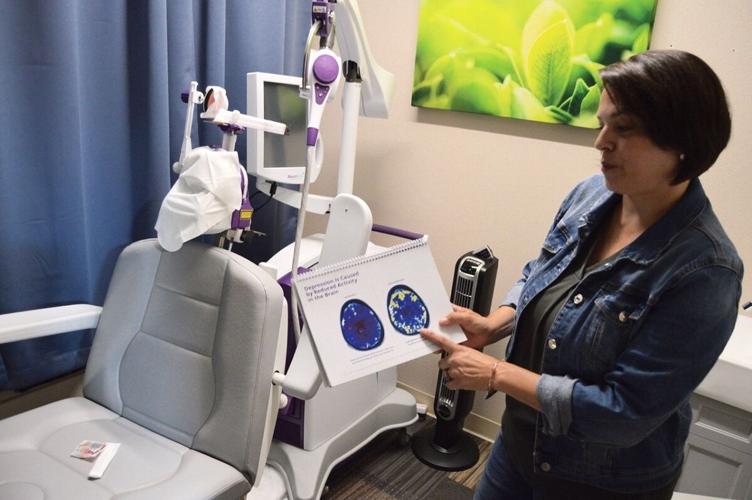
Compass Family Medicine owner and practice manager Stephanie Pate explains the differences between a depressed and non-depressed brain; the non-depressed brain is noticeably lit up with activity. The clinic has an NeuroStar Advanced Therapy transcranial magnetic stimulation treatment for major depressive disorder, the first in the Gorge. “Now we’re just trying to get the word out,” Pate said.
Compass Family Medicine owner and practice manager Stephanie Pate explains the differences between a depressed and non-depressed brain; the non-depressed brain is noticeably lit up with activity. The clinic has an NeuroStar Advanced Therapy transcranial magnetic stimulation treatment for major depressive disorder, the first in the Gorge. “Now we’re just trying to get the word out,” Pate said.
Trisha Walker photo
HOOD RIVER — Compass Family Medicine has a new tool to fight major depressive disorder.
The clinic, located at 1784 May St. Suite B (adjacent to the Hood River Aquatic Center), has recently added NeuroStar Advanced Therapy transcranial magnetic stimulation (TMS) to its list of services.
“We’re really excited about bringing it to the Gorge because our closest place to go (for TMS) is either Vancouver, or on the other side of Portland,” said Stephanie Pate, owner and practice manager.
Here’s how it works: As the patient reclines in the treatment chair, a cushioned coil is placed against the head while magnetic pulses deliver the therapy to the location that regulates mood in the brain. Patients are awake and alert during treatments — it’s noninvasive and requires no anesthesia — and able to resume regular activities immediately following. The treatment has been FDA-cleared since 2008 for those 18 and older.
TMS is for patients with major depressive disorder who have not seen relief with medication. An initial intake form must be filled out prior to starting treatment and is updated each week to monitor progress.
“The first week, it does take a little getting used to, so you might feel some sensitivity on your scalp — we say the first five days because it’s like a pulse in the same spot, over and over,” Pate said. “It’s not painful, it’s just more irritating than anything.”
The 36 treatments range from three to 19 minutes, depending on what protocol the patient decides to use. “The three-minute protocol is maybe a little bit more intense, but you’re in and out,” she said. The longer protocol includes more breaks between pulses.
“I think one of the biggest questions people ask is, ‘Is it shock therapy?’ And it is not shock therapy,” she said. “There’s no radiation, it’s all very safe. Only about 5% of patients even have any complaints as far as maybe a mild headache or scalp sensitivity the first time or two, and then within a week, even that goes away.”
Compass Family Medicine has already had patients complete treatment. “It’s exciting stuff, what they are self-reporting, what their symptoms were and the improvements,” Pate said. She’s seen patients, who were so depressed they had stopped all activities, pick them up again by the end of treatment.
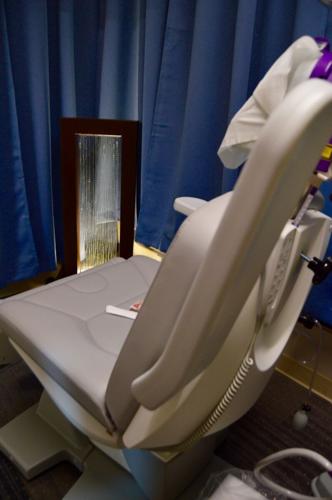
The TMS room has a television and water fountain to help patients relax during treatments.
Trisha Walker photo
Pate stresses that, while you do not need a doctor or therapist referral, TMS is not a standalone treatment and patients should continue working with their care providers. Compass Family Medicine works closely with local mental health providers in an effort to get patients the care they need.
“We view mental health as a joint effort between all the different providers — primary care providers and psychologists and counselors,” she said. “This is one more tool in the toolbox, which we love.
“Eighty-three percent of TMS patients see improvement in their depression symptoms and 62% go into remission, which is huge. You don’t see that with just medication,” she said.
The clinic is self-pay, meaning it doesn’t bill insurance. However, because TMS therapy is widely covered by insurance, they’ve partnered with Northstar Psychiatry in Portland to provide that billing option.
“Their psychiatrist comes out and he will do the initial review,” Pate explained. “The first session is taking what we call motor threshold measurements to see what your prescription is. After that, we do all of the treatments here.
“We do have a considerable discount for people paying out of pocket because we know a lot of people don’t have good health insurance coverage, or coverage at all,” she added.
“We’re just super excited about it,” she said. “You know, we’ve seen so much depression — we had a lot of patients with depression prior to COVID, and then COVID hit and it just skyrocketed.”



Commented
Sorry, there are no recent results for popular commented articles.