
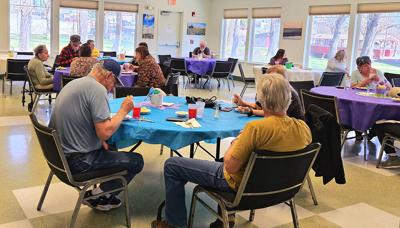
MORO — Like other senior meal programs receiving federal funding, the Sherman County Senior and Community Center in Moro was unexpectedly deprived of contracted federal funds earlier this spring.
But the community has rallied to narrow the new budget gap. “We do have a very generous community that helps us out,” said Kari Silcox, who works halftime managing the senior center.
So far, through bake sales and meal sponsorships, the meal site has raised $3,956, Silcox said.
In March, the Community Action Program of East Central Oregon (CAPECO) informed the Moro meal site that it would lose $1,304 for the remainder of the fiscal year, which lasted until June 30. The lost funding, withheld even though the meal site had a signed contract to receive it, was through the federal Nutrition Services Incentive Program (NSIP). The meal site typically gets $5,218 annually through NSIP, and $30,680 altogether through CAPECO, a regional nonprofit organization.
“The weird part was there was a signed contract through the year,” Silcox said. “You really don’t expect to lose funding on that, so that was alarming.”
She said it was strange that officials did not want “to explain why” the funding was cut.
“I’m grateful it wasn’t more. We still have most of our funding. We’ll see what next year brings,” she said in April of the coming fiscal year, which started July 1.
Under the agreement beginning this month, CAPECO now provides funding on a quarterly basis instead of an annual basis. For the first quarter, the Moro meal site is receiving $4,806 through CAPECO, a 37% decrease from the $7,700 it received for the same period last year, Silcox said.
Even so, she’s pleasantly surprised because she feared there would be no funding at all.
If this funding holds the same for all four quarters of the fiscal year, the amount will be $19,224, which is only $6,238 less than the previous fiscal year, she said.
“I was preparing to be down more than $30,000, so this is better news than expected.”
A big part of the gap funding that the meal site has raised since spring came from the Sherman County Prevention Department, which was able to provide $1,302 to cover losses.
The meal sponsorship program also allows community members to sponsor a single meal, a week’s worth, or a month’s worth. “We’ve had several community members contribute so far, as well as a few local businesses,” she said.
“This is an important thing to have here and keep open,” Silcox said in April. “Our community is amazing. We have a lot of people donate to the Meals on Wheels regularly, so I think we’ll have lots of people donate.
“There’s been so many community milestones here,” Silcox continued. “Every one of my son’s birthday parties has been here. So many birthday parties, so many baby showers, so many funerals. There’s a lot of emotion attached.”
In the last fiscal year, the senior center, which was built in 2002, needed a new refrigerator, freezer and HVAC system, straining its already-tight budget.
“We’re not in the business of charging a lot, but we can’t operate too much in the red here,” Silcox said.
The 25% cut to the just-concluded fiscal year was implemented region-wide. “And in a bigger community it’s easier to be anonymous and look the other way when people are asking for money. And we have really generous people here. We always come together and help for things like this,” Silcox said.
That federal funding stream represents just a portion of the meal site’s annual food budget of $26,000. Sherman County itself is also a co-equal funding source.
The meal site serves lunch to 10-35 people each weekday, averaging 15-20 each day, Silcox said. It asks for a suggested donation of $5 for those over 60, and a suggested donation of $8 for those under 60. People of any age are welcome to come for lunch, and the site also provides to-go lunches.
“We never know how many to cook for so we just cook for an army each day,” she said. The meals are prepared from scratch by a kitchen manager who works 30 hours a week. There is also a kitchen assistant who works 15 hours a week. “We find cooking from scratch saves money, and we’re on a tight budget here,” Silcox said.
Any leftovers are frozen and then taken to seniors through the free, volunteer-run Meals on Wheels program. Each senior gets seven meals delivered to them on Monday mornings, and there is an average of 12 seniors receiving the meals each week.
“They just have to have a freezer to store them in and a microwave to heat them in,” she said.
CAPECO, the regional entity, reimburses the meal site for every meal it serves to regular customers.
“We’re lucky to be open five days a week — that’s pretty rare for a small meal site. So that’s something that everybody praises us on, for being open five days a week,” she said.


Commented