Leif Fox of Washington Fish and Wildlife runs The Dalles Boat Basin check station for northern pikeminnow on Aug. 26, 2022. After the construction of dams, the native pikeminnow proliferated in the Columbia and Snake rivers. When they were found to eat a whopping 74% salmon smolt, a sport-reward program was established and has reduced predation by 40%.
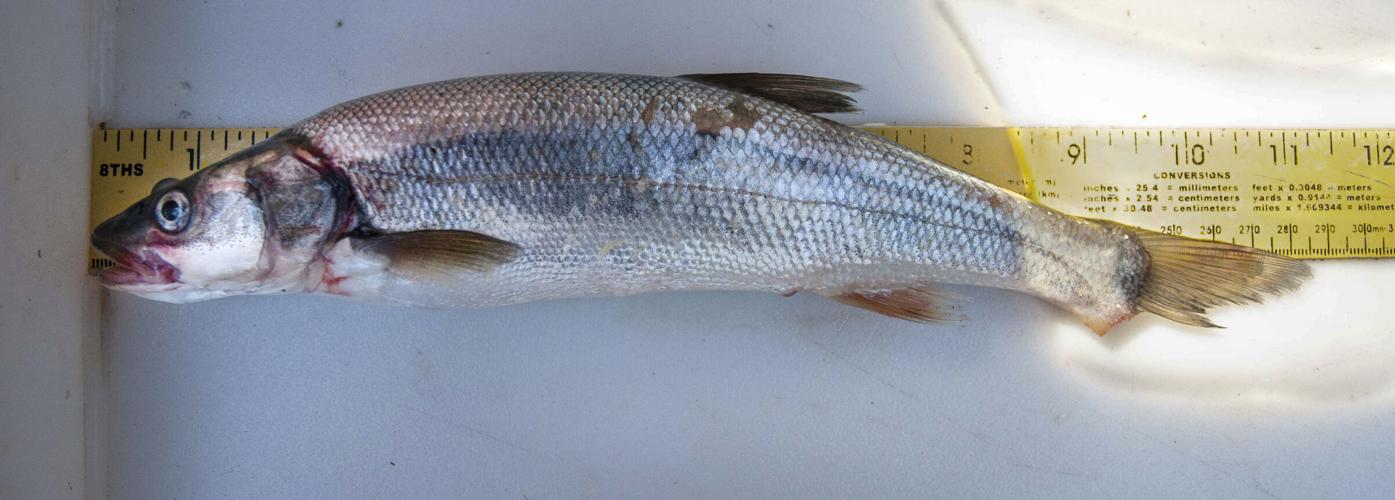
A ten-inch northern pikeminnow awaits processing at The Dalles Boat Basin on Aug. 26, 2022. The Northern PIkeminnow Sport-Reward Program continues through Sept. 30, although participation and catch numbers are dropping.
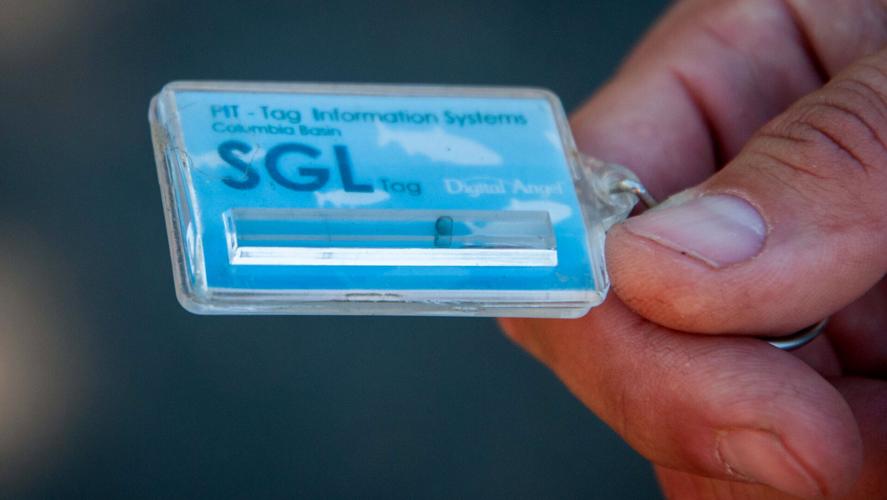
Leif Fox of Washington Fish and Wildlife displays a PIT tag for northern pikeminnow on Aug. 26, 2022. From the tagging program, biologists learned that northern pikeminnow don't usually travel far from their area of birth.
Leif Fox of Washington Fish and Wildlife runs The Dalles Boat Basin check station for northern pikeminnow on Aug. 26, 2022. After the construction of dams, the native pikeminnow proliferated in the Columbia and Snake rivers. When they were found to eat a whopping 74% salmon smolt, a sport-reward program was established and has reduced predation by 40%.
Flora Gibson photo
A ten-inch northern pikeminnow awaits processing at The Dalles Boat Basin on Aug. 26, 2022. The Northern PIkeminnow Sport-Reward Program continues through Sept. 30, although participation and catch numbers are dropping.
Flora Gibson photo
Leif Fox of Washington Fish and Wildlife displays a PIT tag for northern pikeminnow on Aug. 26, 2022. From the tagging program, biologists learned that northern pikeminnow don't usually travel far from their area of birth.
While human anglers toiled through 90 degree temperatures this summer, northern pikeminnow, a native salmon predator with a bounty on its head, lived apparently unaffected by the heat.
This year’s catch is typical, according to Leif Fox of Washington Department of Fish and Wildlife. A grand total of 108,047 fish were turned in to the Northern Pikeminnow Sport-Reward Program as of Aug. 28, with more than 19,000 of those from the region between The Dalles Dam and Rowena, according to the project’s website, pikeminnow.org.
Unlike salmon and sturgeon (and humans), pikeminnows seem to be less impacted by summer temperatures. “If they have an upper limit we haven’t found it yet,” Fox said. Most anglers operate at night, he noted.
Fox was staffing a pikeminnow check station at The Dalles Boat Basin on a 90-degree day. Only one angler had checked in. Earlier in the season, it was 20-25 people a day, he said.
“It’s a grind; people have been doing this five months,” said Fox. When the season winds down here, they must travel west to keep catching fish.
The Boat Basin station, covering an area from The Dalles Dam to Rowena, typically sees a decline in catch after the peak fishing period in May and June. At this time western stations, including Cascade Locks and Bonneville, see an increase in catch through end of the season in September. Why pikeminnow activity fluctuates in this way is unknown, Leif said.
Why the bounty? About 74% of the northern pikeminnow diet is salmon smolt.
A native of the region, northern pikeminnow only threatened salmon after the advent of dams on the Columbia and Snake rivers. When the parts of these rivers’ main channels became chains of lakes, northern pikeminnow proliferated in the warmed, slower-flowing waters, feeding on smolt and lamprey, another species of conservation interest.
“They’re really the perfect invasive species, except they’re not,” Fox noted. “They’re just out of balance.” One female Northern Pikeminnow can live for 20 years and lay 83,000 eggs. Her spawn can grow an inch a year, and will not travel far from the channels were they hatched. “I feel really bad for whoever counted those eggs,” Fox remarked.
Bass and other nonnative sport fish also inhabit the warmed waters behind the dams, but they do not target salmon smolt with the same voracious focus, although they will eat them opportunistically. Plus, anglers need little incentive to pursue sport fish.
The caught pikeminnow are measured, then sent to a facility and turned into fertilizer, or whatever else the plant happens to be making that day.
“We’ve got a couple of pikeminnow guys that catch a fish every time they put a pole in the water,” Fox noted. Other anglers sometimes come in empty-handed, even when they use the same bait and equipment in the same waters.
Pikeminnow of nine inches or more earn vouchers for monetary rewards starting at $6; fish with special tags are worth $200-$500. Pikeminnow that carry the tags of swallowed smolt do not count.
“It’s a learning curve,” Fox said. It takes a couple years to get good at pikeminnow fishing. When lucky experts can earn a cool $60,000, and beginners sometimes return from their first trip with one or two fish, it can be discouraging, Fox commented.
Finding locations were pikeminnow can be caught is important, he says, as is figuring out what bait to use and how. Fresh salmon eggs are popular, as are Mormon crickets, an invasive insect that can be collected in the region — thus using one out-of-control species to catch another.
The goal of the Sport-Reward program is not to eliminate the northern pikeminnow, but to reduce its numbers by 10%-20% each year, reducing predation of salmon.
There are many programs striving to improve salmon runs, and it’s hard to know exactly which one is taking effect, Fox noted. Since the program started in 1991, more than 5.3 million pikeminnows have been caught and predation on salmon reduced by up to 40%, according to pikeminnow.org.
The program has also seen a reduction in body size and numbers of pikeminnows, Fox added. When that happens, they raise the bounties to keep anglers interested.
The program is funded by Bonneville Power and administered by Pacific States Fisheries Commission, in collaboration with Northwest fish management agencies and tribes. The check stations are run by Washington Department of Fish and Wildlife, while the Oregon Department of Fish and Wildlife tags pikeminnow for population monitoring just before the season opens in early to mid April.
The tagging project, which involves electrocuting the water, then netting stunned pikeminnows and injecting a PIT tag, began operations in 2006. Pikeminnows tagged in that year may still be living, says Fox, feasting on salmon smolt and lamprey in the tepid depths of the Snake and Columbia: A prize for researchers, as well as fisherman, when they are fetched in.




Commented
Sorry, there are no recent results for popular commented articles.