HOOD RIVER — We’ve all heard or seen the name Gifford Pinchot, either zooming by a highway sign, perusing a local map or dusting off a Pacific Northwest history book. But beyond this unique moniker, which labels a 1.3 million-acre forest expanse in Southwest Washington, lies a deep, complex history of stewardship, mismanagement and revitalization.
Author and old-growth enthusiast Rand Schenck brought Pinchot’s legacy to light at the Columbia Center for the Arts on Dec. 10, guiding audience members through decades of the United States Forest Service’s (USFS) polarizing history within and beyond the Gifford Pinchot National Forest (GPNF).
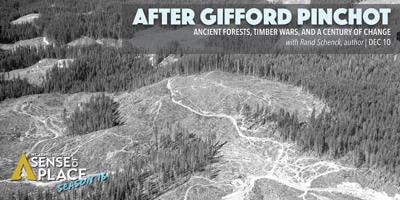
Schenck’s lecture, contributing research conducted for his novel, “Forest Under Siege: The Story of Old Growth After Gifford Pinchot,” was the third presentation in Mt. Adam’s Institute’s “Sense of Place” season 16, hosted and curated by Sarah Fox.
During his youth, Schenck hiked and backpacked in the same old-growth woods where Pinchot first worked as a forester and fell in love with the Pacific Northwest’s immense beauty. For the last 25 years, he has owned a small 1920s cabin tucked into an old-growth grove within the GPNF — an astonishingly rare prospect considering only 5 percent of these ancient ecosystems remain today.
Curious, Schenck began writing his novel with two distinct aims. One, to figure out why most old-growth forests no longer exist today, and two, to delve into Pinchot’s principles as the chief and co-founder of the USFS. “If he were alive today, how would he have felt about what happened to his namesake forest?” Schenck said.
Schenck spoke with several prominent figures during his research process, including renowned forest ecologist Jerry Franklin and the grandson of Pinchot, Gifford Pinchot III, who resides in Hood River.
Before launching into his research, he framed his lecture into three distinct phases of forest management: stewardship, high production and ecological management.
The stewardship phase lasted around 40 years, beginning when Pinchot initially set foot in the Cascade Range in the 1890s. During this period, relatively few trees were felled. Working alongside Theodore Roosevelt, Pinchot founded the USFS, viewing government control as the most effective means to counter the monopoly over natural resources.
Pinchot believed conservation was “the foresighted utilization, preservation and/or renewal of forests, lands and minerals, for the greatest good, for the greatest number and for the longest time,” Schenck said.
Unfortunately, this mindset was not a popular one. In the 1940s, the USFS shifted much of its attention to economics over ecology. Pinchot passed away in 1946, and the high production phase began.
In the 1950s and 60s, natural forests were transformed into timber plantations, leaving vast clearcuts across sweeping landscapes. In 1965, the USFS chief stated, “When we harvest over-mature, defective timber that would otherwise be wasted, there is bound to be a temporary loss of natural beauty,” Schenck said. “But there is a promise to come: a thrifty new forest replacing the old…the point is there often must be a drastic, even violent upheaval to create a new forest.”
At the time, the dominant mindset was to liquidate old-growth forests to allow vigorous, fast and well-regulated forests to take their place.
Various policies planted the seeds for change in the 1970s, including the National Environmental Policy Act, the Endangered Species Act and the National Forest Management Act. Each National Forest had to develop a plan for their future, and for the first time, the public had a seat at the table. The USFS hired “ologists,” namely ecologists, biologists and hydrologists, to develop such plans, additionally considering increased gender and racial diversity in the process.
After Mt. St. Helens erupted in 1980, leaving thousands of acres of logs flattened on the landscape, the USFS wanted to engage in the largest salvage operation ever contemplated. Scientists disagreed, recognizing an incredible research opportunity to let the area restore itself over time.
Undisturbed areas recovered the quickest, prompting an ecological epiphany that would shift culture and shape the next few decades of forest management.
In the 1990s, at the direction of President Clinton, Jerry Franklin and a team of ecologists developed the Northwest Forest Plan, resulting in a 75% decrease in logging within National Forests. The plan was designed to protect vulnerable habitats and the endangered species that call them home.
In the end, the GPNF’s story circles back to Pinchot himself, whose resurrected vision lives on in individuals like Schenck, stewarding the land that bears his name.
“These natural forests are messy, complex and can’t be well-regulated,” Schenck said. “My hope for the future, thinking about my great-grandchildren, is that they will begin to experience the kinds of forests my grandfather would have seen walking through the Cascades in the early 1900s.”



Commented