
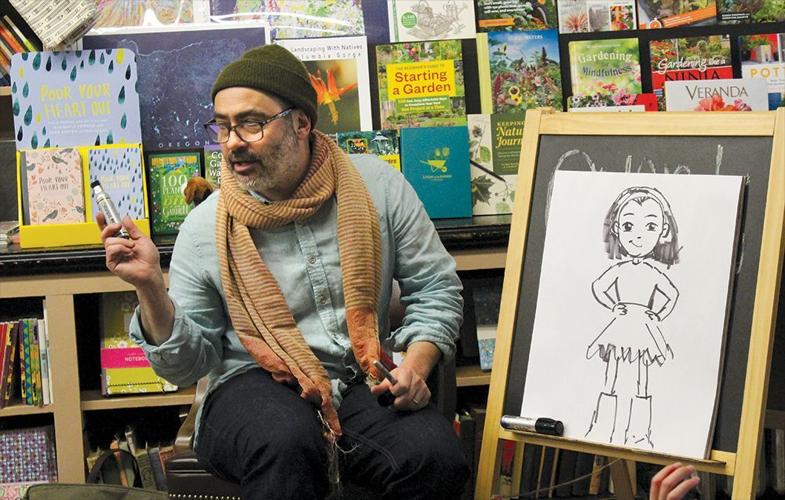
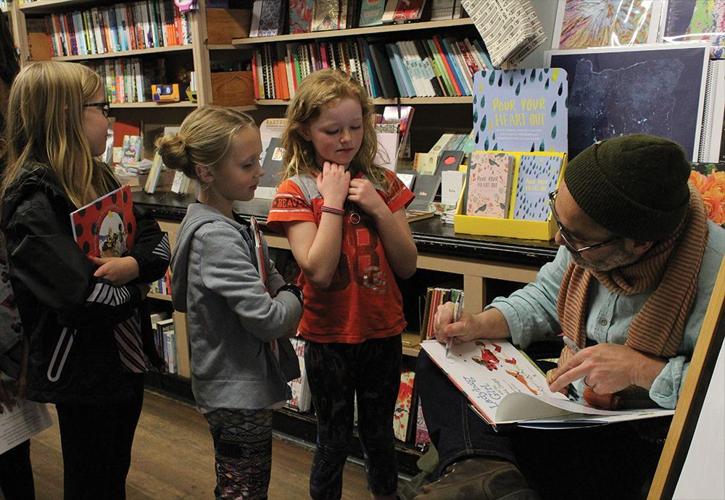
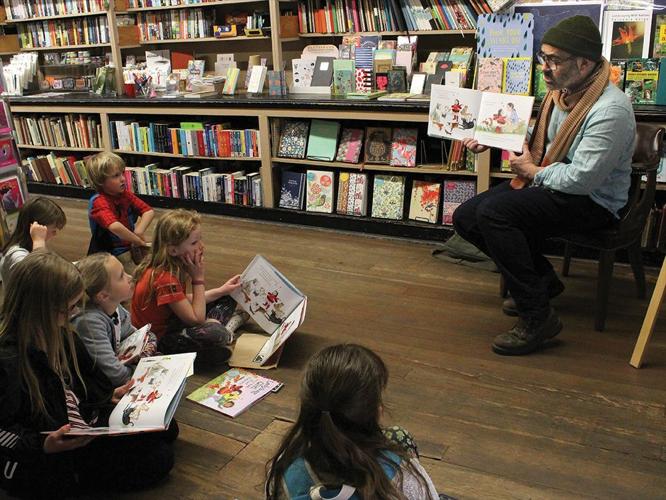
A chalkboard served as an easel in the corner of Klindt's Booksellers & Stationers Thursday evening as David Soman asked the kids sitting around him how to draw his character, “Ladybug Girl.” He told them he needed crazy music to get in the drawing mood.
Not just any crazy music: Crazy superhero music. He asks the kids to sing him some.
“Make sure that you all know different songs, because that sounds really good,” he said.
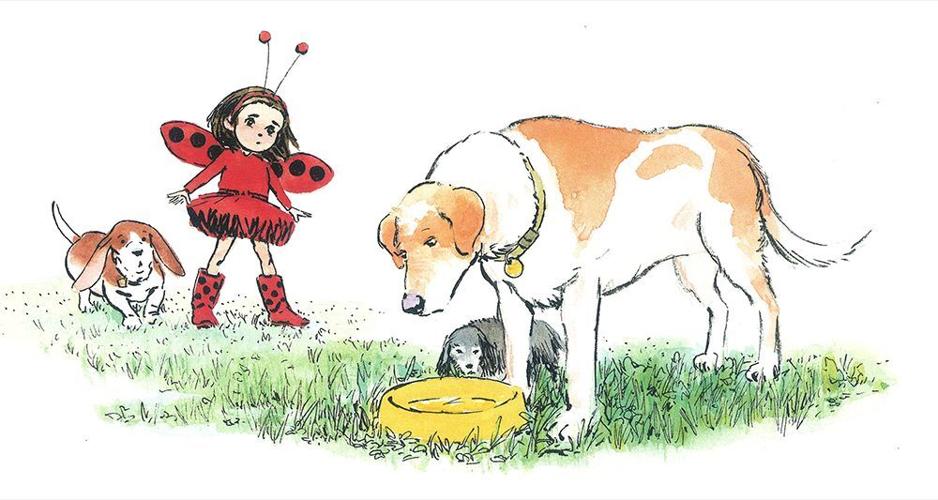
Soman and his wife, Jacky Davis, are the husband and wife creative team behind the popular “Ladybug Girl” picture books, which feature the imaginative Lulu taking on a superhero persona to make her own fun playing with her dog and having adventures in her own backyard — sometimes joined by friends, the Bug Squad.
Soman traveled to Portland from his home in Rochester, N.Y., as part of the couple’s book tour to promote the latest “Ladybug Girl” book: Ladybug Girl and the Rescue Dogs.
He took a day to tour The Dalles and visit Dry Hollow and Chenowith elementary schools before doing the reading at Klindt’s.
Soman sat down with a reporter during his visit to chat about “Ladybug Girl” and how she came to be.
Q: What brings you to Oregon?
A: A bus. No, a plane — Alaska Airlines. No, a book tour, I came here to visit bookstores and schools. My wife was here a year ago for some event at Powell’s and she loved Portland, she said we should do this thing together, next time we do a book tour, let’s go to Portland; and I said fine, that sounds great. And, unfortunately, our childcare fell through and so she had to stay behind. We debated just leaving the kids, they’re 16 and 14, and I was like ‘yeah, so we could — y’know we could have fun” but she’s better than me and she was right because yesterday — first my daughter texted me and said that her car won’t start and then like five minutes later my wife texts me, ‘we have a blackout,’ because there had been a really bad wind. So, if Jacky had actually been here she might have just died. First, she would have killed me, then she would have died, so it was very, very good that she stayed home.
Q: How did you and your wife get started in children’s books?
A: Well, before I met her, I was a children’s book illustrator — I hadn’t written anything, but I’d illustrated a number of books; and she had also worked in various media, she had done graphic design for book companies and she had done
production for television graphic companies and she had even worked for The Muppets Meeting Dr. Seuss TV show that existed for a little while…so she was into books, and I was; so when we finally left New York, we talked a little bit about ‘y’know hey, should we try to work together sometime?’ and I used to do cartoons of my daughter and was thinking it’d be fun to do this kind of fun style and then one day, while we were just sitting in the living room, my daughter came down the steps from her bedroom dressed in little red rainboots, a tutu, and ladybug wings, and my wife looked at her and was like, ‘oh hi, Ladybug Girl, how are you doing?’ and something about that name, we’re just like ‘Oh my God, that’s such a cute name’ and then we started thinking like ‘maybe that’s what we’re going to do. We’re going to do this.’
Q: Can you tell me what it’s like collaborating with your wife on these books? What’s your process?
A: The shorthand version, it’s a lot like marriage…we had to learn how to work together, that was a big part. I mean, we were excited about the project right away, but then just trying to figure it out — I am very much used to working alone and she is very much used to being a collaborator because most of her jobs were collaborative, when she was producing, like she did the X-Games — the first X-Games — their graphic design, she was part of the company that did that, and that’s a total team effort: There’s guys in charge and she’s one of them and there’s these other people; and so for her, butting in and being part of everything is natural. I’ve spent my entire creative life alone in a room. And so, someone coming in and saying to me ‘I think you should do that’ I’m like Step. Back… so there was trying to figure out where we had space from each other and then also learning to say ‘wow, that piece of writing you just did sucks…’ and knowing how to talk to each other about what to change, to keep stuff, and mostly about how to let go of everything. Truth is, by the time we’re done writing, I don’t remember who wrote what, and I don’t think she does, either…sometimes I’ll write something and Jacky will change a word and make the sentence better. So, we’ve gotten comfortable with it. It took a few books to get to where it’s not that stressful anymore when we write together. I mean, once that part’s done, I did stay pretty proprietary about the artwork where I do it, but we get to a certain stage in the art, it’s called a dummy, where you have a pencil layout of the whole book, that’s when she’ll get a real chance to look at it again because you can really see that it’s a book at that point. And she can see what we’ve written and what the picture is and if she likes it — and that’s usually what we give our editor and art director, and that’s where we get all these chances to make changes.
Q: What’s your process for getting an image from the written book?
A: One of the things that’s important as an illustrator is, even if it’s your writing, you have to recognize that you’re working with the writer — you’re working with the words. And so, you have to come from being a bit of a collaborator in terms of thinking ‘what can I do to make these words better?’ Like, ‘what needs to go there to make it stronger or what shouldn’t I do,’ and so you’re playing with that. And when you’re also the writer, you get to also change the writing, too, if it works. And so, you’re starting by thinking ‘so, what is this scene about?’ So, for me, the very first step of making a book is to take just the written manuscript and start circling and using parentheses and writing what’s going on what page by doing a scene breakdown of where these things go, what are the important moments. And I’m used to it enough now that I’ll know, oh, this’ll be a good double page, these are vignettes — and once I’ve done that, then I can just get into the finer points of how can I get this point across better visually and what does the book need, does it need a sense of place at this point, or some humor or some white space…and you’re thinking of it like a movie, or, y’know, a longer piece of music where you have to think where does it get big, where does it get small, where does it rest; so you’re just sort of trying to organize it that way. And once you’ve sort of thought about those things, then it’s just, you’re solving drawing problems. I do hundreds of sketches, if not more, for any book.
Q: What’s one thing that you and your wife want readers to take away from these books?
A: When we started doing the very first book, what we were thinking about is we wanted a book that our daughter would like, obviously. And what we decided is we wanted the book to be about her but about kids and about what life is like for them. And you forget — we forgot — I forgot until I had them again, how things we take for granted are so big, you know? So, in watching them…you just really see how every little thing is a big deal. And so, life is tough when you’re learning everything. You’re learning how to play, you’re learning how to be alone, you’re learning how to be brave, you’re learning how to do something new or have a difficulty with a friend, and so there’s all this stuff and we take it for granted. I mean that’s just a day at the office, that’s just a day at work, but for them it’s new and it’s huge. And so, we thought we wanted them to recognize that they’re sort of superheroes.


Commented